In a generative adversarial network, what is the primary job of the generator network?
Select an answer to reveal the explanation.
Short Explanation and Infographic
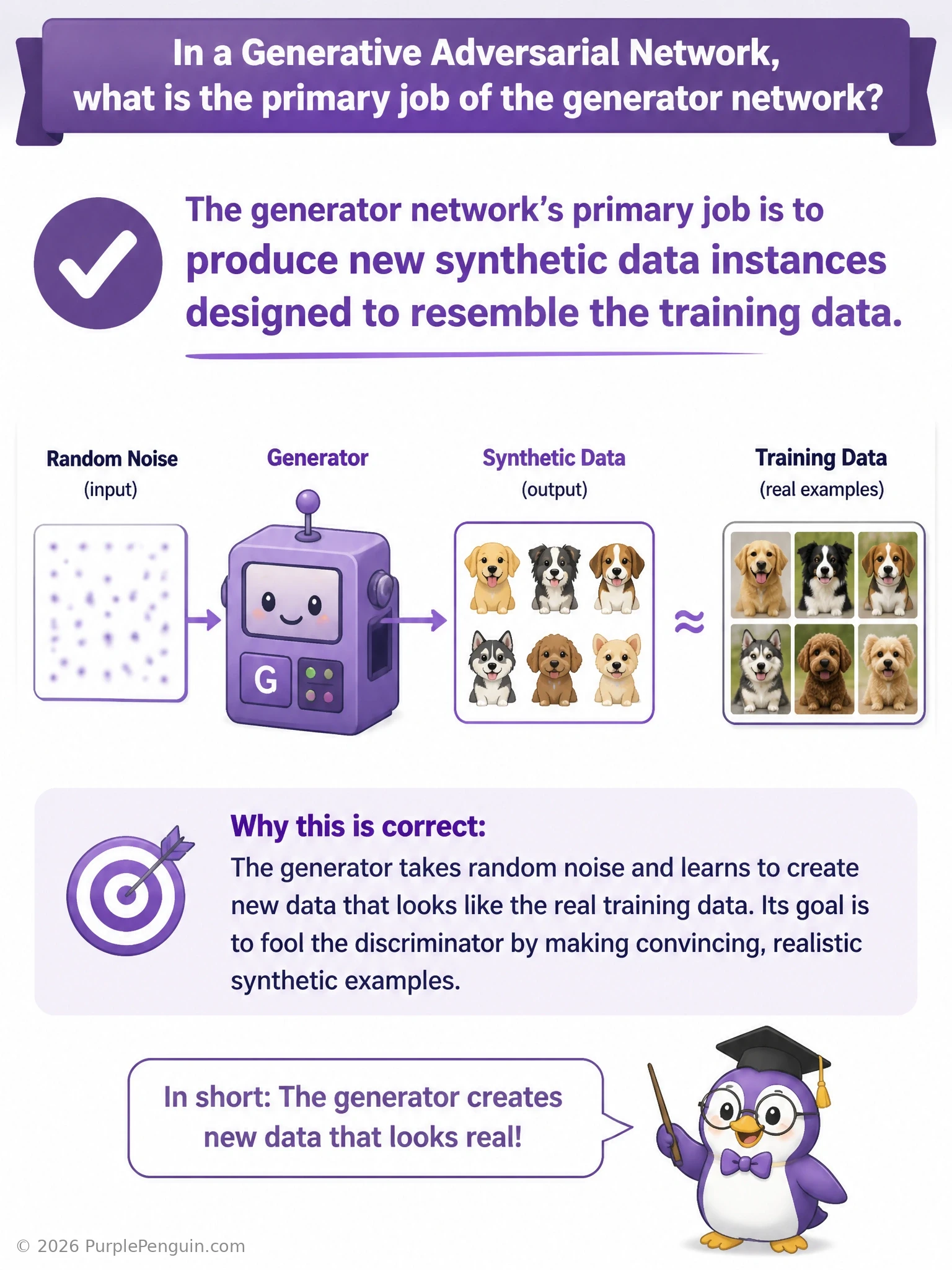
Here's the deal with GANs: you've got two networks locked in a little rivalry. The generator's whole job is to manufacture fake data — images, audio, whatever — that looks so convincing the discriminator can't tell it apart from the real training set. That's option B, and it's the heart of the architecture. It's not a classifier itself (that's the discriminator's gig), it doesn't grade the discriminator's performance, and compressing input into a latent code is more of an autoencoder move. The generator starts from random noise and learns, through the adversarial feedback loop, to turn that noise into something that fools its opponent. Once it's good enough, you can use it to generate brand-new, realistic samples on demand.
Full explanation below image
Full Explanation
The generator in a generative adversarial network (GAN) is trained to synthesize new data samples that are statistically similar to a real training dataset. It typically starts from a random noise vector sampled from a latent space and maps that noise through a series of learned transformations (often transposed convolutions in image-based GANs) into a full data sample, such as an image. The generator never sees real training examples directly during its forward pass; instead, it receives feedback indirectly through the discriminator, which judges whether a given sample is real or generated. Over many training iterations, the generator adjusts its parameters to produce increasingly convincing fakes, effectively learning the underlying distribution of the training data. Option A is incorrect because classifying an image's category is a supervised discriminative task, not the generator's function — that kind of labeling belongs to a standard classifier network, not the generative half of a GAN. Option C is incorrect because scoring the discriminator's performance is not a role either network plays explicitly; instead, the two networks are trained jointly through a minimax game where each one's loss depends on the other's output, but neither one "scores" the other in an evaluative sense. Option D is incorrect because compressing input into a lower-dimensional latent code is the encoder's job in an autoencoder, a different generative architecture; GAN generators go the opposite direction, expanding a latent vector into full-dimensional data rather than compressing existing data down. A useful memory aid: think of the generator as a counterfeiter and the discriminator as a detective — the counterfeiter's only objective is to produce forgeries good enough to pass inspection, which is precisely the generator's role in the GAN framework.