In a convolutional layer, what does the stride parameter control?
Select an answer to reveal the explanation.
Short Explanation and Infographic
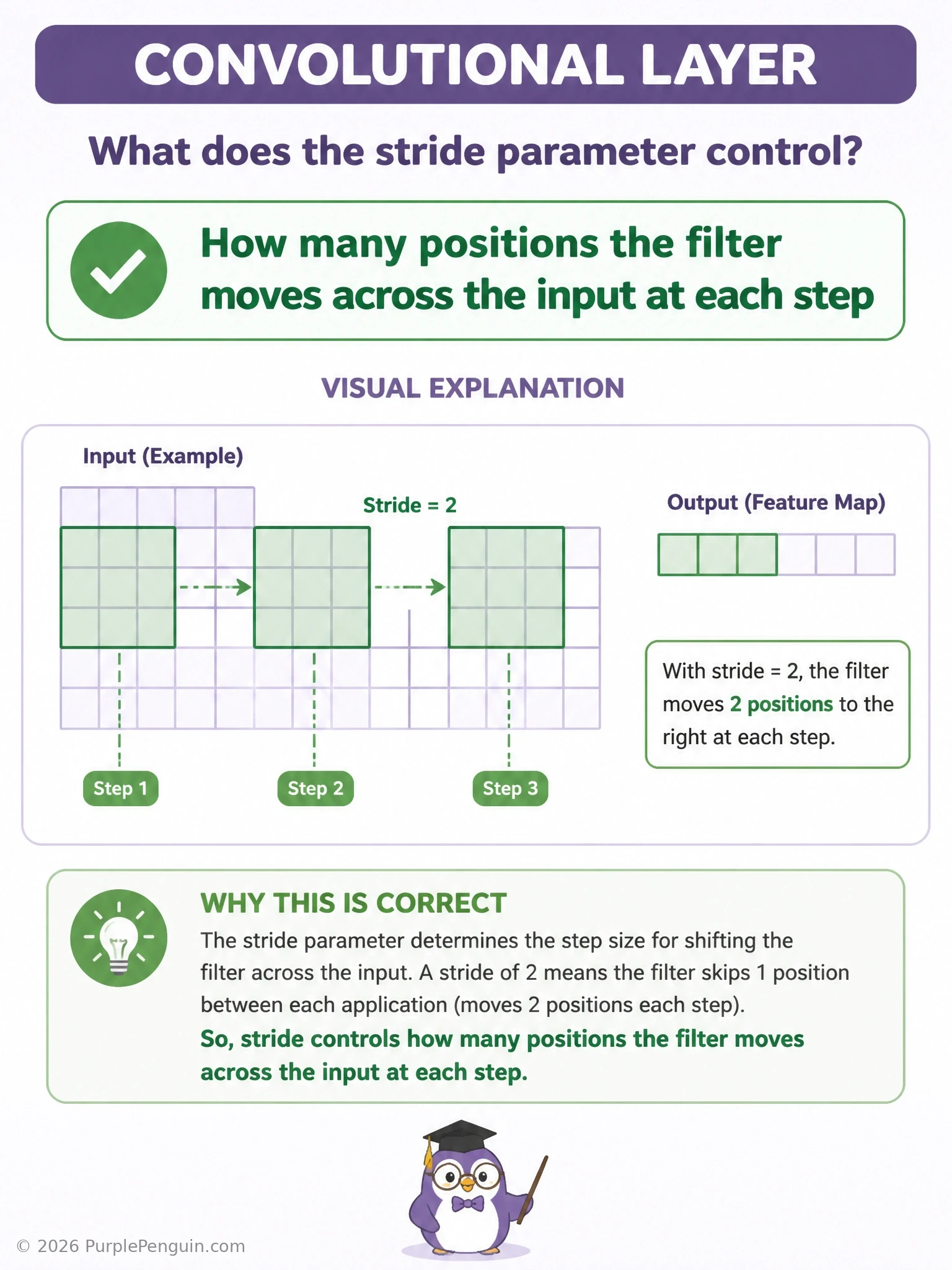
Stride is all about how big a jump the filter takes as it slides across the input. A stride of 1 means the filter moves one pixel at a time, nice and thorough, covering nearly every possible position. Bump the stride up to 2 or 3, and the filter starts skipping positions, moving further with each step, which shrinks your output feature map and cuts down on computation. That's answer C. Stride has nothing to do with how many output classes your network predicts, that's determined by your final layer's design and your problem itself. It's not dropout's fraction of neurons zeroed out either, that's a completely separate regularization knob. And there's no such thing as 'a learning rate specifically for convolutional weights' as a standard concept, the learning rate applies to how the optimizer updates weights generally, not to how the filter physically moves across the input. Stride is purely about step size in the spatial sliding operation.
Full explanation below image
Full Explanation
The stride parameter of a convolutional layer specifies how many positions the filter shifts between successive applications as it slides across the input's height and width. A stride of 1 means the filter moves one position at a time, examining nearly every possible location and producing a relatively large output feature map (before considering padding). A stride of 2 or more causes the filter to skip positions, which reduces the spatial dimensions of the resulting feature map and lowers the number of computations required, effectively acting as a form of downsampling similar in effect (though mechanically different) to pooling. Stride is therefore a key factor, alongside filter size and padding, in determining the output shape of a convolutional layer, and larger strides are sometimes used deliberately in place of separate pooling layers to reduce spatial resolution while extracting features simultaneously.
The first distractor describes the size of the output layer in a classification network, which is determined by the number of distinct classes in the task and is set in the final dense/output layer, not by any parameter of a convolutional layer. The second distractor describes the dropout rate, a regularization hyperparameter specifying what fraction of neurons to randomly deactivate during training; this is unrelated to how a convolutional filter traverses spatial positions. The third distractor invents a nonstandard concept — a learning rate specific to convolutional weights; while some advanced training setups do use per-layer or per-parameter-group learning rates, this is not what 'stride' refers to, and stride itself is a fixed architectural setting controlling spatial movement, not something related to the magnitude of gradient-based weight updates.
A helpful memory aid: stride is the 'step size' of the filter's walk across the image — small stride means a slow, thorough walk covering nearly every spot, while large stride means a fast walk that skips ahead and produces a smaller, coarser feature map.