What is a perceptron in the context of neural networks?
Select an answer to reveal the explanation.
Short Explanation and Infographic
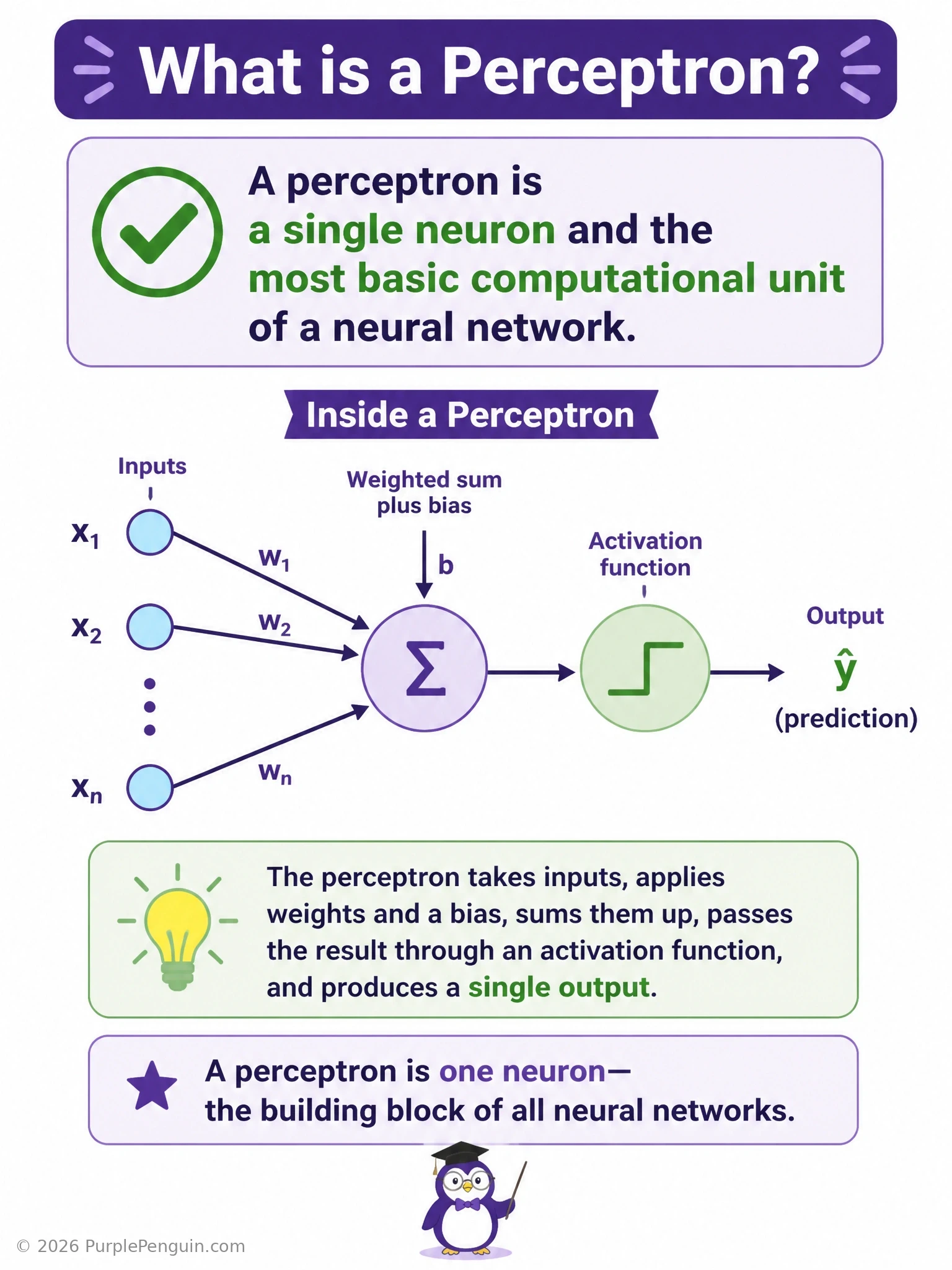
Strip a neural network down to its smallest building block and you're left with a perceptron — that's just a single neuron. It takes some inputs, multiplies them by weights, adds a bias, and passes the result through an activation function to produce one output. That's it, that's answer D. It's the LEGO brick everything else is built from, not a full deep network with dozens of layers — that's the opposite scale entirely. It's also not something exclusive to CNNs; perceptrons are the general-purpose building block used in feedforward networks, RNNs, you name it. And it's not a clustering algorithm — perceptrons were originally designed for supervised binary classification, learning a linear decision boundary between two classes. Keep the scale straight: perceptron is singular and small, deep network is plural and large.
Full explanation below image
Full Explanation
A perceptron is the simplest and most foundational computational unit in neural network theory, representing a single artificial neuron. It takes one or more input values, multiplies each by a corresponding weight, sums these weighted inputs together with a bias term, and passes the result through an activation function (historically a simple step function) to produce a single output. Introduced by Frank Rosenblatt in 1958, the perceptron was originally designed as a supervised learning algorithm for binary classification, capable of learning a linear decision boundary that separates two linearly separable classes. Modern neural networks are built by connecting many such units (often with more sophisticated activation functions like ReLU or sigmoid) into layers, and stacking multiple layers to form deep networks.
The first distractor describes a deep neural network, which is composed of many stacked layers of neurons (often perceptron-like units with nonlinear activations); this is essentially the opposite scale from a perceptron, which is a single unit, not an entire multi-layer architecture. The second distractor is incorrect because the perceptron is a general concept that appears as the basic building block across virtually all types of feedforward architectures, not a specialized structure unique to convolutional networks; convolutional layers apply filters using a similar weighted-sum-plus-activation computation, but the term perceptron itself is not CNN-specific terminology. The third distractor is incorrect because the classic perceptron algorithm is a supervised learning method for classification, trained on labeled examples to adjust its weights; it is not used for unsupervised clustering tasks, which rely on entirely different algorithms like k-means.
A helpful memory aid: if a neural network were a wall, the perceptron would be a single brick — the smallest structural unit — while a deep network is the entire finished wall built from many such bricks stacked and connected together.