How does a recurrent neural network (RNN) fundamentally differ from a standard feedforward network?
Select an answer to reveal the explanation.
Short Explanation and Infographic
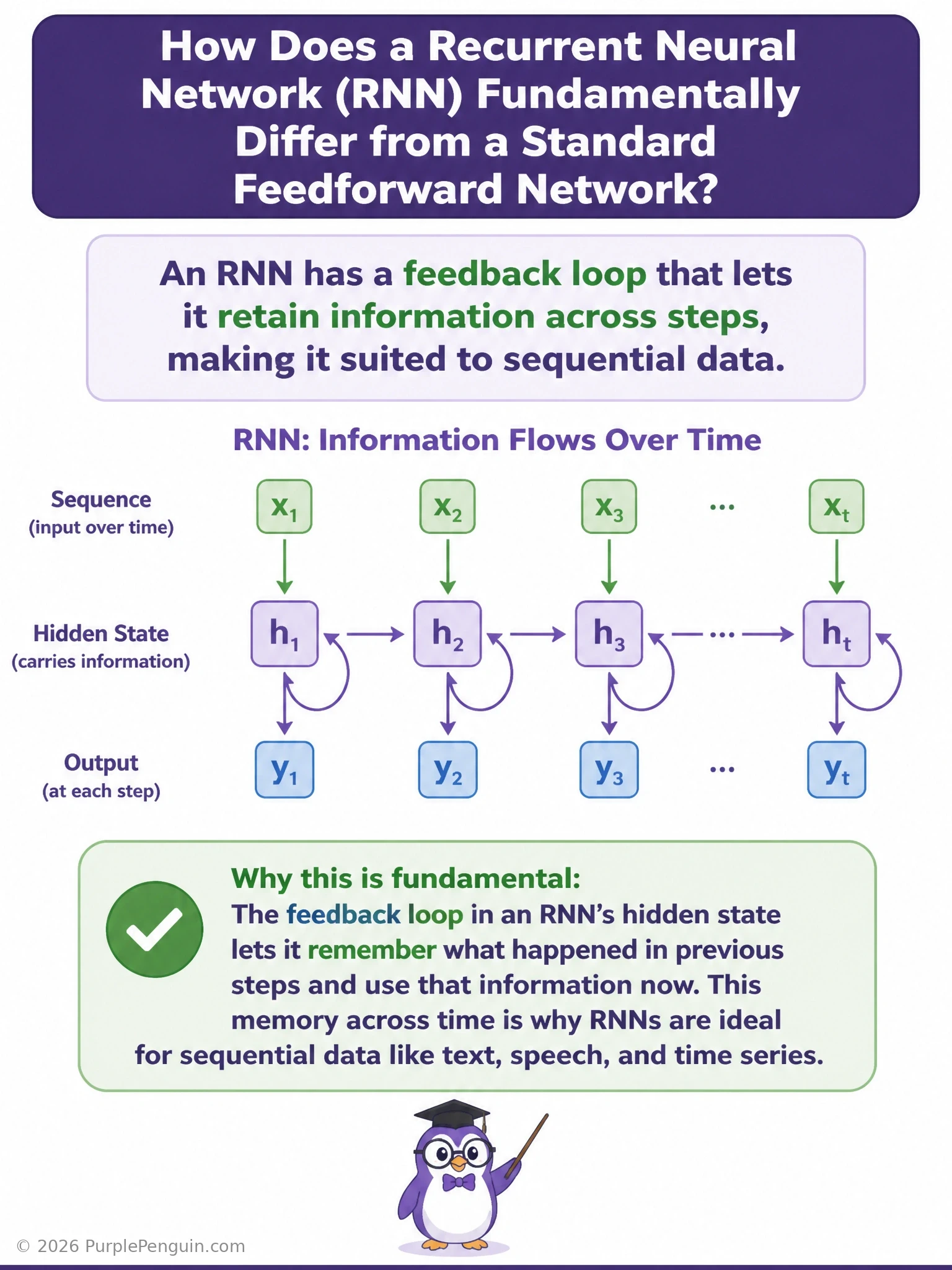
Picture a feedforward network as a one-way street — data goes in, flows through the layers, and comes out the other end, with no memory of what happened before. An RNN adds a feedback loop: the output from one step gets fed back in alongside the next input, so the network carries a kind of memory forward through a sequence. That's exactly why RNNs are the go-to for time series, text, or anything where order matters, and it's answer A. RNNs aren't restricted to unsupervised learning at all — plenty of RNN applications, like next-word prediction, are supervised. There's no rule that RNNs need more layers than feedforward nets for equal accuracy; it depends on the task. And RNNs absolutely use backpropagation — a special flavor called backpropagation through time, but it's still gradient-based learning. The feedback loop is the one true differentiator here.
Full explanation below image
Full Explanation
The defining architectural difference between a recurrent neural network and a standard feedforward network is the presence of a feedback loop. In a feedforward network, information flows strictly in one direction, from input to output, with no connections that loop back to earlier points in the computation, and each input is processed independently of any other. An RNN, by contrast, maintains a hidden state that is updated at every time step and fed back into the network alongside the next input in the sequence. This recurrence allows the network to retain information about previous elements of a sequence, making RNNs naturally suited to sequential or temporal data such as time series, audio, or text, where the order and context of elements matter.
The first distractor is incorrect because RNNs are commonly trained with supervised learning, such as predicting the next word in a sequence given labeled sequences, or classifying a sequence's sentiment; nothing about the recurrent architecture restricts it to unsupervised settings. The second distractor is incorrect because the number of layers needed for a given accuracy is task- and data-dependent, not a fixed property of RNNs versus feedforward networks; some problems may require deep feedforward stacks while others are solved with shallow RNNs, and vice versa. The third distractor is incorrect because RNNs are trained via a variant of standard backpropagation called backpropagation through time (BPTT), which unrolls the recurrent computation across time steps and applies the chain rule just as ordinary backpropagation does, just across the temporal dimension as well as the layer dimension.
A helpful memory aid: feedforward networks have no memory of the past, while RNNs are built specifically to carry a running memory (the hidden state) forward through a sequence, which is why RNNs (and their descendants like LSTMs and GRUs) dominate sequence-modeling tasks that plain feedforward networks handle poorly.