
What problem does Petastorm solve when training deep learning models on large Spark Delta Lake datasets?
Select an answer to reveal the explanation.
Short Explanation and Infographic
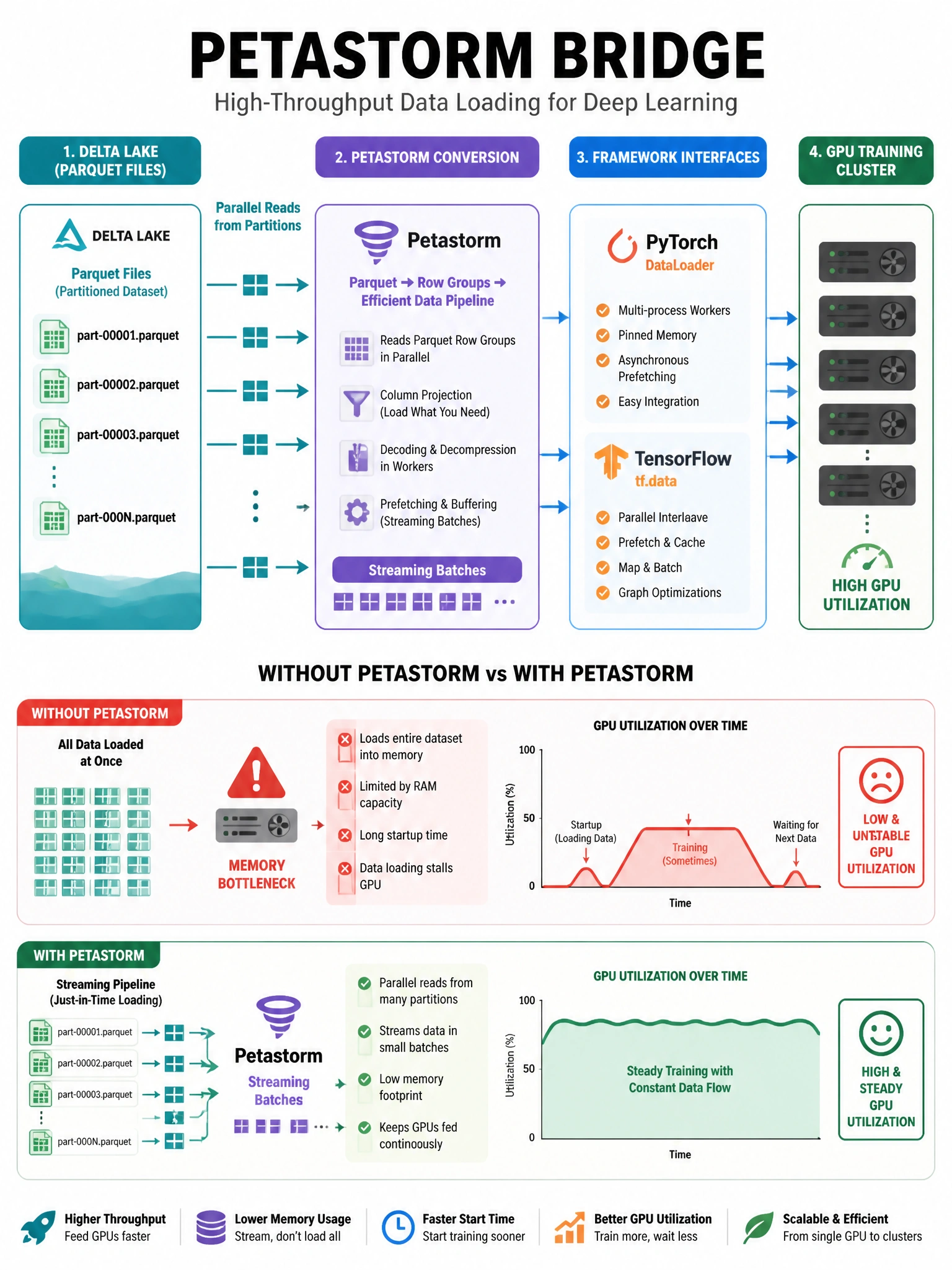
Petastorm is the bridge between your data lake and your GPU — it converts Parquet/Delta data into a format that PyTorch DataLoader or TensorFlow can stream directly, without loading everything into memory first.
Full explanation below image
Full Explanation
Training deep learning models on large datasets stored in Delta Lake poses a challenge: PyTorch DataLoaders and TensorFlow's tf.data expect data in specific formats, not Spark DataFrames. Petastorm (open-sourced by Uber) solves this by: 1) Materializing Delta/Parquet data into Petastorm's format with row-group indexing for random access. 2) Providing a torch.utils.data.DataLoader-compatible interface. 3) Enabling parallel streaming from multiple Parquet files across workers. Alternative (Databricks native): use spark-tensorflow-connector or the TorchDistributor with Data Loader APIs. For modern Databricks workflows, mlflow + TorchDistributor or HorovodRunner with built-in Spark data readers is often preferred. Petastorm is useful when you need fine-grained control over data streaming to GPUs from Delta tables without converting to TFRecords.