
What is the key advantage of TrainValidationSplit over CrossValidator in Spark MLlib when training on very large datasets?
Select an answer to reveal the explanation.
Short Explanation and Infographic
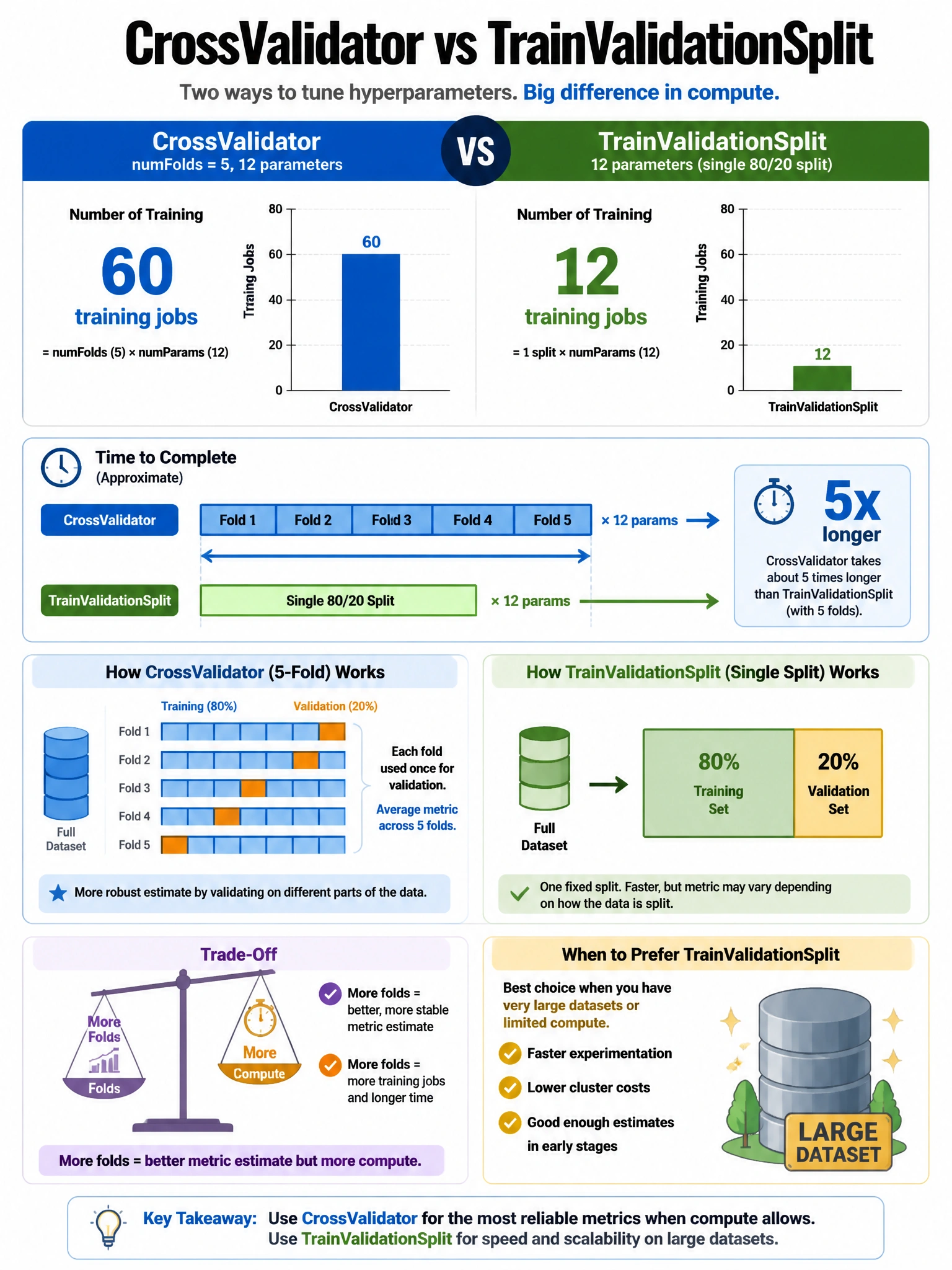
TrainValidationSplit is CrossValidator's faster sibling — instead of training k models per hyperparameter set (k-fold), it trains just one. That's a k-times speedup for large datasets where k-fold is prohibitively expensive.
Full explanation below image
Full Explanation
CrossValidator(numFolds=5) trains 5 models per hyperparameter combination (one per fold). With 12 parameter combinations, that's 60 training jobs. TrainValidationSplit(trainRatio=0.8) trains 1 model per combination using an 80/20 split. With 12 combinations, that's 12 training jobs — 5x faster. Tradeoffs: CrossValidator: lower variance in metric estimates (multiple folds average out noise), better for small datasets where variance in the estimate matters. TrainValidationSplit: faster computation, appropriate for large datasets where even a single 80% training sample is large enough to give stable metric estimates. Both: evaluate all parameter combinations, select best, refit best model on the full training dataset (when fit on the full dataset). Both use the same ParamGrid. For billion-row datasets, CrossValidator may be impractical — TrainValidationSplit is often the pragmatic choice.