
What is the difference between data drift and concept drift in production ML models?
Select an answer to reveal the explanation.
Short Explanation and Infographic
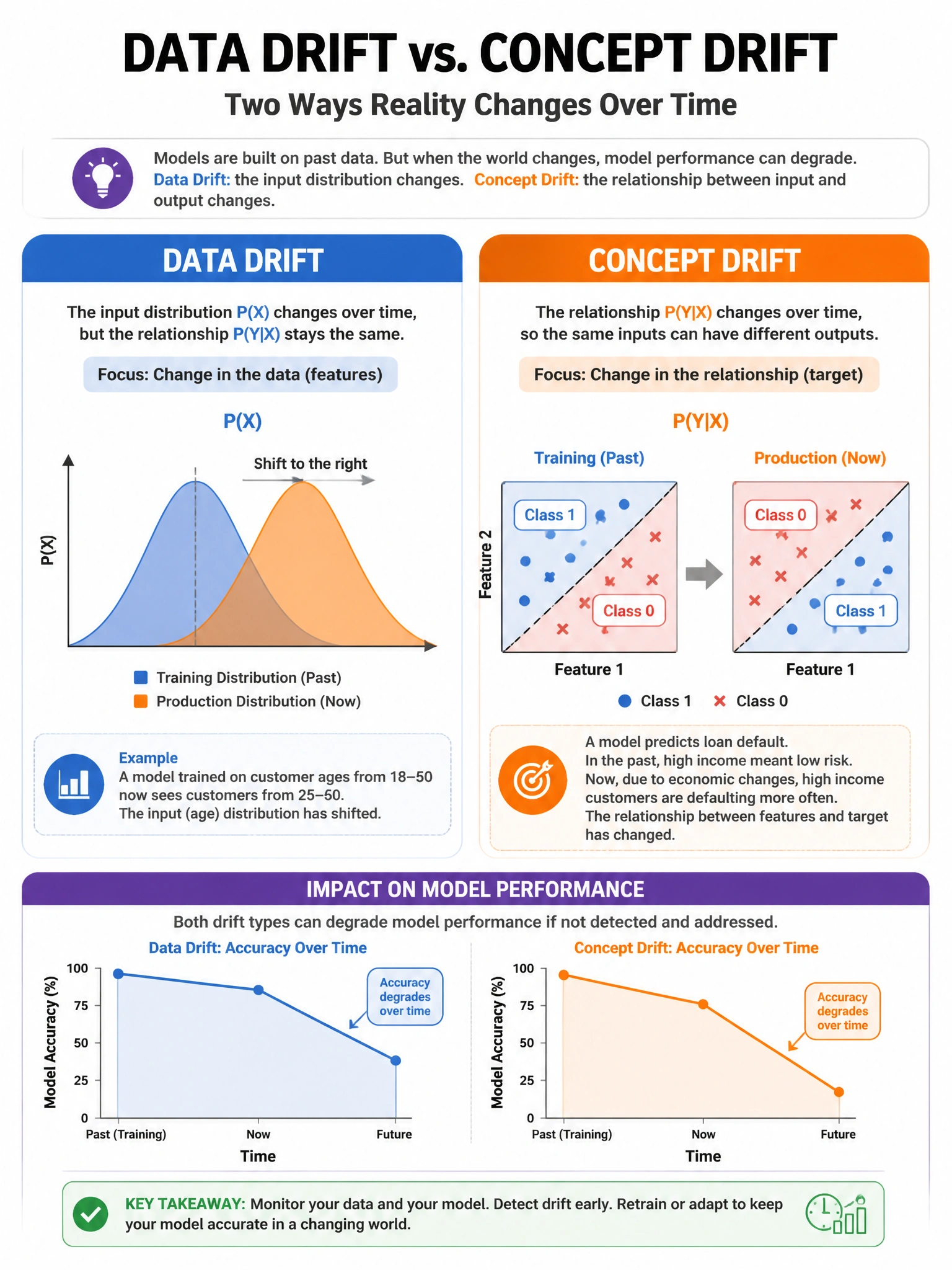
Data drift is when your customers change — the inputs look different. Concept drift is when the world changes — the same inputs now mean something different. Both degrade model performance but require different responses.
Full explanation below image
Full Explanation
Data drift (also called feature drift or covariate shift): the statistical distribution of input features P(X) changes between training and production. Example: a model trained on young demographics is deployed to an older user population — age distribution shifts. Detection: statistical tests (Kolmogorov-Smirnov, Population Stability Index) on feature distributions. Remedy: retrain on current data. Concept drift: the relationship P(Y|X) between features and target changes. Example: a credit scoring model trained before an economic recession — the same income/debt ratio now predicts default differently post-recession. Detection: requires labeled production data (monitor accuracy over time). Remedy: retrain with current labeled examples. Both types cause model degradation. Data drift can be detected without labels (compare feature distributions). Concept drift requires ground truth labels to detect. Both can occur in batch and real-time systems.