
A regression model predicts house prices. The RMSE is $45,000 and the MAE is $28,000. Which statement correctly interprets these metrics?
Select an answer to reveal the explanation.
Short Explanation and Infographic
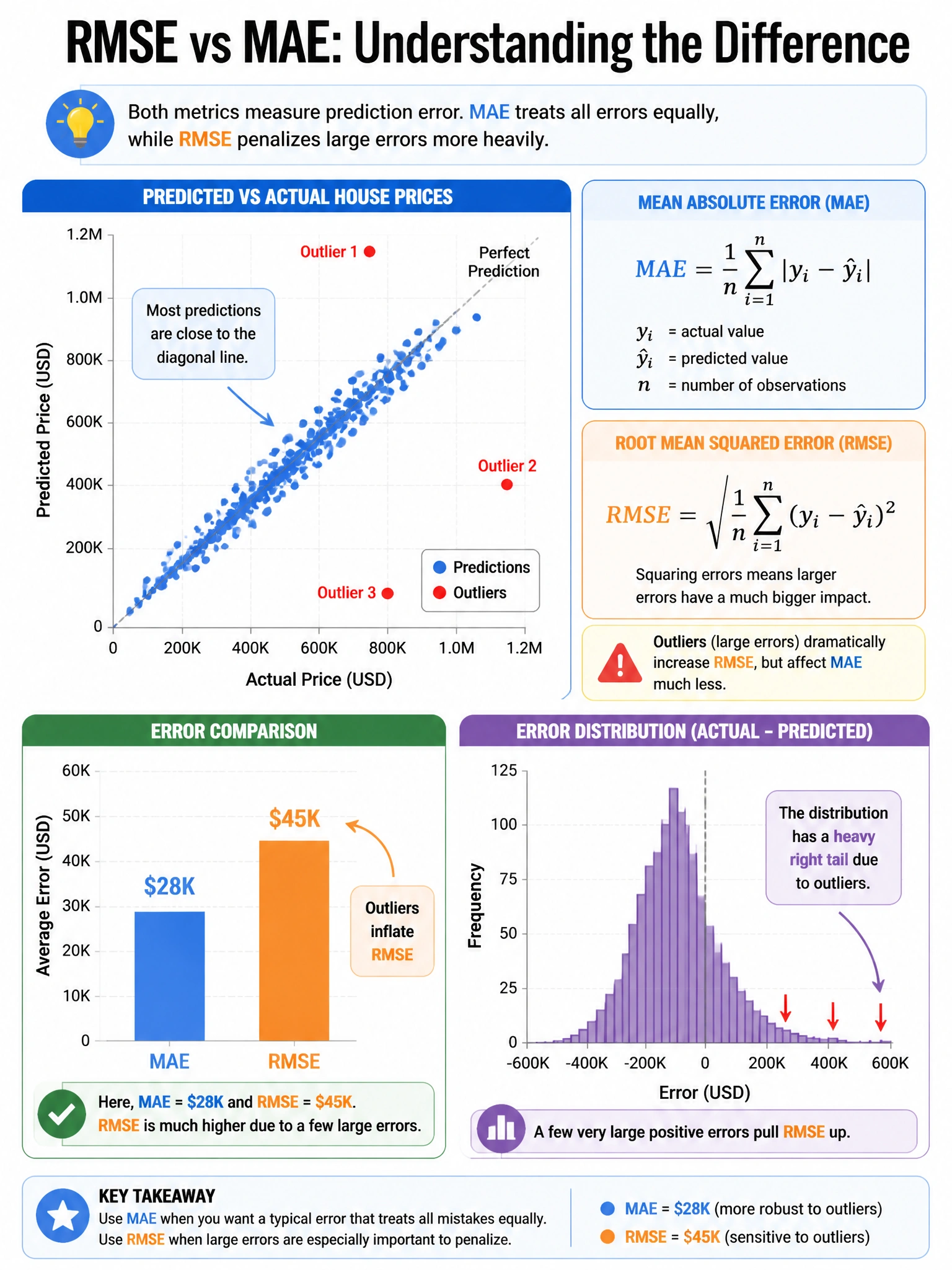
RMSE being higher than MAE is normal and expected — squaring errors amplifies big mistakes. A big gap between the two is a signal that a few predictions are wildly off.
Full explanation below image
Full Explanation
RMSE (Root Mean Squared Error) = sqrt(mean((y_pred - y_true)^2)) penalizes large errors quadratically — a $100,000 error contributes 100x more to RMSE than a $10,000 error (compared to 10x for MAE). MAE (Mean Absolute Error) = mean(|y_pred - y_true|) treats all errors linearly. RMSE is always >= MAE for the same predictions (by the Cauchy-Schwarz inequality). A large RMSE/MAE ratio (here 45K/28K ≈ 1.6) suggests outlier predictions — a few houses with very large errors. If RMSE ≈ MAE, error distribution is approximately uniform (no outliers). Choice between metrics: use MAE when you want robust-to-outliers evaluation; use RMSE when large errors are particularly bad (business impact scales with error squared). RMSE < MAE is mathematically impossible.