
How can Delta Lake's time travel feature help prevent training-serving skew in ML pipelines?
Select an answer to reveal the explanation.
Short Explanation and Infographic
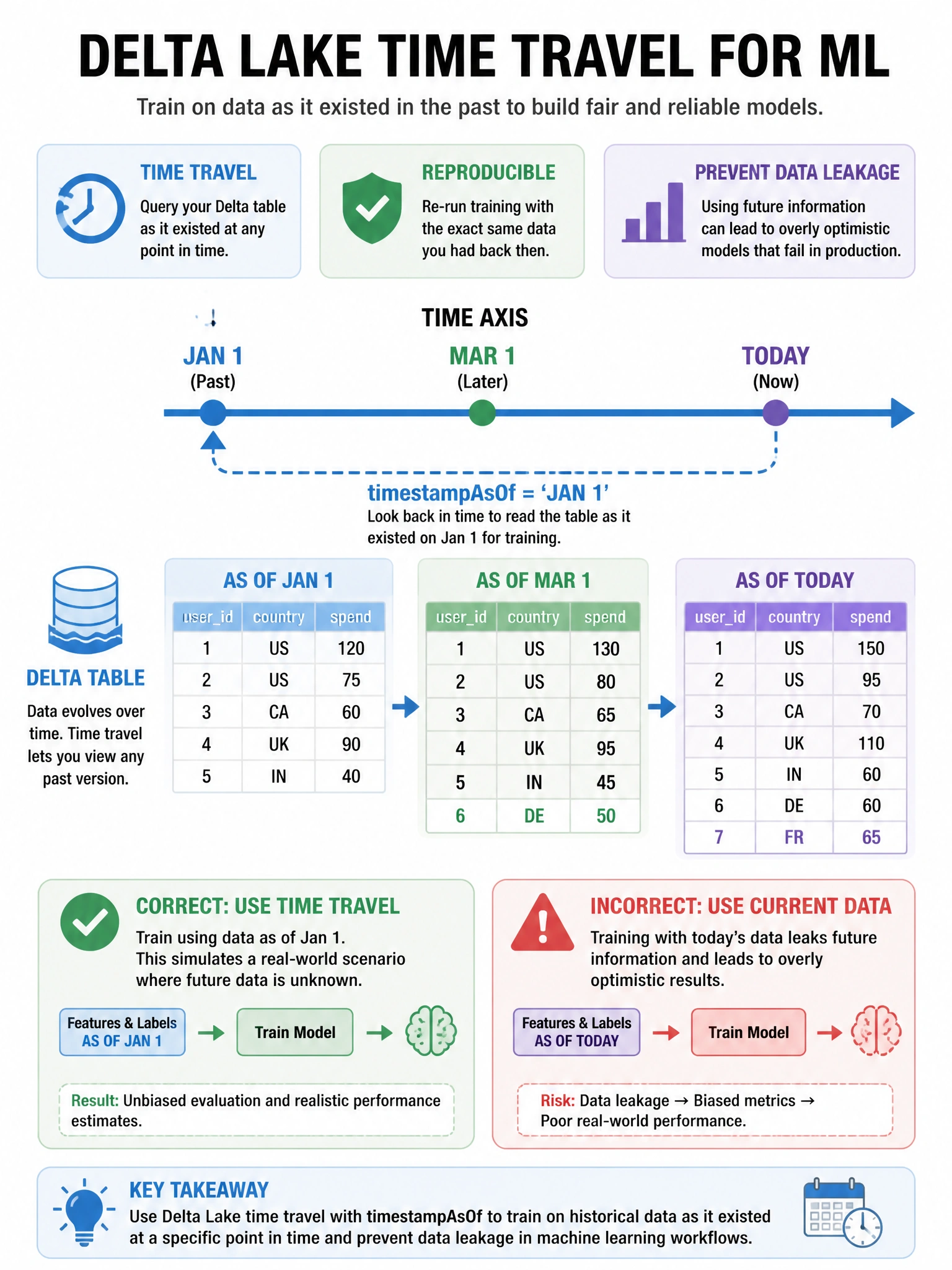
Time travel is like a DVR for your data — if your labels were generated on March 1st, you can rewind the feature table to exactly that moment so your training data matches reality, not today's updated values.
Full explanation below image
Full Explanation
Training-serving skew occurs when features used to generate labels differ from features used at serving time. Delta Lake time travel (df = spark.read.format('delta').option('timestampAsOf', '2024-03-01').load('/path')) allows you to reconstruct the exact state of a table at any historical point. In practice: if a customer's order_count feature is used to generate churn labels on Jan 1, you need the Jan 1 value of order_count in training, not the current value (which has changed). Delta's transaction log (stored in _delta_log/) enables querying any historical version using either timestamp or version number. The Feature Store's point-in-time lookup feature automates this pattern. Auto-retraining, caching inference results, and encryption are all real capabilities of Databricks but unrelated to the time travel concept.