
A data scientist calls mlflow.autolog() before training a scikit-learn model. Which items will be automatically logged without any additional mlflow.log_* calls?
Select an answer to reveal the explanation.
Short Explanation and Infographic
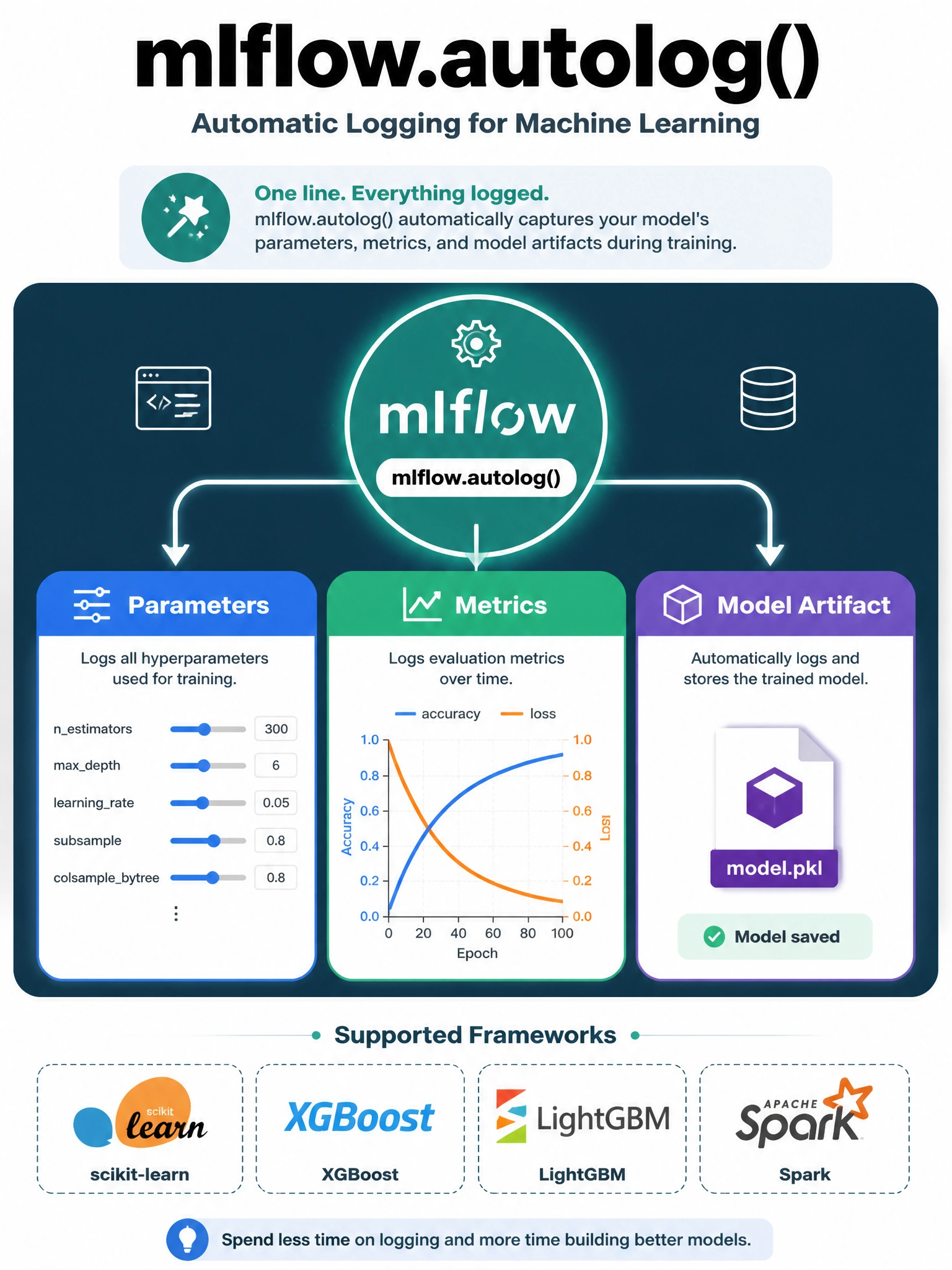
mlflow.autolog() is like a dashcam — it records everything automatically: your inputs (parameters), your results (metrics), and saves the model (artifact) without you lifting a finger.
Full explanation below image
Full Explanation
mlflow.autolog() enables automatic logging for supported ML frameworks including scikit-learn, XGBoost, LightGBM, TensorFlow/Keras, PyTorch Lightning, and Spark MLlib. For scikit-learn, it automatically logs: all constructor parameters (e.g., max_depth=5, n_estimators=100), fit-time metrics (training accuracy, validation scores if cross-validation used), the trained model as an artifact in the MLflow model format, and feature importances where applicable. It does NOT log custom metrics you compute manually — those still need mlflow.log_metric(). The autolog behavior is framework-specific: XGBoost also logs training curves per iteration, for example.