
Which MLflow component is responsible for logging parameters, metrics, and artifacts during a model training run?
Select an answer to reveal the explanation.
Short Explanation and Infographic
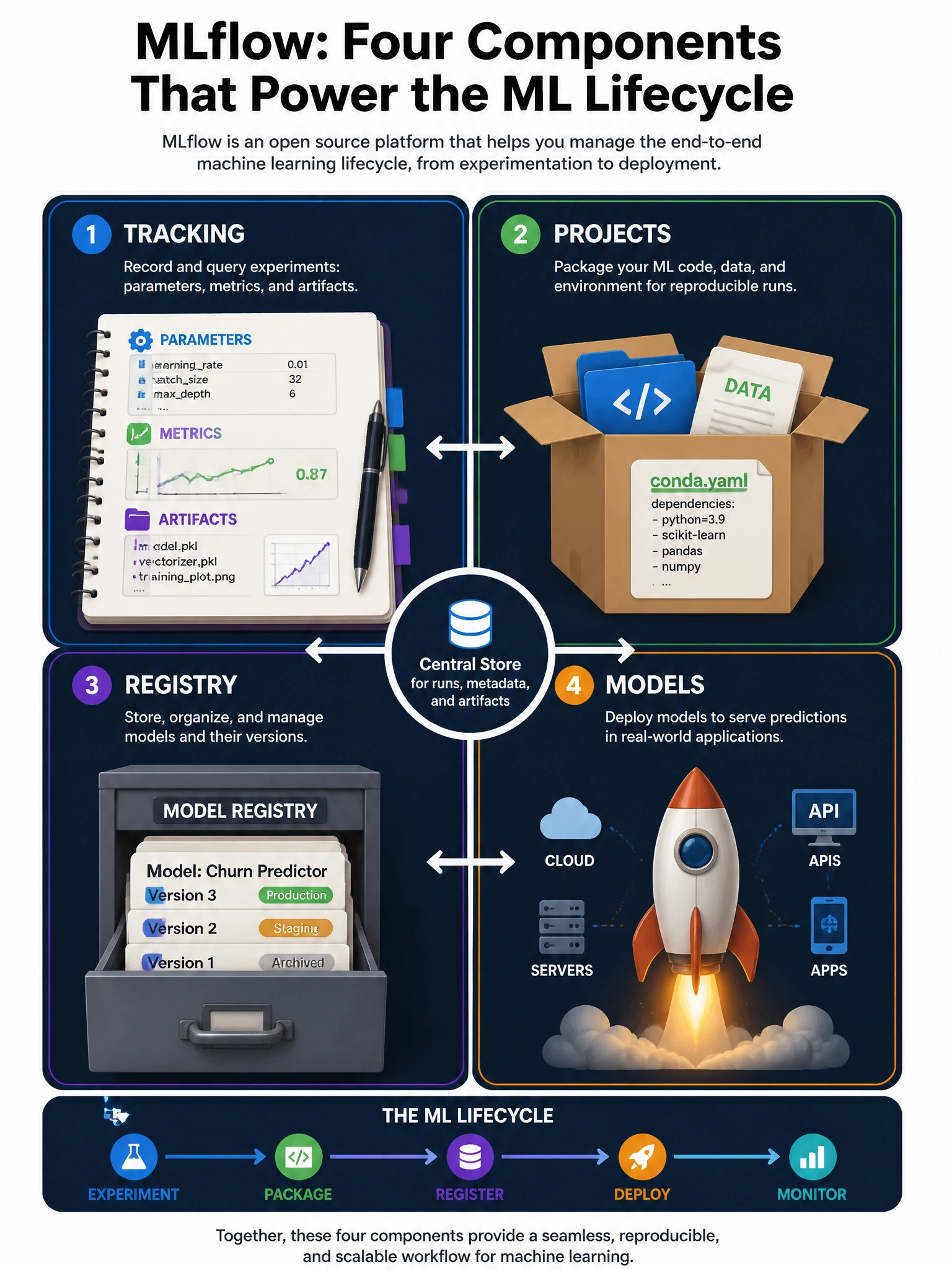
Think of MLflow Tracking like a lab notebook — every experiment run gets its own page where you jot down what you tried (parameters), how well it worked (metrics), and save your files (artifacts).
Full explanation below image
Full Explanation
MLflow Tracking is the component that records and queries experiments. It logs: parameters (key-value pairs for hyperparameters like learning_rate=0.01), metrics (numeric values like accuracy=0.95, which can be logged over time), artifacts (files like model weights, plots, or datasets), and run metadata (start time, status). MLflow Projects packages ML code into a reproducible format with dependencies. MLflow Registry provides model versioning and lifecycle management (Staging, Production, Archived). MLflow Models defines a standard model format for deployment. The other options are real MLflow components but serve different purposes: Projects for reproducibility, Registry for lifecycle management, and Models for a unified deployment format.