
For batch inference on a large Delta table using an MLflow-logged scikit-learn model, which approach is most efficient on Databricks?
Select an answer to reveal the explanation.
Short Explanation
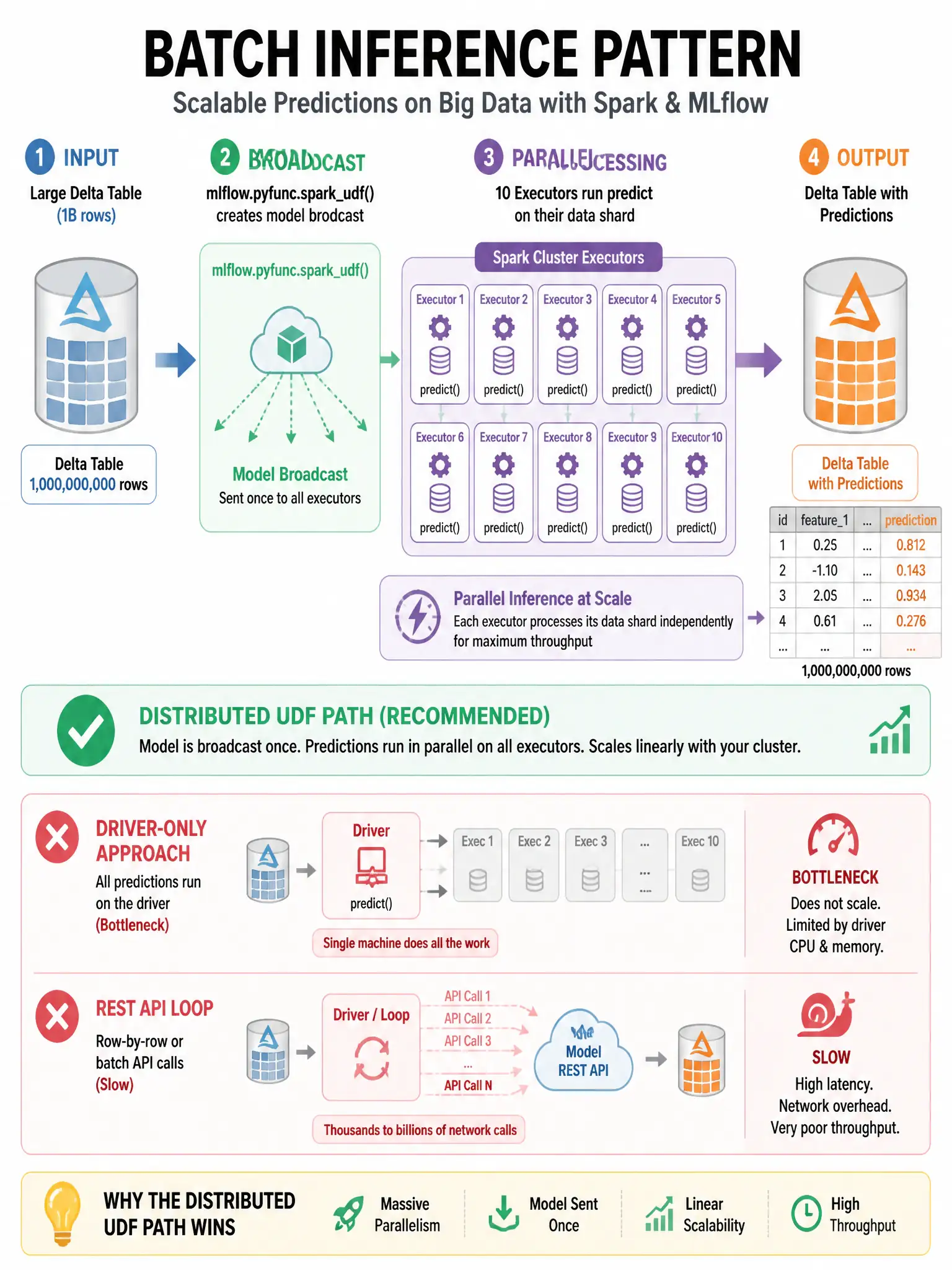
mlflow.pyfunc.spark_udf() is the bridge between your MLflow model and Spark — it wraps the model as a UDF so predictions run in parallel across all executors on your data, not bottlenecked on the driver.
Full Explanation
mlflow.pyfunc.spark_udf(spark, model_uri, result_type='double') creates a Spark UDF that: 1) Broadcasts the model to all executor nodes. 2) Applies predictions in parallel, partition by partition, leveraging all cluster cores. 3) Returns predictions as a new Spark column. Usage: predict_udf = mlflow.pyfunc.spark_udf(spark, 'models:/fraud_detector/3'); predictions = df.withColumn('prediction', predict_udf(*feature_cols)). Why not alternatives: df.toPandas() loads all data to driver memory — fails for large tables, single-threaded. REST API row-by-row creates massive network overhead (thousands of HTTP calls). Converting sklearn to Spark MLlib is complex and may change prediction behavior. This pattern scales to billions of rows.
Prefer to study offline? Printable PDF study book + test engine ($7.50, unofficial). These questions stay free here.