
Meridian Line's customs-compliance agent is capable of stating a definitive legal classification for a shipment, but the compliance team has decided the agent should never present itself as making the final classification decision, only as providing supporting analysis for a licensed customs broker. Where should this constraint be enforced?
Select an answer to reveal the explanation.
Short Explanation
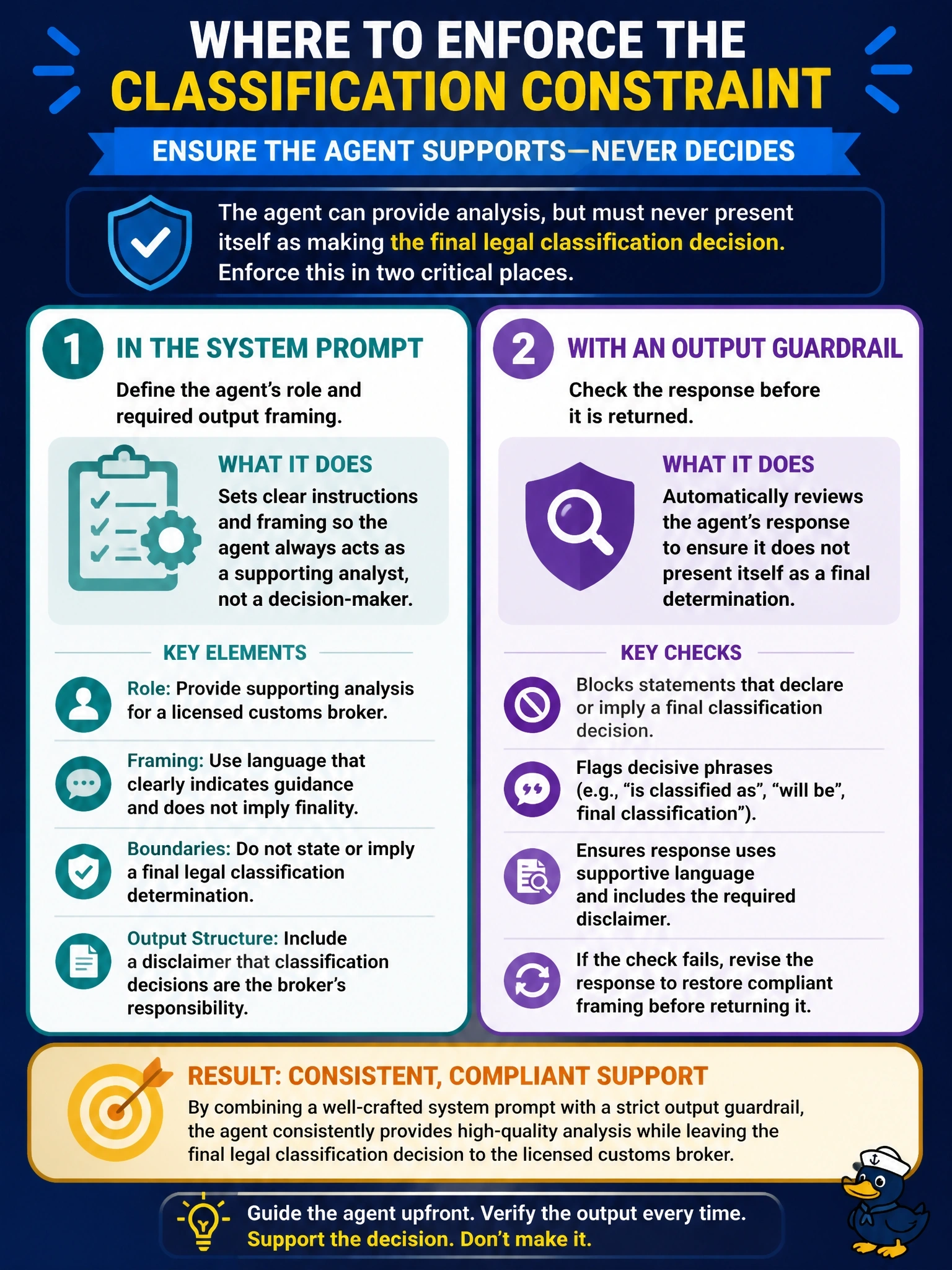
You can't rely on training material or the source documents to control how the model frames its own answer, that has to be built into the agent itself: the system prompt sets the expected framing, and a guardrail checks the actual output honors it before anything reaches a broker.
Full Explanation
A policy constraint on how a model presents its own conclusions has to be enforced at the layer that controls what the model generates and what is allowed to leave the system, which means the system prompt should define the agent's role and required framing, decision support rather than final determination, and an output guardrail should verify the generated response actually honors that framing before it is returned, catching cases where the model still slips into definitive language. Employee training material governs human behavior around the output, not what the agent actually says, and does nothing to stop the agent itself from phrasing an answer as a final ruling, which is the behavior the compliance team wants prevented at the source. Putting the disclaimer only in the source tariff documents does not control how the agent synthesizes and phrases its own answer, the model can still generate confident, definitive-sounding language even when the source material it drew from was appropriately hedged. Trusting professional judgment to compensate for the agent's phrasing ignores that framing affects how information is used in practice, and it is not a substitute for a guardrail when the compliance team has explicitly decided this constraint matters enough to require enforcement. Exam framing: mitigating problematic output framing is enforced through prompt design and an output-level guardrail, not through downstream training or source-document text.