
Meridian Line's customs-compliance agent produces a written classification rationale that references specific tariff clauses and duty percentages, and brokers have started forwarding that rationale directly to port authorities as supporting documentation. What governance step addresses the risk this creates?
Select an answer to reveal the explanation.
Short Explanation
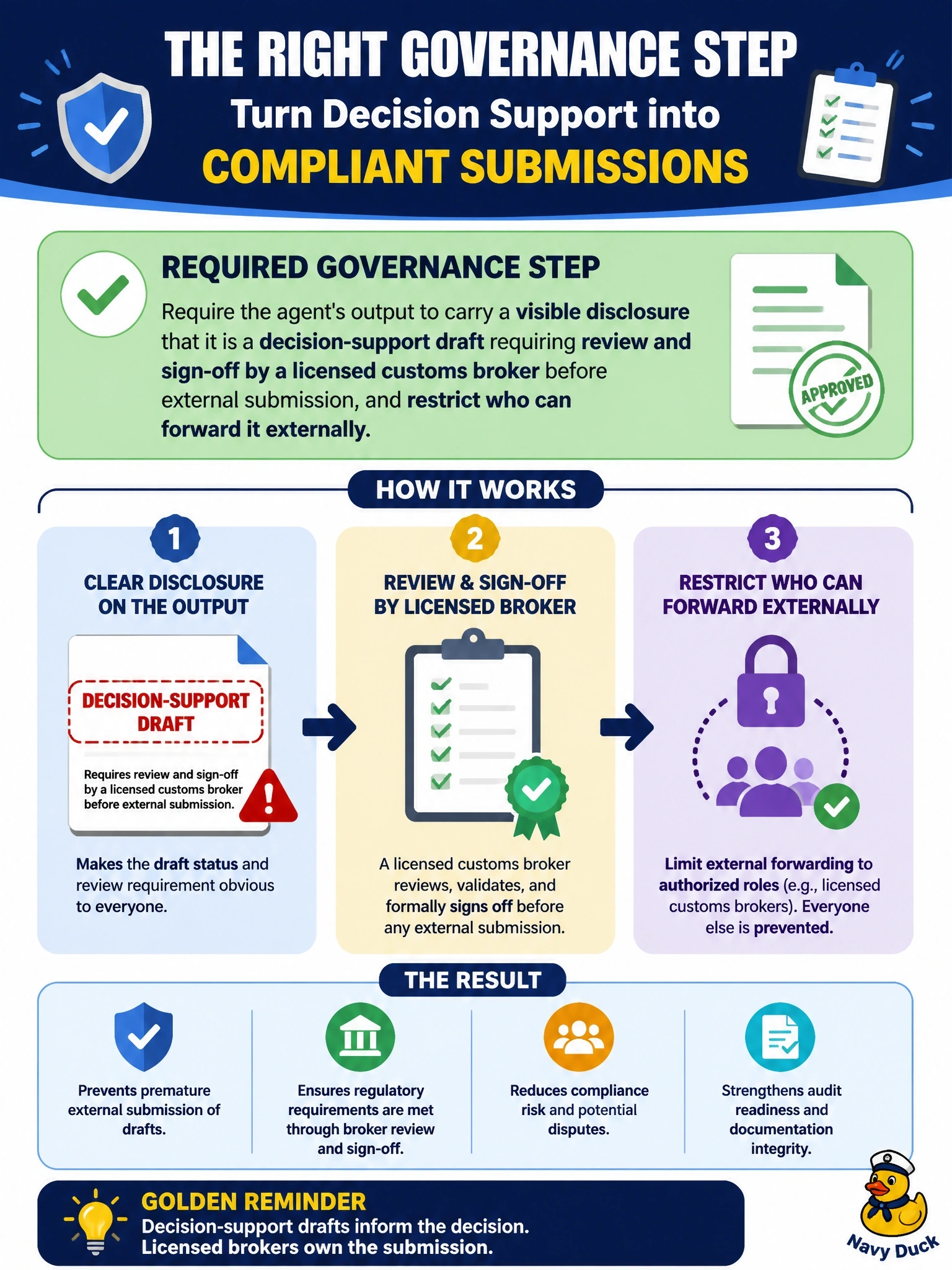
The problem isn't accuracy, it's that a draft is getting treated as an authoritative filing. The fix is a policy control: label it as decision support, require broker sign-off, and stop it from walking out the door on its own.
Full Explanation
The governance risk here is not primarily about the agent being wrong, it is about an internal decision-support draft being treated as an authoritative external filing without a human accountable for it, which is a policy and process gap rather than a retrieval-accuracy gap. The correct fix is to attach a clear disclosure to the output marking it as draft decision support requiring a licensed broker's review and sign-off, combined with a control on who is permitted to forward agent output externally, so a human remains accountable for anything submitted to a port authority. Assuming the agent cannot be wrong because it cites real clauses ignores retrieval failure modes, a retrieved clause can be real but misapplied to this shipment's specifics, and citing a real source does not guarantee the conclusion drawn from it is correct. A larger context window might improve retrieval coverage but does nothing to address the actual problem, which is an accountability and review gap, not an information-completeness gap. Removing citations entirely makes the output less trustworthy and auditable while doing nothing to stop it being forwarded externally, and it actively removes the evidence a human reviewer would need to check the agent's reasoning. Exam framing: mitigating problematic use of model output is often a policy and workflow control, not a model-quality fix.