
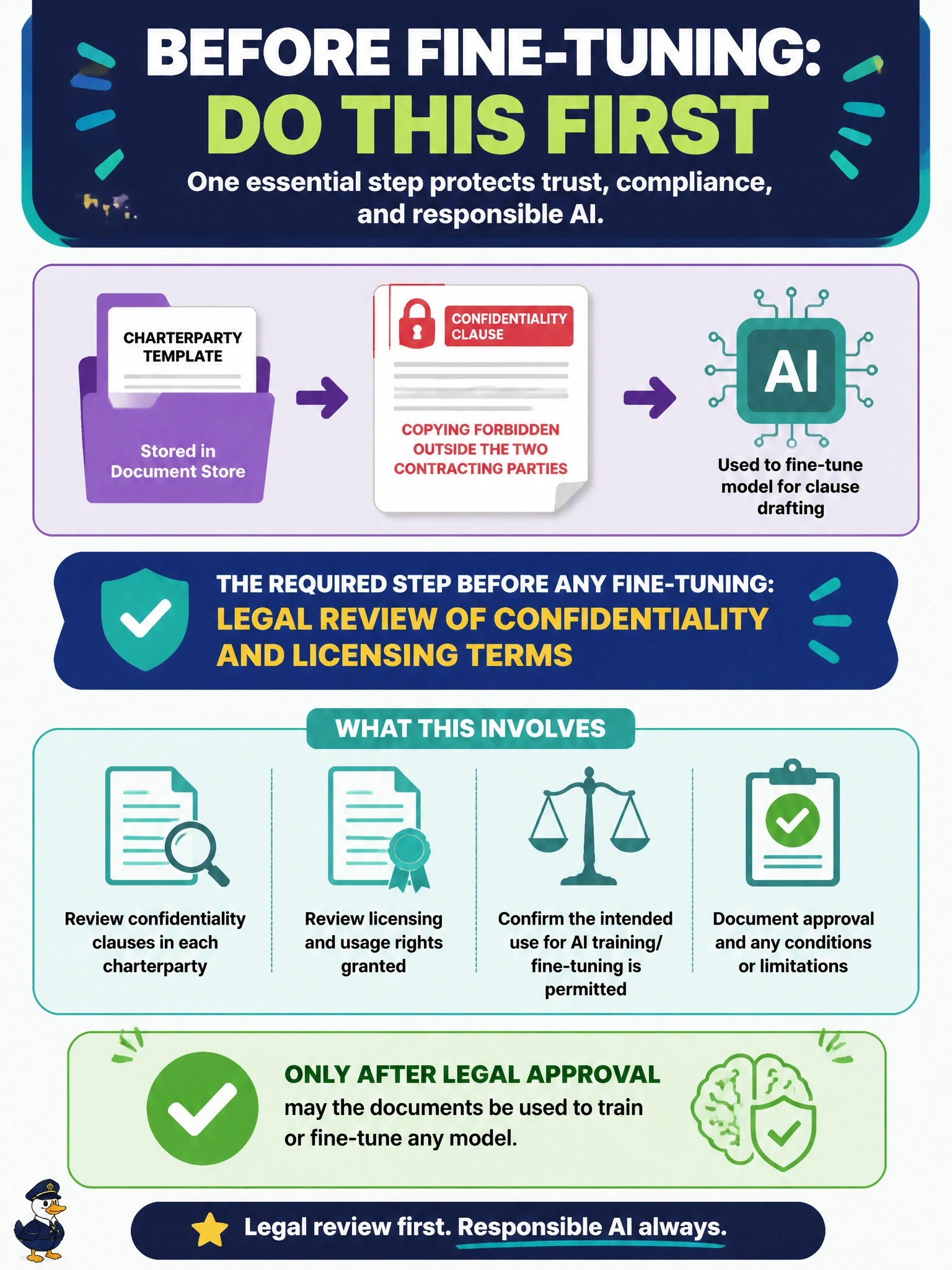
A counterparty's charterparty template lands in Meridian Line's document store carrying a confidentiality clause that forbids the text being copied outside the two contracting parties. The AI platform team wants to use a large batch of these historical charters to fine-tune a foundation model for clause drafting. What must happen before that fine-tuning job runs?
Select an answer to reveal the explanation.
Short Explanation
A confidentiality clause travels with the words, not the file format or the party's name still being visible. If the contract says the text can't be reused this way, that has to get sorted out with legal before a training job ever touches it, workspace-internal or not.
Full Explanation
Confidentiality and licensing constraints attach to the content and the permitted use, not to where the compute happens to run or what format the file is stored in. A model trained on the text can encode and later reproduce fragments of it, and 'fine-tuning' is a use of the document beyond whatever the original contracting purpose was, so the correct step is a legal review of the confidentiality and licensing terms before any training or fine-tuning job consumes those charters. Assuming internal Databricks compute exempts the company from the clause misunderstands what the obligation restricts, since the clause concerns who the content is disclosed and used for, not the physical location of the job. Stripping the counterparty's name does not remove a confidentiality obligation that covers the substance of the agreement, and a model fine-tuned on that text can still leak identifying or sensitive clause language regardless of whether a name string was deleted. Changing the file format is irrelevant, since the clause protects the content, not a particular container for it. Exam framing: governance over source documents includes verifying legal and licensing permission for the specific downstream use, including training or fine-tuning, before ingestion, not after.