
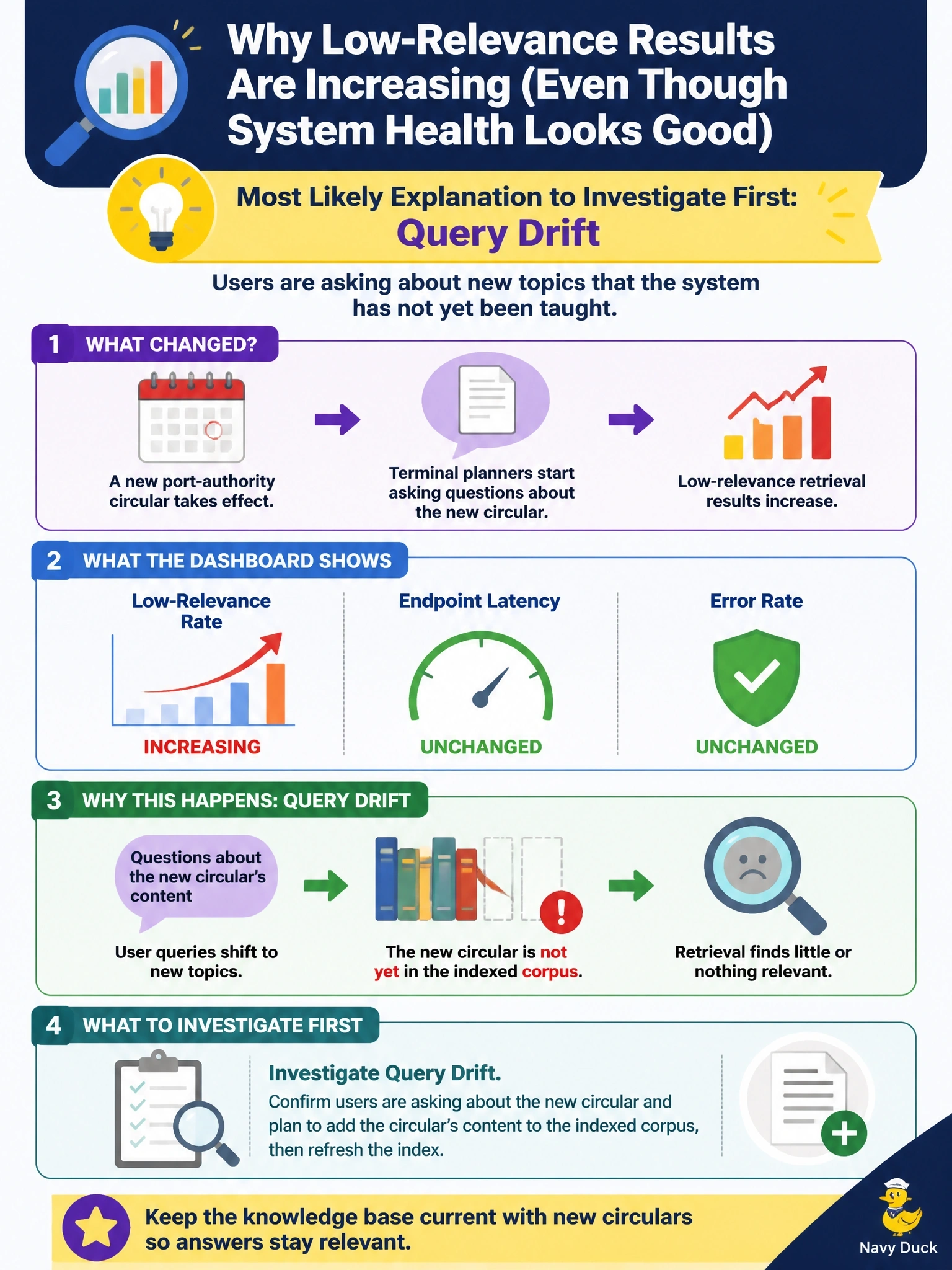
Several weeks after a new port-authority circular takes effect, the port-operations copilot's monitoring dashboard shows a rising share of user questions returning low-relevance retrieval results, even though the endpoint's latency and error rate are unchanged. What is the most likely explanation the team should investigate first?
Select an answer to reveal the explanation.
Short Explanation
Falling relevance with flat latency and error rate is the classic sign that nothing broke, the world just changed. A new circular means planners are asking about content that simply is not in the index yet, so retrieval keeps coming back empty, and the fix is a data-pipeline update, not a rollback.
Full Explanation
This pattern, degraded retrieval relevance alongside unchanged latency and error rate, points to query drift: the population of incoming questions has shifted to reference new content, here the new port-authority circular, that has not yet been ingested and chunked into the indexed Delta table, so Vector Search correctly reports low relevance because there is genuinely nothing relevant to retrieve yet. The fix is a data-preparation and indexing update, not a code or infrastructure fix. A lost scale-to-zero configuration would affect whether the endpoint spins down during idle periods and could show up as unexpected cold-start latency, but the scenario explicitly states latency is unchanged, ruling this out. An AI Gateway rate limit set too low would produce throttled or rejected requests, visible as a rising error rate, which the scenario also explicitly rules out. A silently swapped, lower-dimension embedding model is the closest-looking trap, since it could plausibly degrade relevance, but it would typically also break the index outright, because a Delta Sync index and its embeddings are tied to a specific embedding dimensionality, causing failures rather than the described gradual relevance decline correlated with a real-world content event. Recognizing query drift and re-indexing new source material promptly is a recurring production-monitoring responsibility for a RAG application.