
The safety-review summarizer condenses incident narratives into a one-paragraph summary for the safety officer. The ML team wants a metric that specifically checks whether every claim in the generated summary is supported by content in the source incident report, rather than checking overall summary quality. Which class of metric are they describing?
Select an answer to reveal the explanation.
Short Explanation
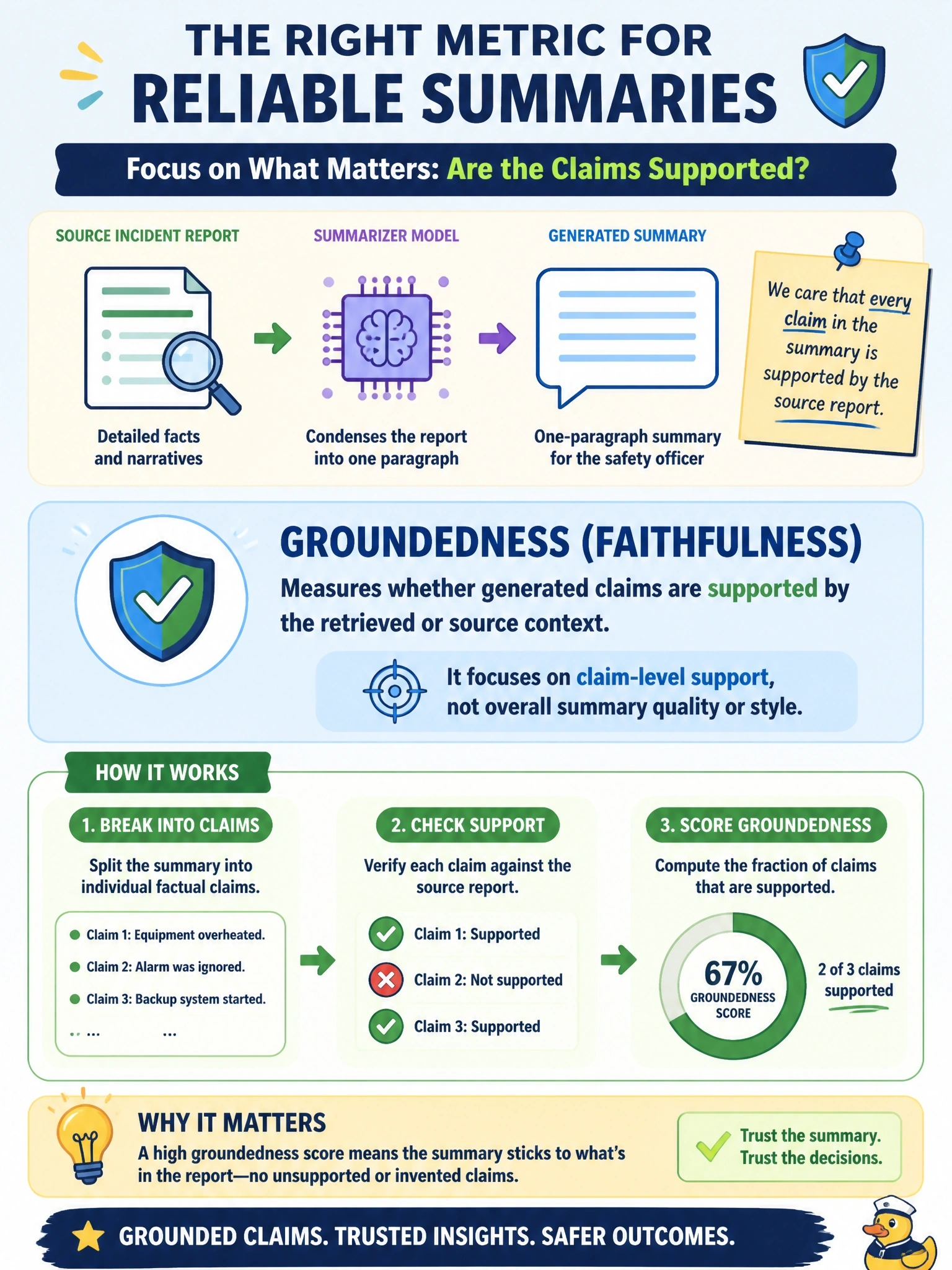
Groundedness is the exam-graded, show-your-work version of correctness: it does not just ask whether the summary sounds right, it checks every claim against the source document and flags the ones the model made up. That is different from asking whether the summary reads well or covers the highlights, which is what most other metrics measure instead.
Full Explanation
Groundedness (also called faithfulness) is defined precisely as claim-level support: for each assertion in the generated output, does the source or retrieved context actually contain evidence for it? That is exactly what the team is describing, and it is the standard metric family for catching hallucinated or unsupported statements in a summary. ROUGE overlap measures lexical overlap between the generated summary and a human reference summary, which captures whether the summary covers similar content and phrasing, but two summaries can overlap heavily in wording while one still invents a detail the other did not, so ROUGE does not verify claim-level support. Latency is an operational metric about response time and has nothing to do with output correctness. Embedding cosine similarity between the summary and the whole source document is the closest-looking trap: it produces a single similarity score for two blocks of text, but that document-level score can stay high even when one specific claim in the summary is fabricated, because the rest of the summary still resembles the source. Groundedness evaluation typically works at the sentence or claim level for exactly that reason, often using an LLM-as-judge to check each claim individually against the retrieved context.