
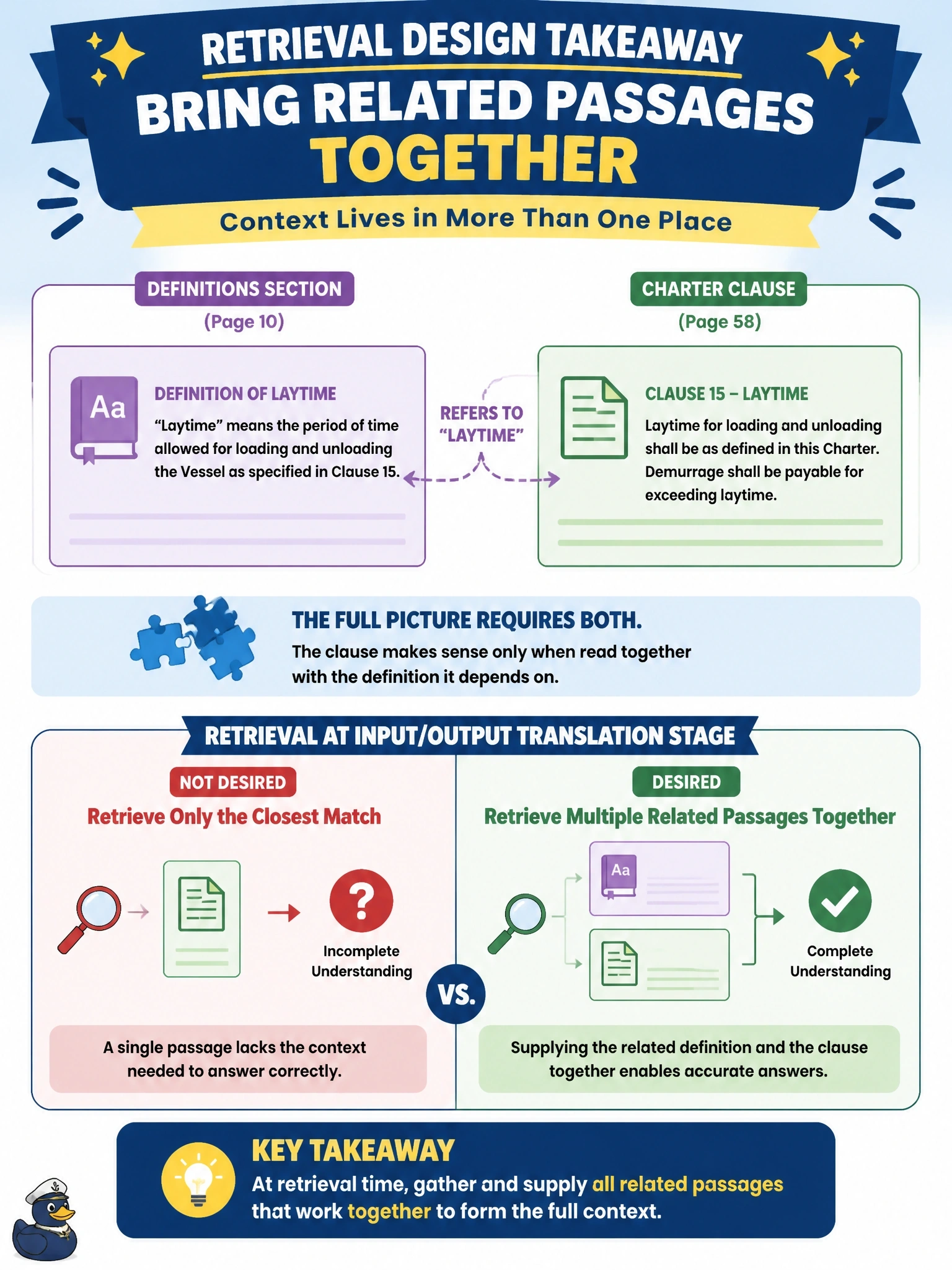
A charter clause references a defined term ('Laytime') whose meaning depends on an earlier definitions section of the same contract, dozens of pages before the clause in question. The assistant, when asked about laytime obligations in this clause, needs both passages to answer correctly. What does this imply for retrieval design at the input/output translation stage?
Select an answer to reveal the explanation.
Short Explanation
One chunk isn't enough when the clause literally can't be understood without a term defined dozens of pages earlier - the pipeline needs to be designed to pull both the clause and its definition together, not just whichever single passage scores highest on similarity.
Full Explanation
The correct implication is that the desired output (a correct laytime answer) requires multiple related passages retrieved and supplied together - the clause itself and its governing definition - because a single closest-matching chunk cannot on its own contain both pieces of information the answer depends on. Assuming a single top-1 nearest-neighbor result is sufficient ignores the described dependency entirely; the clause text alone, without the definition, is insufficient for the model to answer correctly about what laytime actually means in context. Rewriting the contract to eliminate cross-references is not a realistic option - charterparty contracts are external legal documents Meridian does not control the structure of, and 'fix the source documents so retrieval is easier' is not an available lever in this framing. Telling the model to ignore unfamiliar defined terms would produce an incomplete or wrong answer whenever a term it needs is one it doesn't recognize, which directly undermines correctness rather than addressing the retrieval gap. Translating a business requirement ('answer laytime questions correctly') into the actual inputs a chain needs sometimes means recognizing that more than one retrieved passage is required, not just tuning how many chunks are retrieved from a single relevance ranking.