
Meridian's engineer is deciding what a customs-lookup tool should return to the calling agent: the raw, full-text government tariff webpage, or a small structured object with just the fields the agent's next reasoning step needs (code, rate, effective date). Which choice better supports reliable multi-stage reasoning?
Select an answer to reveal the explanation.
Short Explanation
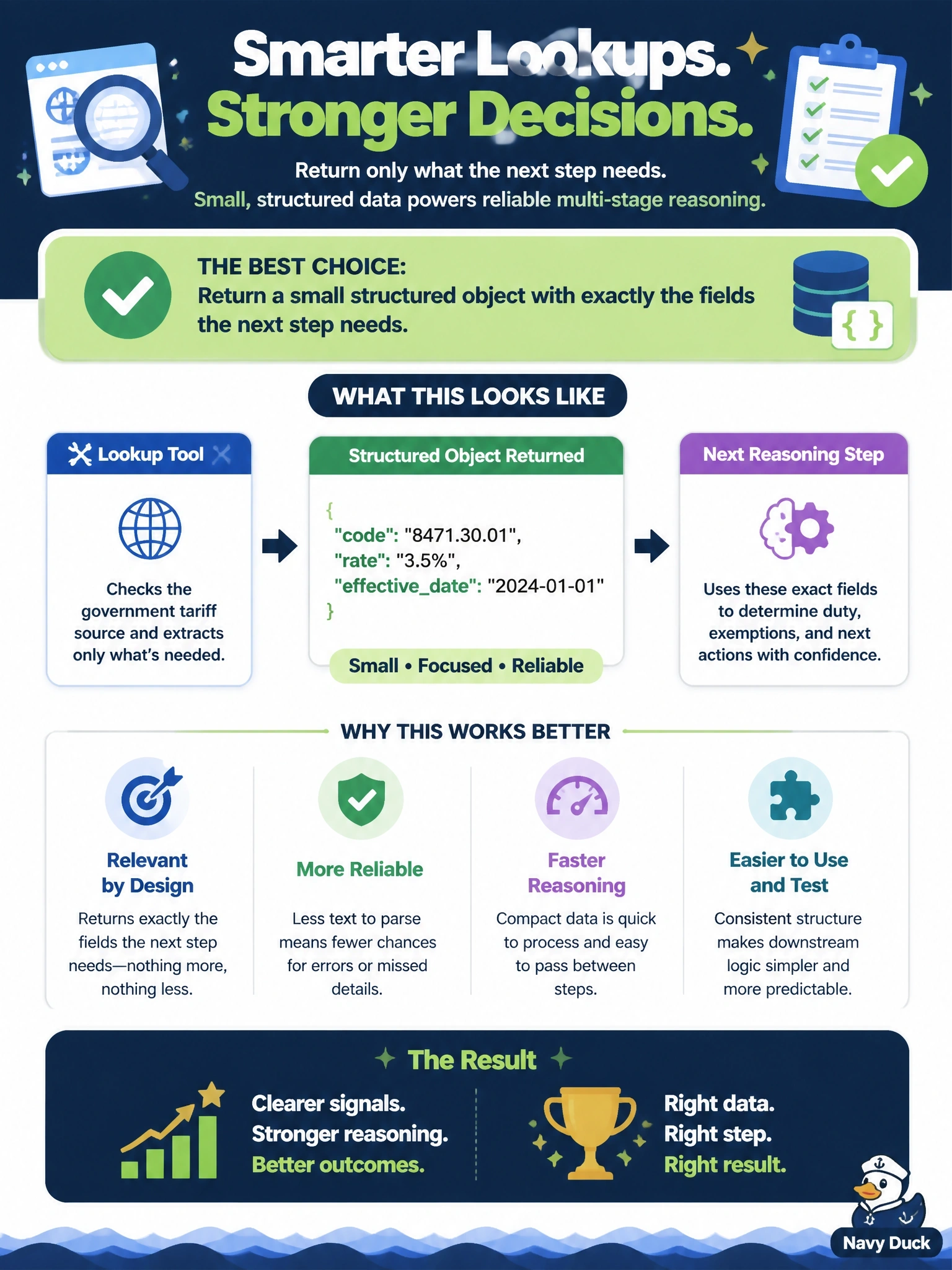
Hand the next step exactly the three facts it actually needs, not a whole webpage it now has to re-read and re-parse - a clean, small object is easier for the next tool or prompt in the chain to consume correctly, the same way a good API returns a tidy response instead of a full HTML page.
Full Explanation
A small structured object containing exactly the fields the next reasoning step requires (code, rate, effective date) is the better tool design because it produces a clean, directly consumable input for the following stage of the chain, minimizing the chance that the next step has to re-parse or misinterpret irrelevant surrounding content. Returning the raw full-text webpage is the wrong choice despite sounding more thorough - it forces the next step (whether another tool or the LLM itself) to extract the same three facts again from unstructured HTML/text, adding cost, latency, and a fresh opportunity for extraction errors that the tool could have prevented by returning clean data itself. Returning nothing and relying on the model's memory defeats the entire purpose of building a tool in the first place - tariff rates and effective dates are exactly the kind of authoritative, frequently-changing facts that must come from a live lookup, not from the model's static training data, which is why the tool exists at all. A screenshot image adds no reasoning value here and actually makes the next step's job harder, since extracting three specific fields from an image requires additional vision-based parsing rather than simply reading structured fields that were already provided. This item tests tool output design as part of 'defining tools for multi-stage reasoning' - the tool's return shape should be optimized for what the next step consumes, not for maximum raw information volume.