
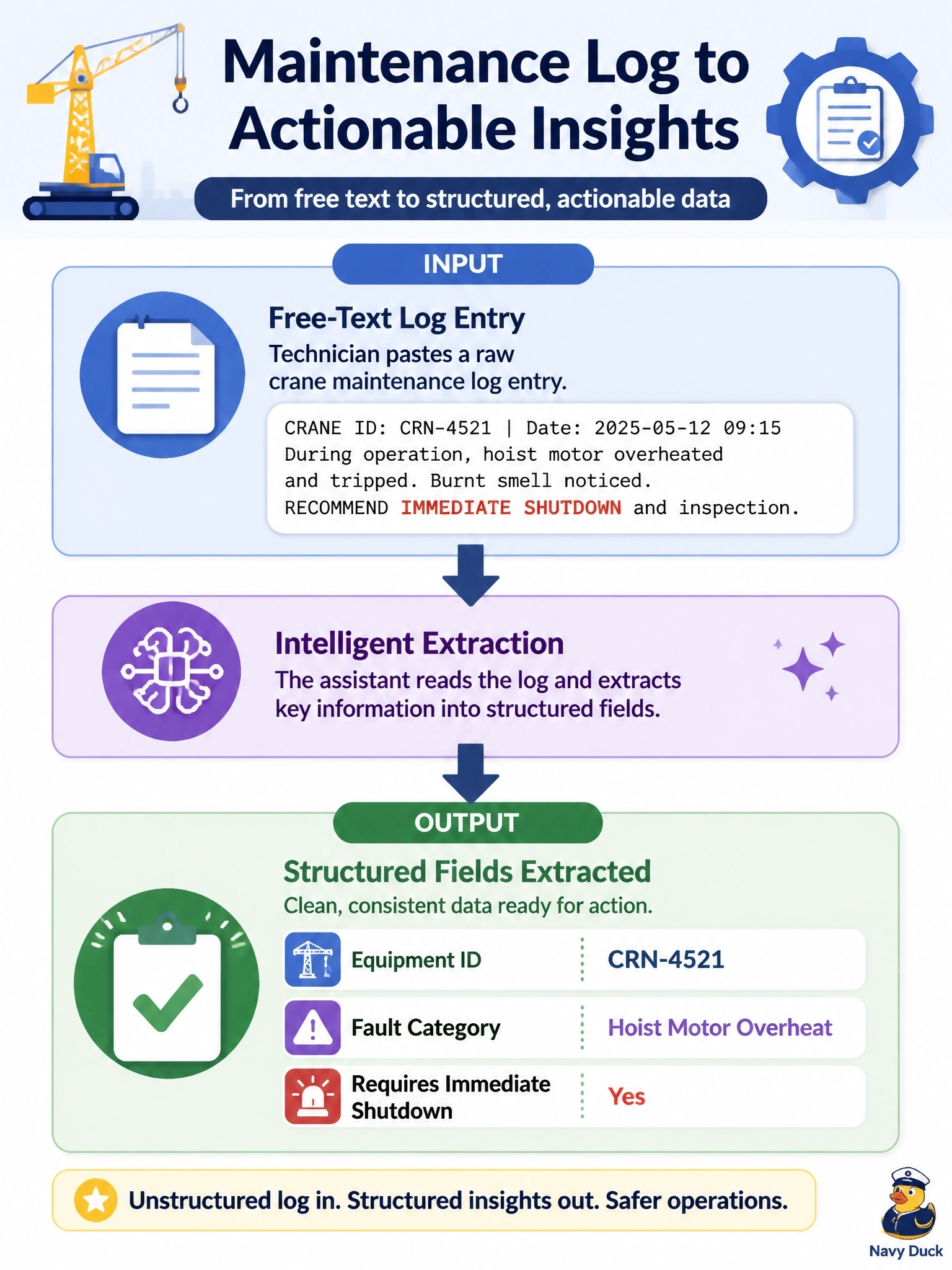
Meridian's maintenance-triage lead says: 'A technician pastes in a raw crane maintenance log entry, and the assistant should return the equipment ID, the fault category, and whether the fault requires an immediate shutdown.' Which description of desired pipeline inputs and outputs matches this ask?
Select an answer to reveal the explanation.
Short Explanation
You’re looking at one messy note going in and three clean facts coming out—not a search or a history dump. That’s extraction: a free-text log entry in, structured fields out.
Full Explanation
The matching pipeline takes a free-text log entry as input and returns structured fields for equipment ID, fault category, and shutdown flag. That fits the lead’s description: a technician pastes in one raw entry, and the assistant pulls specific facts from it. A natural-language maintenance question followed by ranked manual passages is retrieval; it returns possible causes and repairs, not the requested fields extracted from the entry. An equipment ID followed by the full unsummarized history is a lookup or reporting task, not triage of one incoming log. A fault category followed by a generated example entry is content generation, not analysis of a real technician’s note. On an exam, distinguish extraction from retrieval, lookup, and generation by identifying the input artifact and the expected output, rather than focusing only on the maintenance topic. One caveat: the shutdown flag must be determined from the entry according to the task’s criteria; if the criteria are not specified, the system may need a defined rule or label policy. As a practical check, ask whether the user supplies a raw log and expects particular fields back; if so, the described pipeline is structured extraction.