
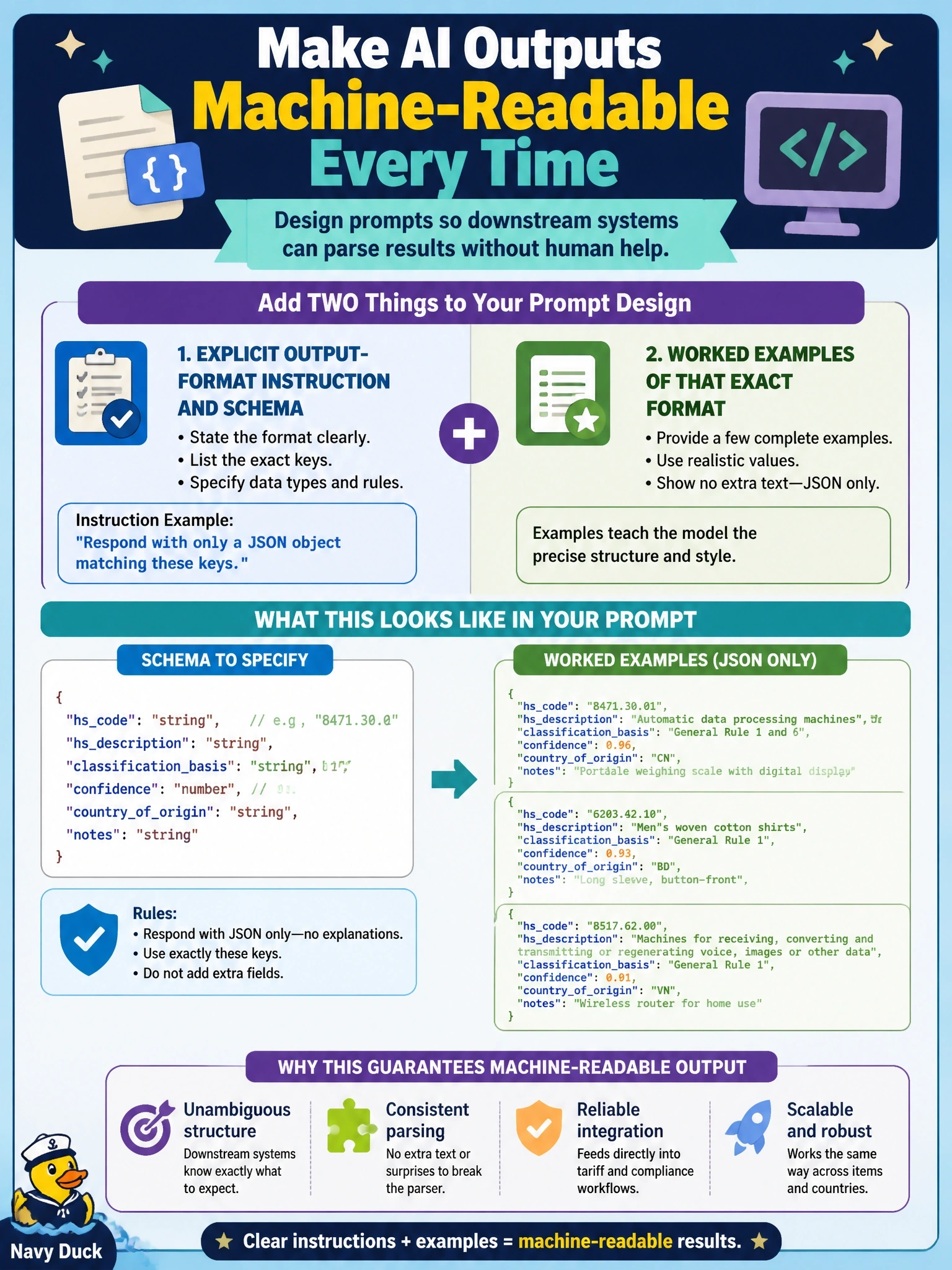
A customs-compliance agent at Meridian must return its HS-code classification result as machine-readable output that a downstream tariff-calculation service can parse without a human reading it first. What should the engineer add to the prompt design to guarantee this?
Select an answer to reveal the explanation.
Short Explanation
If a machine has to read the output, you can't just ask nicely for 'precise' - you hand the model the exact shape you want and show it a couple of filled-in examples, the same way you'd hand a new hire a template instead of describing one in prose.
Full Explanation
A schema-plus-few-shot instruction is the reliable way to force a specifically formatted response because it gives the model both a rule (these keys, this structure, nothing else) and worked examples that disambiguate edge cases a rule alone won't cover. 'Be precise and professional' is a vague stylistic instruction that does nothing to constrain structure, so downstream parsing would still break the moment the model varies its wording. Raising temperature makes output less deterministic and more varied, the opposite of what a strict-format requirement needs; sampling should be lowered, not raised, when consistency matters. Dumping the entire tariff schedule into context is a data-volume move, not a formatting move, and it does not on its own make the output any easier to parse; it just adds tokens and cost while the format problem remains unsolved. The exam distinction is between controlling what the model knows and controlling how the model must respond; only the schema-and-examples approach addresses the latter, which is exactly what this downstream-parsing requirement demands.