
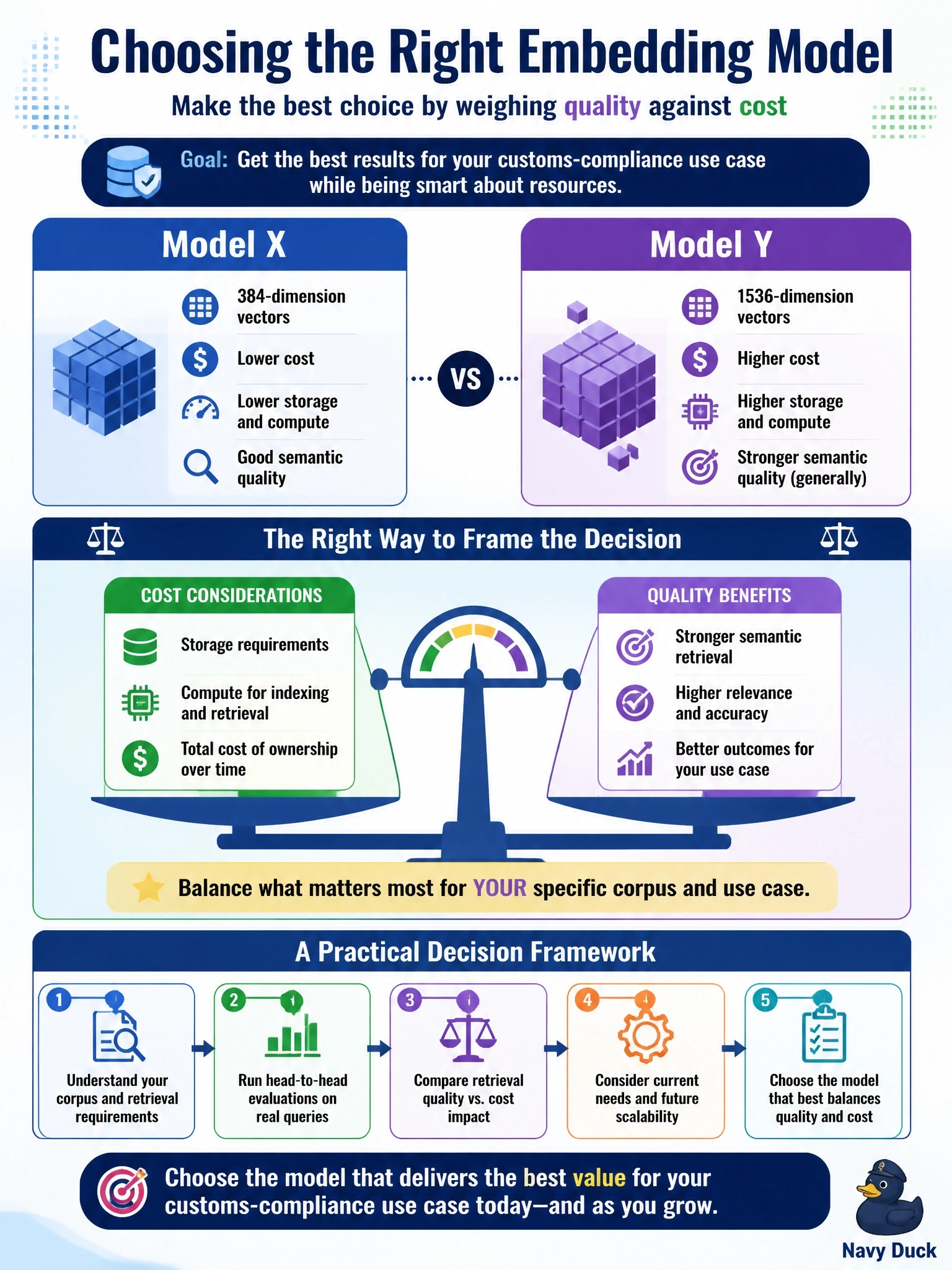
A data engineer is choosing between two embedding models for the customs-compliance corpus: Model X produces 384-dimension vectors at lower cost, Model Y produces 1536-dimension vectors at higher cost and generally stronger semantic quality. What is the correct way to frame this decision?
Select an answer to reveal the explanation.
Short Explanation
This is a real trade-off, not a free lunch - more dimensions generally means better semantic quality but also more storage and compute cost, so the right call depends on how much retrieval precision this particular corpus actually needs, not a blanket rule.
Full Explanation
Weighing Model Y's stronger quality against its higher storage and compute cost for this specific corpus is correct because embedding-model selection is explicitly a cost/quality trade-off, and the right choice depends on how much retrieval precision the use case actually demands versus what cost and storage overhead the larger vectors introduce - a customs-compliance corpus that needs to distinguish subtly different HS-code language might justify the higher-quality model, while a less precision-sensitive corpus might not. Always choosing Model Y is wrong because it treats dimensionality as a guarantee of better outcomes rather than a trade-off - higher dimensional vectors cost more to store and to search, and if the retrieval task does not need that extra precision, the added cost buys nothing. Always choosing Model X is wrong for the mirror-image reason: treating cost as the only criterion ignores that retrieval quality is also part of the business requirement, and a model that is too weak for the corpus's needs can produce wrong or missed answers regardless of how cheap it is. Claiming dimension count has no effect on storage or quality is factually wrong - vector dimensionality directly determines per-vector storage size and is generally correlated with a model's representational capacity, so this option denies a real and exam-relevant relationship. The exam-relevant skill is stating embedding choice as an explicit trade-off evaluated against the specific corpus, not a fixed rule in either direction.