
Meridian's port-operations copilot corpus contains a circular that has been re-issued four times over two years with only the effective date and one paragraph changed each time; the rest of the notice is boilerplate carried forward unchanged. What is the recommended data-preparation step?
Select an answer to reveal the explanation.
Short Explanation
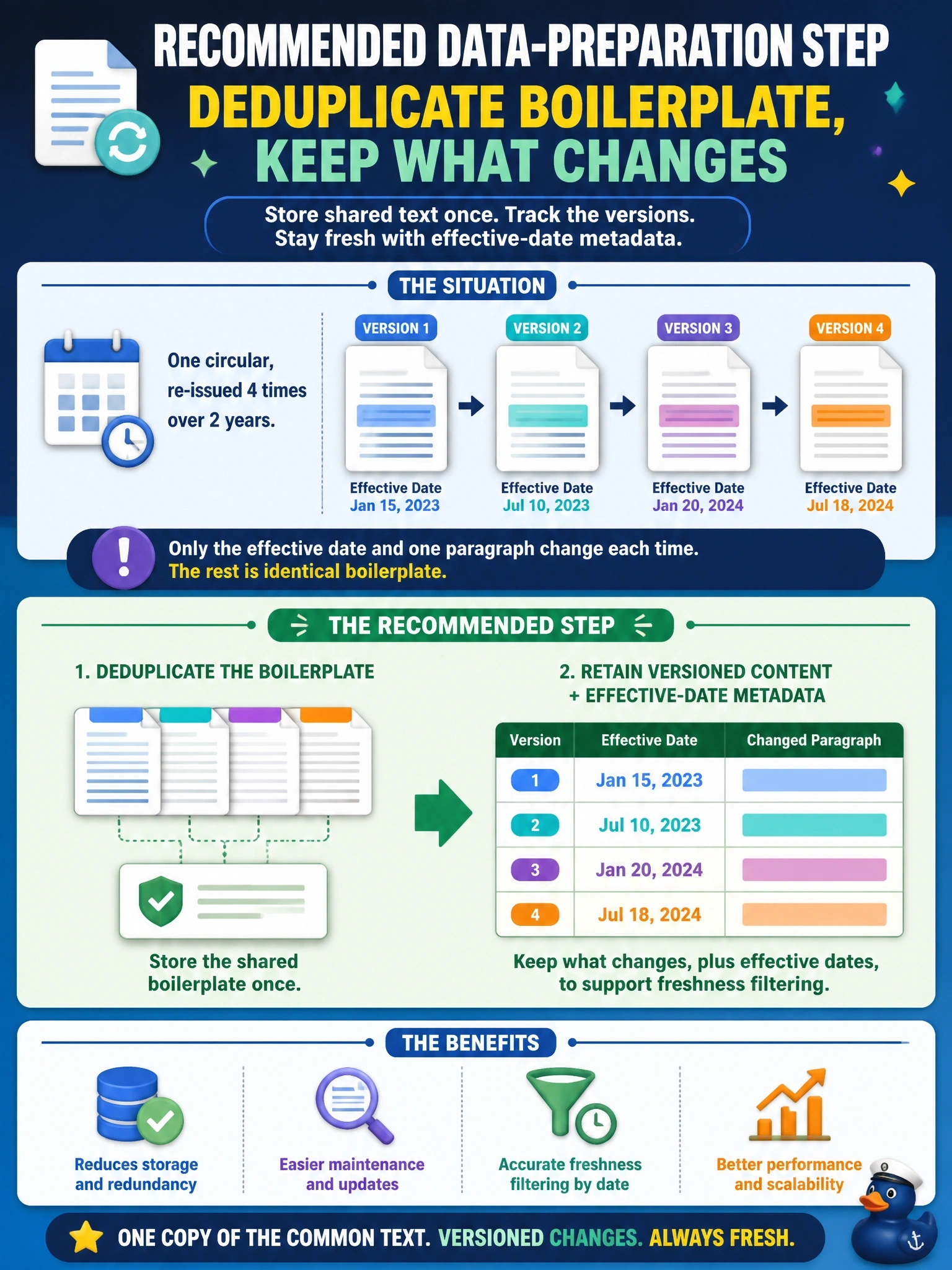
Four re-issues of basically the same notice is a data-hygiene problem, not four different notices - strip out the boilerplate that's identical every time, keep the part that actually changed, and tag each with its effective date so the assistant can tell 'current' from 'superseded' at query time.
Full Explanation
Deduplicating the shared boilerplate while retaining the versioned content and effective-date metadata is correct because it addresses both problems at once: it prevents four largely-identical vectors from crowding the index the way repeated boilerplate does elsewhere in this corpus, and it preserves the effective-date field needed to filter for the currently valid version at query time - port circulars are explicitly a freshness-sensitive, superseding document type. Indexing all four versions unchanged is wrong because it reproduces the near-duplicate-vector problem and gives the retriever no reliable way to distinguish the current notice from an outdated one unless date metadata is attached, which this option does not address. Keeping only the first issued version and discarding the rest is wrong because it throws away the current, operative content - later versions specifically exist because something changed, and dropping them means the assistant would answer with stale information. Merging all four into a single chunk covering the full history is wrong because it re-introduces the low-precision problem of an oversized chunk that blends multiple time periods and changed paragraphs into one embedding, making it hard for retrieval to isolate the specific version relevant to a given query. The exam-relevant pattern is combining deduplication with metadata-based freshness filtering for documents that supersede one another over time.