
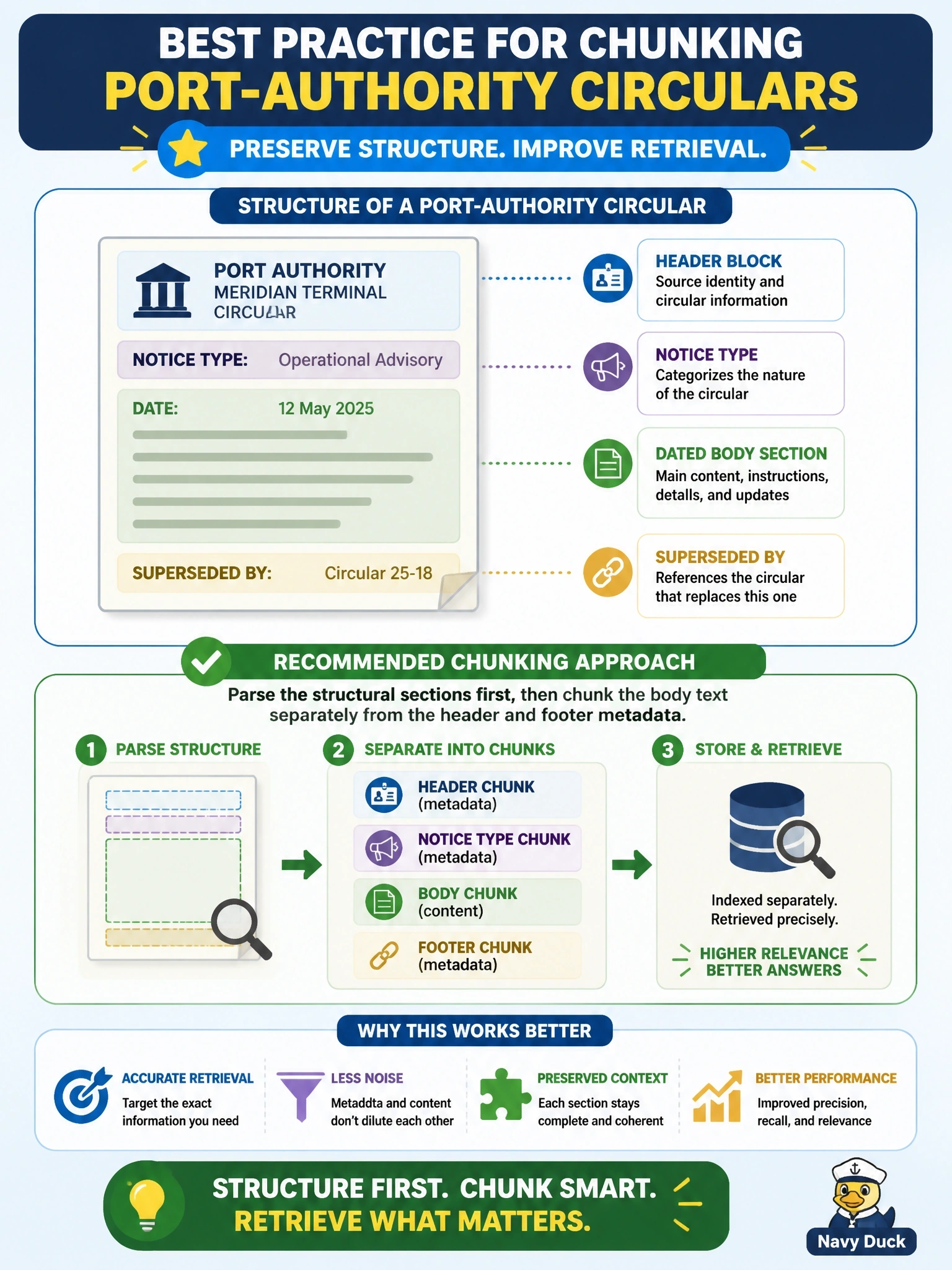
Port-authority circulars at Meridian's terminal follow a consistent structure: a header block, a 'Notice Type' field, a dated body section, and a 'Superseded By' footer. Which chunking approach best preserves retrieval quality for this source?
Select an answer to reveal the explanation.
Short Explanation
These circulars practically hand you the chunk boundaries already - header, notice type, dated body, superseded-by footer - so parse those fields out as structured metadata and chunk the actual notice text on its own, instead of blending a date stamp and a footer into the same vector as the substance.
Full Explanation
Parsing the structural sections and chunking the body separately from the header/footer metadata is correct because these circulars carry explicit, repeating structural markers, and the right move with structured text is to extract fields like notice type and date as metadata columns while chunking only the substantive body for embedding - this keeps the embedded text focused on meaning rather than boilerplate labels. Splitting purely on a fixed token count is wrong because it ignores the structure entirely, frequently mixing a header fragment, a date stamp, and body text into the same chunk, which dilutes the semantic signal the embedding is supposed to capture. Concatenating every circular from a calendar year into one chunk is wrong because it destroys per-notice retrievability - a query about one specific circular would have to compete against an entire year of unrelated notices bundled into a single vector. Chunking by counting words backward from the end of the document is an arbitrary, structure-blind rule with no relationship to where meaning actually breaks, and it does not respect section boundaries any better than counting forward would. This item tests recognizing when a source format's own structure should drive both metadata extraction and chunk boundaries.