
Before Meridian Line can create a Delta Sync index over its port_circulars table, an engineer needs to stand up the compute that will serve vector search queries. Which object provides that compute, separate from the index itself?
Select an answer to reveal the explanation.
Short Explanation
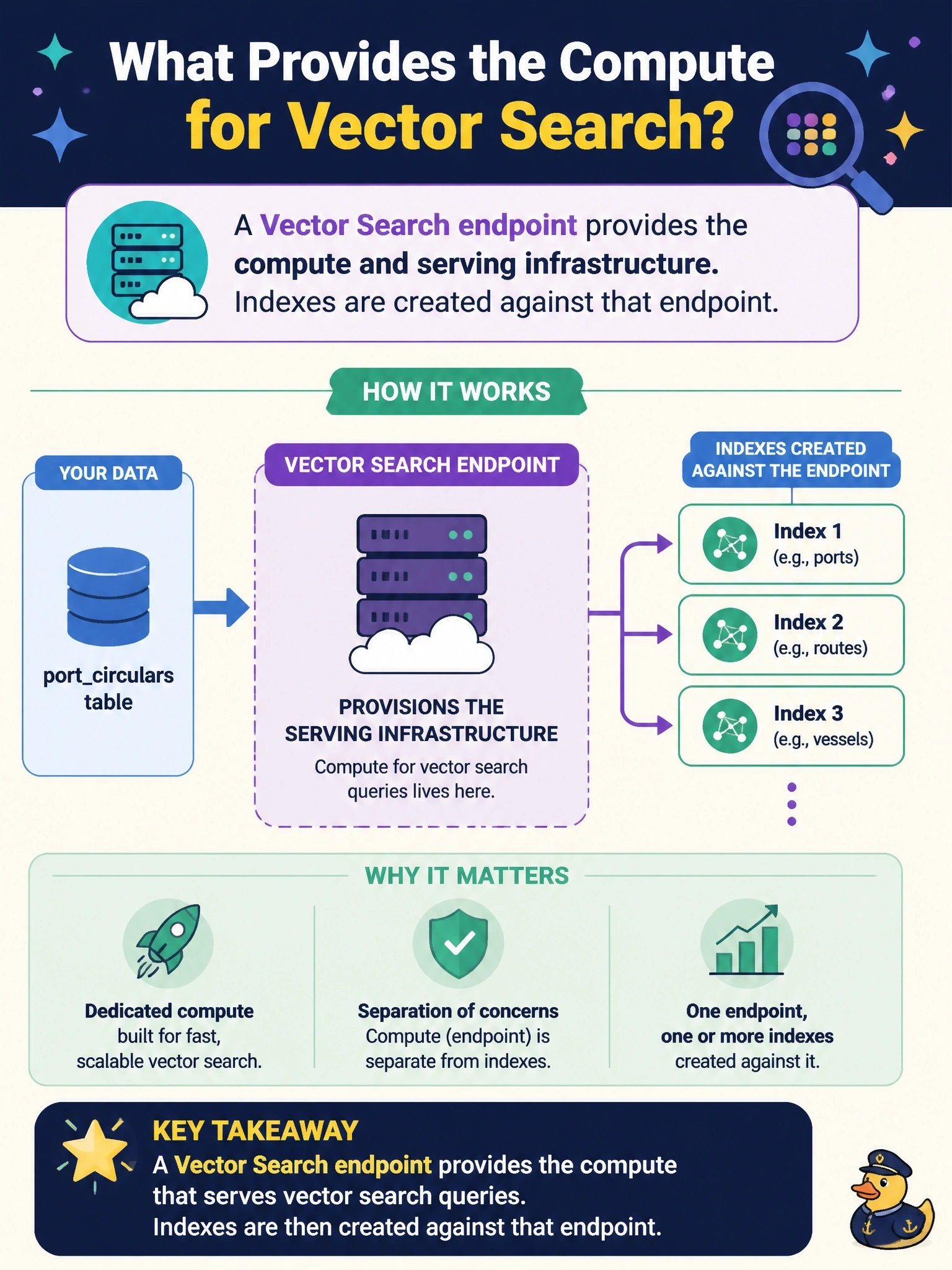
The index is the filing cabinet; the Vector Search endpoint is the office building it sits in. You stand up the endpoint first, as the compute layer, and then create one or more indexes against it — you can't file anything before the building exists.
Full Explanation
A Vector Search endpoint is the compute resource that serves similarity-search queries; it is created independently of any particular index, and one or more indexes (Delta Sync or Direct Vector Access) are then created against that endpoint to actually hold and query vectors. This separation of endpoint (compute) from index (data) mirrors how Model Serving separates an endpoint from the model version it serves. A Model Serving endpoint with an embedding-model flavor is a different service used to generate embeddings on demand or serve a chat/completion model — it does not provide the specialized similarity-search infrastructure a Vector Search index needs to run nearest-neighbor queries at scale. A Unity Catalog volume is unstructured file storage governed by UC; mounting one to a cluster gives file access, not vector-search serving compute. An MLflow experiment is a tracking construct for runs, parameters, and metrics during development; it has no relationship to provisioning query-serving infrastructure. For the exam, remember the two-step sequence: create a Vector Search endpoint first, then create the index (Delta Sync or Direct Vector Access) against that endpoint.