
The customs-compliance agent runs on a Foundation Model APIs model with a steady, high volume of requests during business hours, and the team already determined provisioned throughput is the right purchasing mode. When configuring the Model Serving endpoint, which setting most directly reflects that decision?
Select an answer to reveal the explanation.
Short Explanation
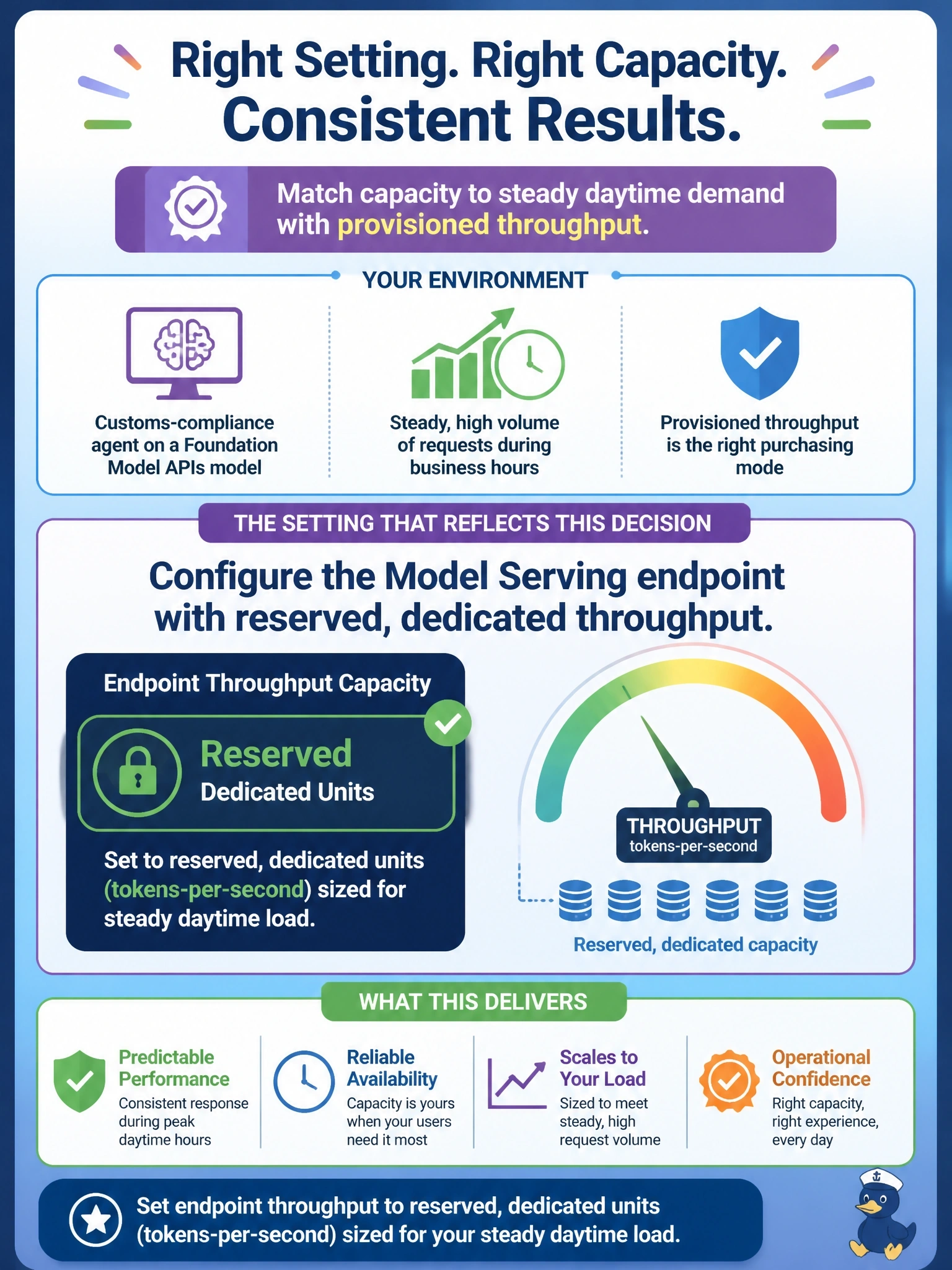
Think of provisioned throughput as a capacity dial: you reserve dedicated units, often measured in tokens per second, to match the steady daytime load you expect. Scale-to-zero, payload logging, and attaching a Vector Search index address different needs, not reserved serving capacity.
Full Explanation
Provisioned throughput is configured on the serving endpoint by specifying reserved capacity, typically expressed as throughput units tied to tokens per second, and sizing those units for the workload’s expected steady volume. That is the concrete step that implements the purchasing-mode decision. Scale-to-zero is a real Model Serving setting, but it suits intermittent or bursty workloads that benefit from shutting down while idle; for steady daytime traffic, enabling it works against consistent low latency rather than reflecting the provisioned-capacity choice. Detailed payload logging is a governance and observability setting, part of AI Gateway, for capturing requests and responses for audit or monitoring; it does not configure throughput capacity. Attaching a Vector Search index directly to the model-serving endpoint is not how the services are wired: application or agent logic queries Vector Search indexes, and Vector Search has its own separate endpoint. For the exam, distinguish these four choices by purpose: reserved throughput sets serving capacity, scale-to-zero controls idle shutdown, payload logging captures request and response data, and Vector Search provides retrieval through its separate endpoint. As a practical check, compare the reserved tokens-per-second capacity with the agent’s expected steady daytime demand.