
Meridian Line wants one system that can answer a mixed question like 'Which port circular governs hazardous cargo at Rotterdam, and does the current charter allow us to divert there under that restriction?' — a question that spans the port-operations knowledge base and the charter-clause knowledge base, each with its own retrieval index and specialized prompting. Which composition best fits this requirement?
Select an answer to reveal the explanation.
Short Explanation
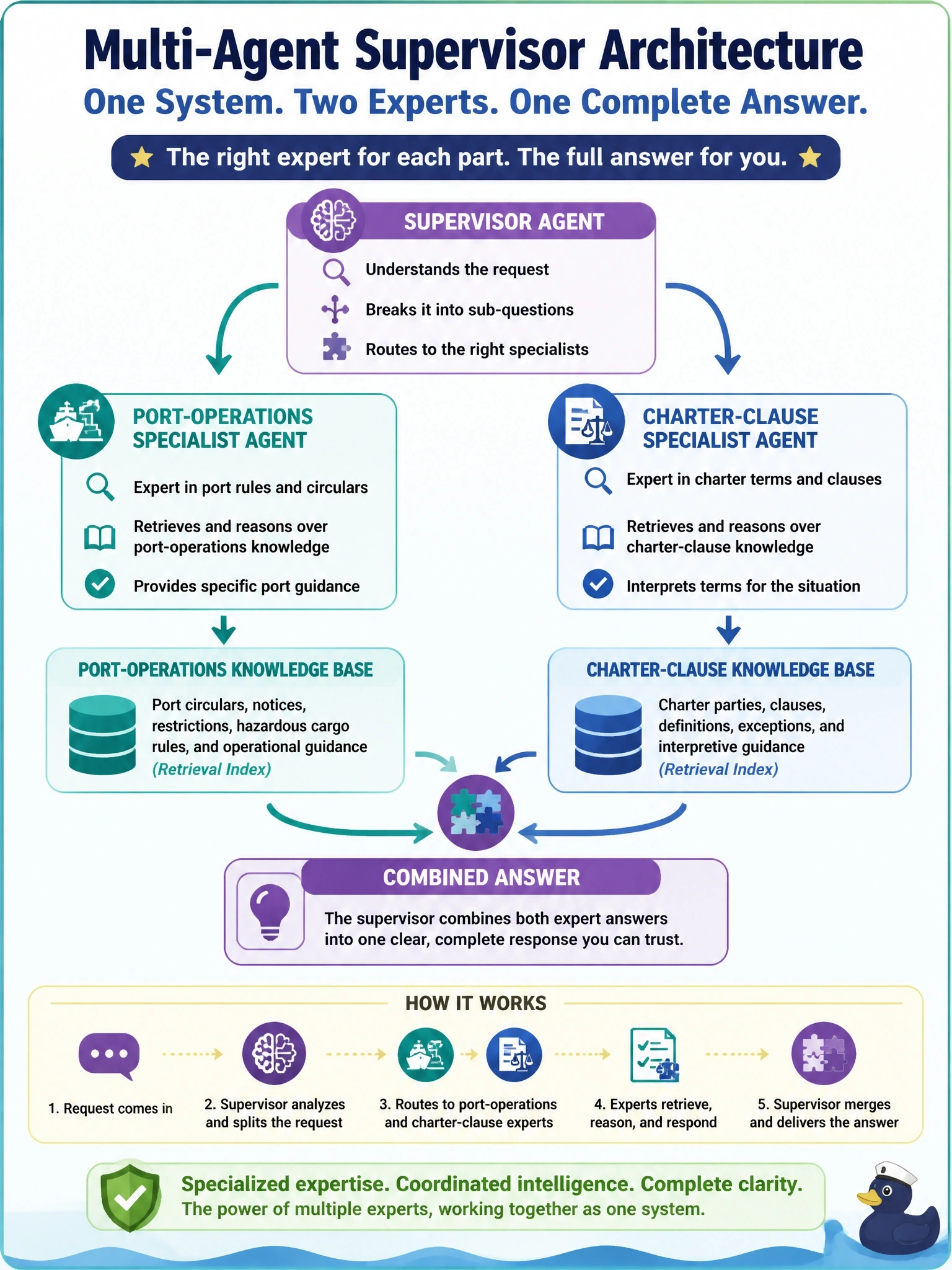
One generalist who's read two different rulebooks badly beats two specialists who never talk to each other, and it beats one giant merged rulebook too. A multi-agent supervisor is the specialist-plus-coordinator pattern: it hands the port question to the port expert, the charter question to the charter expert, and stitches the two answers into one.
Full Explanation
This question spans two distinct, differently-structured knowledge domains that already have their own specialized retrieval and prompting setups, which is the textbook case for a multi-agent supervisor: a coordinating agent decomposes the compound question, routes each part to the specialist agent best suited to it (one tuned for port circulars, one for charter clauses), and composes their outputs into a single coherent answer. That preserves each specialist's tuned retrieval and prompting rather than forcing a compromise. Concatenating both indexes' results into one prompt is the closest-looking trap — it can technically work for small cases, but it discards the benefit of specialized prompting per domain, bloats the context window unnecessarily, and gives the model no structured way to reason about which source supports which half of the answer. Two disconnected applications with manual copy-paste is not a composed system at all and fails the stated requirement that one system answer the mixed question. A single fine-tuned model replacing retrieval entirely abandons retrieval-augmented grounding altogether, losing citability and freshness, and conflates fine-tuning (which adapts model behavior) with the retrieval-plus-orchestration problem actually being asked about. For the exam, know that a multi-agent supervisor pattern is the answer for compound questions that cross specialist domains. Databricks offers this as Supervisor Agent (formerly Agent Bricks Multi-Agent Supervisor, now marked legacy for new systems), and you can also build the same pattern in code.