
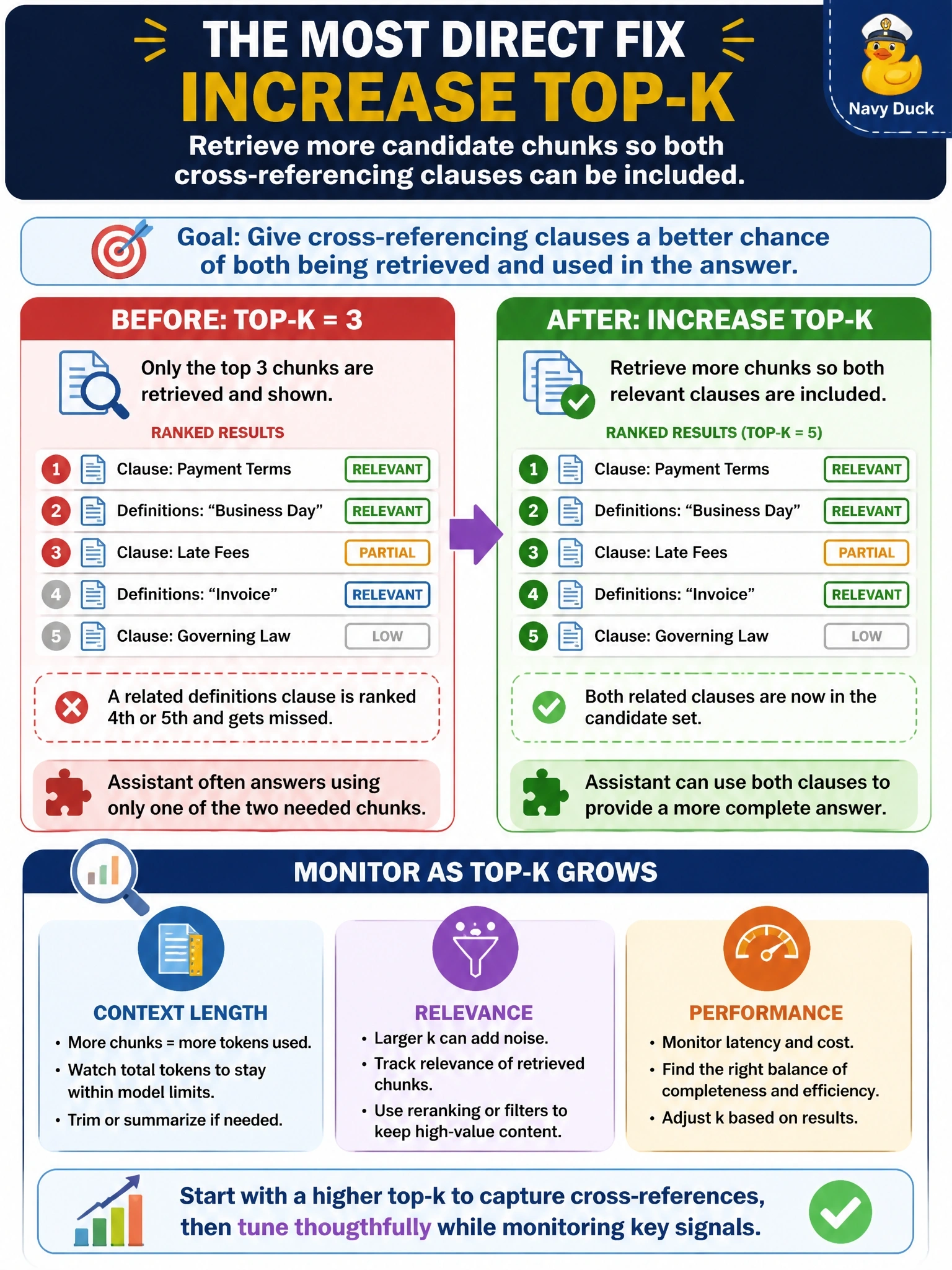
The charter-desk assistant retrieves the top 3 clause chunks per query, and evaluation shows that for questions spanning a clause and a related definitions-section clause elsewhere in the same contract, the assistant often answers using only one of the two relevant chunks because the second one ranked fourth or fifth. What is the most direct fix?
Select an answer to reveal the explanation.
Short Explanation
When your answer genuinely needs two chunks and the second keeps ranking fourth or fifth, increase top-k so you retrieve more candidates. You’ll want to monitor context length and relevance as you raise it.
Full Explanation
When an answer depends on both a clause and a related definition elsewhere in the contract, increasing top-k is the most direct fix: retrieving more candidates gives the chunk ranked fourth or fifth a better chance of being included alongside the top three. Decreasing top-k moves in the wrong direction, making it less likely that the missed cross-reference will be retrieved. Swapping in a newer embedding model while leaving retrieval settings unchanged is not the most direct response to the stated symptom; without evidence that embedding quality is the cause, the numeric cutoff is the targeted lever to adjust. Rewriting questions so they need only one clause does not solve the underlying problem: contracts can legitimately connect clauses and definitions, and avoiding those questions would reduce the assistant’s usefulness. The practical trade-off is that a larger top-k can increase context length and admit less relevant chunks, so monitor both as you raise it. Exam caveat: tuning retrieval parameters such as top-k in response to observed failure modes is core Section 3 retrieval-building work.