
A terminal planner asks the port-operations copilot for circulars about hazardous-cargo handling issued in the last 30 days at the port of Rotterdam. What retrieval approach best satisfies this query?
Select an answer to reveal the explanation.
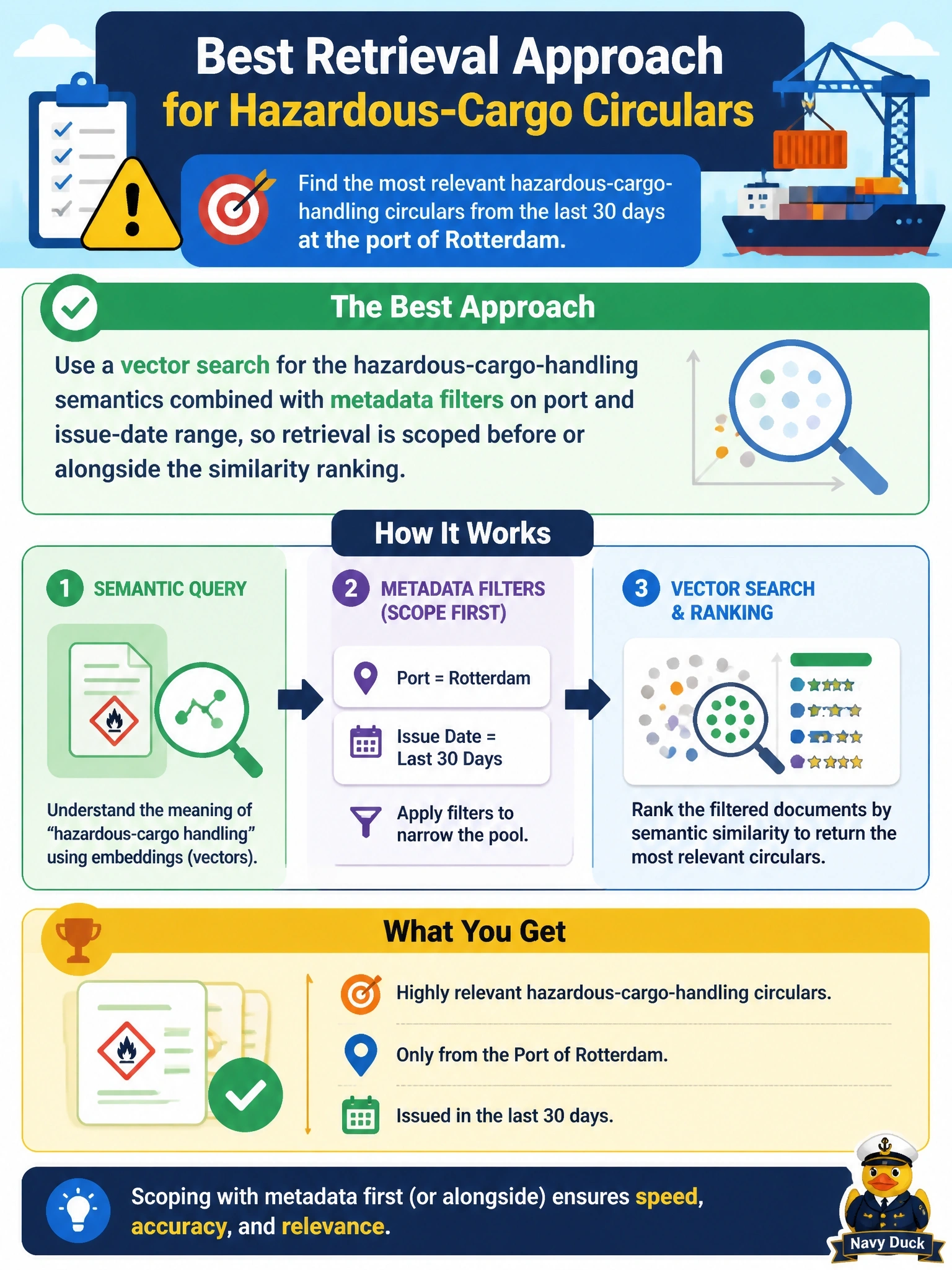
Short Explanation
'About hazardous cargo' is a job for semantic search; 'issued in Rotterdam in the last 30 days' is a job for a metadata filter, not for the embedding to somehow intuit. Combine both -- filter what you can filter exactly, and let vector search handle the fuzzy part.
Full Explanation
This query has two distinct components that call for two different retrieval mechanisms: the topical concept 'hazardous-cargo handling' is best matched by semantic vector similarity, while 'port of Rotterdam' and 'issued in the last 30 days' are exact, structured constraints that belong in metadata filters applied alongside or before the similarity search, which is precisely what Databricks Vector Search's metadata filtering capability is for -- combining the two gives both fuzzy topical relevance and hard scoping in one retrieval call. Relying on pure semantic search with no filters to somehow encode an exact date range and port name asks the embedding to do a job it is not designed for; dates and place names are not reliably captured by semantic similarity the way a discrete filter captures them precisely, and this was already the failure mode behind the Rotterdam-vs-Singapore mix-up seen elsewhere in this corpus. A literal keyword-only search for the exact phrase would miss circulars using different wording for the same hazardous-cargo concept (synonyms, different phrasing of the rule) even though they are exactly what the planner needs. Retrieving everything and asking the model to filter after the fact wastes context window on irrelevant circulars, risks exceeding context limits, and pushes filtering work onto the model instead of the retrieval layer where it can be done precisely and cheaply. Exam framing: building retrieval with metadata filtering is a named Section 3 objective, specifically because production queries usually combine a semantic component with structured constraints.