
Crew reports occasionally include hostile or abusive language directed at named crew members, and Meridian Line does not want that language echoed verbatim into a summary that gets circulated more widely. Where should this be addressed?
Select an answer to reveal the explanation.
Short Explanation
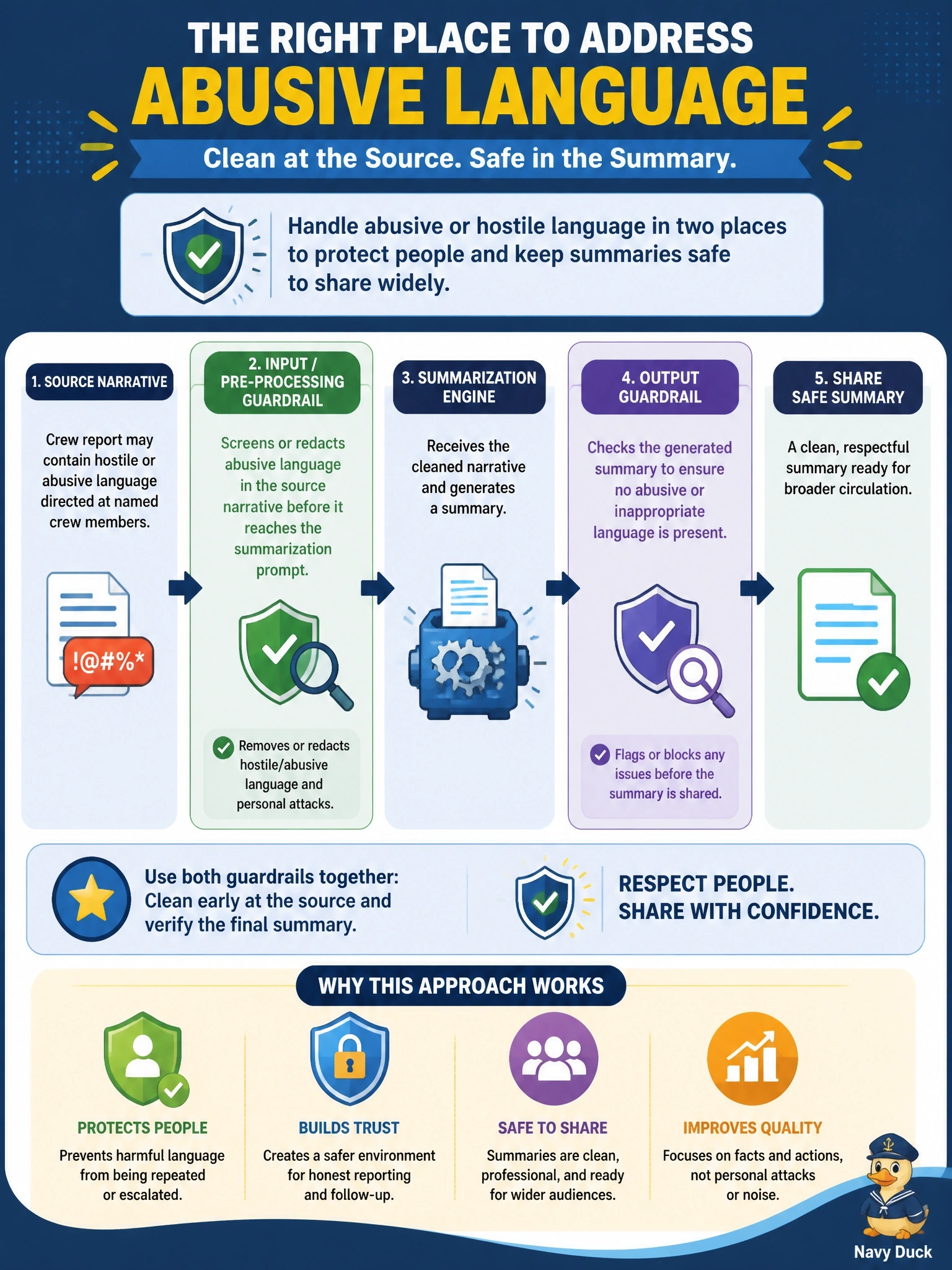
Screen it going in, and check it coming out -- that's a guardrail sandwich, not a single checkpoint. Relying on the model to self-censor language it's still reading raw is asking it to do a job the pipeline should be doing before the prompt even gets built.
Full Explanation
Guardrails apply on both sides of a generation call: an input guardrail can screen or redact hostile language in the source narrative before it is placed in the summarization prompt, reducing the chance it gets echoed, and an output guardrail independently checks the generated summary as a second layer, since neither check alone is airtight -- abusive phrasing might survive redaction and still leak through generation, or might be paraphrased into the output even after being softened on input. Relying solely on manual post-generation review does not scale and reintroduces exactly the workload automated guardrails exist to reduce, especially at any real volume of incident and crew reports. Putting a politeness instruction in the user message rather than the system prompt does not create a guardrail at all -- it is just an unenforced instruction, and its placement (user versus system) does not meaningfully change whether the model follows it or whether hostile source language gets echoed. Raising temperature increases randomness in phrasing; it has no targeted effect on whether abusive language from the source is filtered, and it can just as easily make output less predictable in unrelated ways. Exam framing: implementing guardrails on both input and output is stated explicitly and separately in the Section 3 objectives -- treating them as one combined step is the trap.