
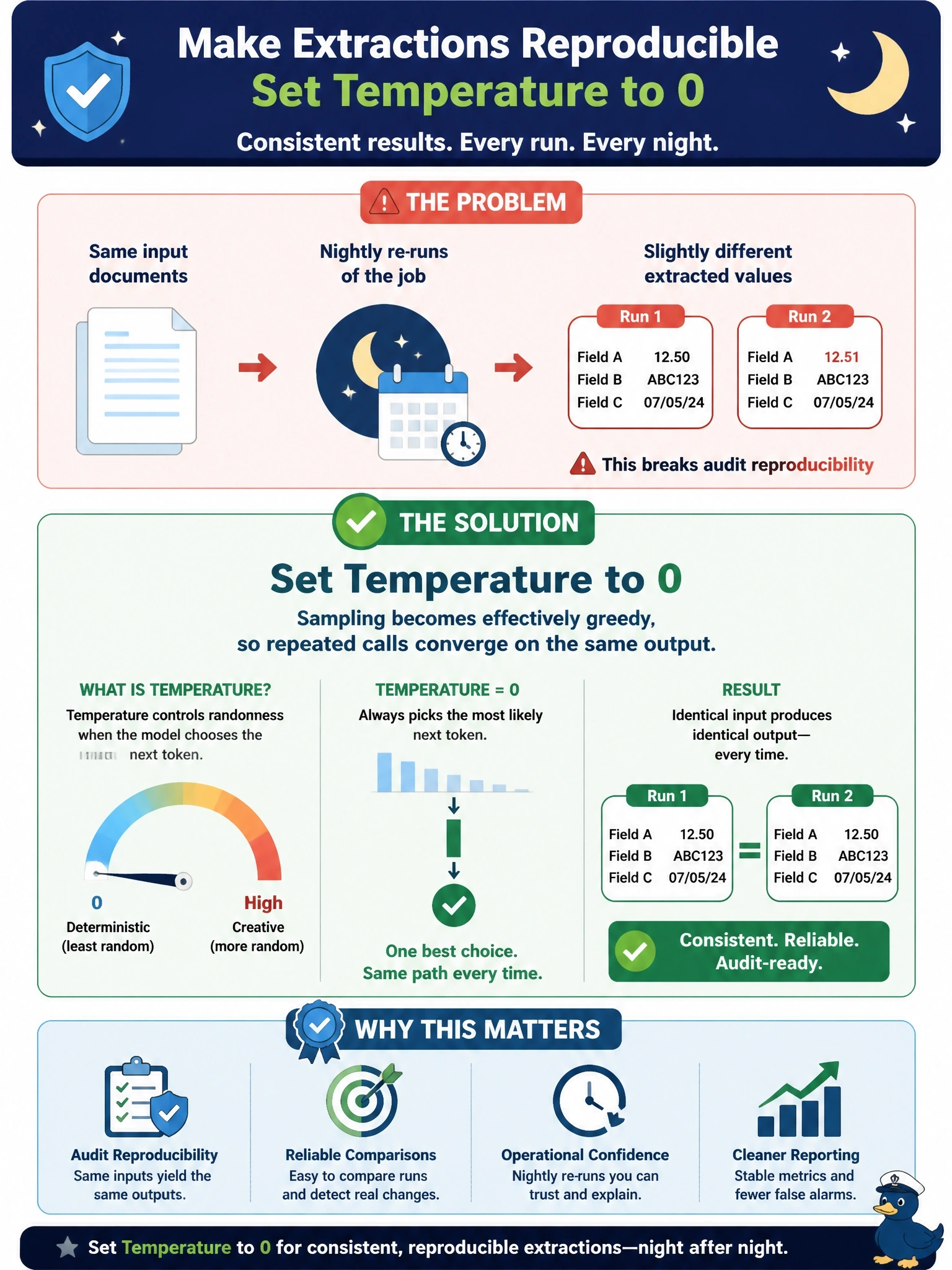
The customs-compliance extraction job at Meridian Line reruns nightly over the same declarations for audit reproducibility, and auditors have flagged that identical input documents sometimes yield slightly different extracted values between runs. Which model parameter setting most directly addresses this?
Select an answer to reveal the explanation.
Short Explanation
Temperature is the randomness dial. Turn it to zero and the model takes the most likely token every time, so the same document gives the same answer. For creative summaries you may want some warmth; for an audited extraction you want none.
Full Explanation
Temperature scales the sampling distribution over next tokens. At higher values lower-probability tokens become reachable and repeated calls diverge; at zero, sampling is effectively greedy and the model returns the highest-probability continuation each time, which is what an auditable extraction pipeline needs. Note the honest caveat the exam expects you to hold: temperature zero makes output near-deterministic rather than guaranteed identical, because model version changes, batching effects and floating-point non-determinism can still produce variation — reproducibility also depends on pinning the model version. The top_p distractor is the closest trap because it is a sampling parameter and sounds like it narrows choice, but the relationship is inverted: raising top_p toward 1.0 admits more of the distribution and increases variability, while lowering it restricts the candidate set. max_tokens caps response length and cannot influence which tokens are chosen within that budget. A stop sequence controls where generation halts, not what is generated before it. For the exam, associate low temperature with extraction, classification and structured output, and reserve higher temperature for tasks where variety is genuinely desirable.