
An engineer assembles the charter-desk prompt as ten retrieved clauses followed by the system instructions and finally the planner's question. Answers frequently ignore the required citation format even though the instructions state it clearly. What is the most likely cause?
Select an answer to reveal the explanation.
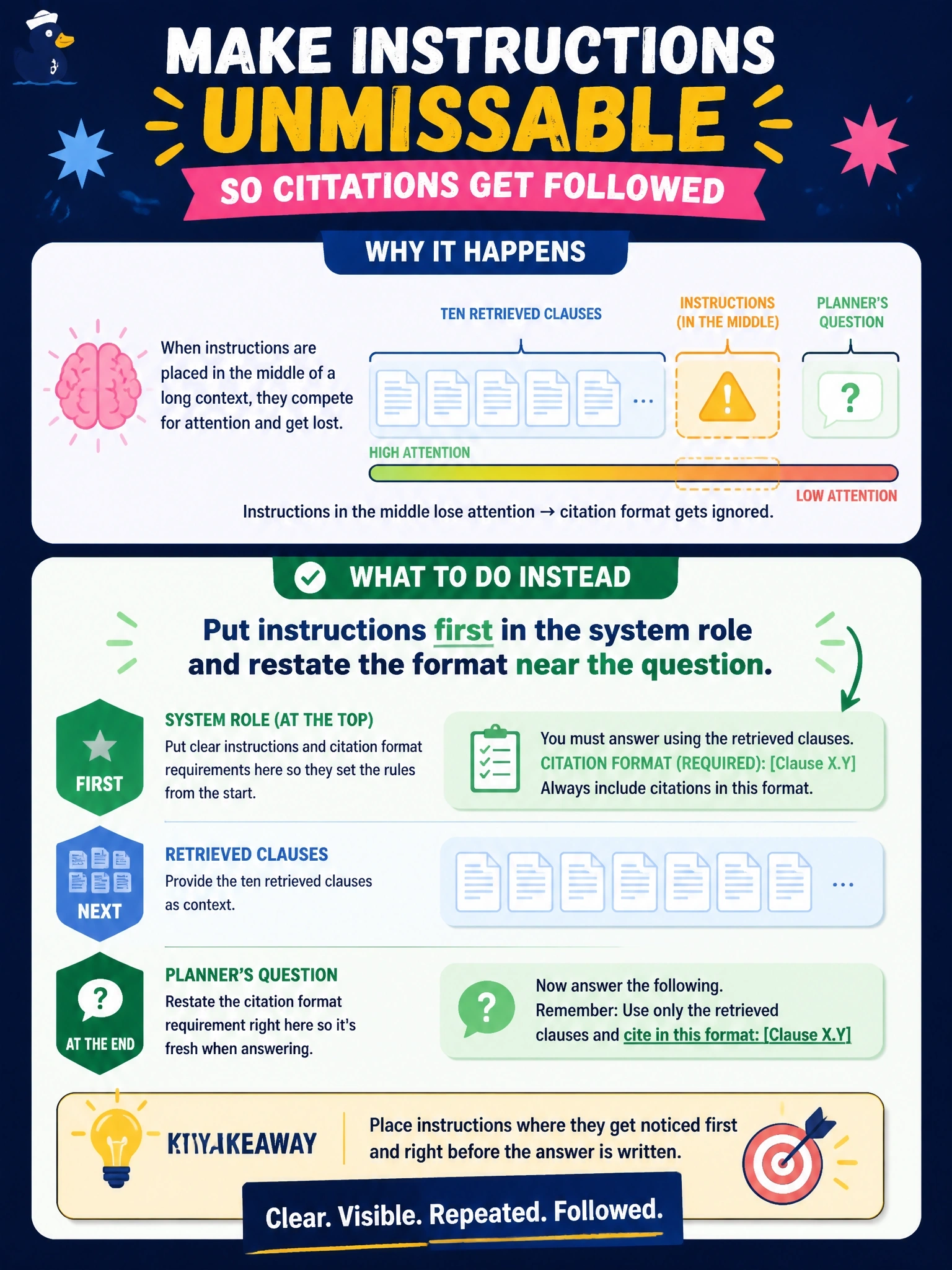
Short Explanation
Models pay the most attention at the start and the end of a long prompt and skim the middle. Instructions buried behind ten clauses get skimmed. Put the rules in the system message up top, and repeat the format line right before the question.
Full Explanation
Long-context attention is uneven — the well-documented 'lost in the middle' effect means content placed between large blocks is followed less reliably than content at the beginning or the end. Instructions buried after ten clauses sit exactly in that dead zone. The fix is structural: persistent behavioural rules belong in the system role where they anchor the whole conversation, and a short restatement of the output format immediately before the user question exploits the recency end of the same effect. This is a prompt-assembly decision, not a model capability limit. The claim that formatting requires fine-tuning is the closest trap because fine-tuning genuinely is one way to bake in a format, but it is a heavy answer to a prompt-ordering problem and would be the wrong recommendation at associate level when a reordering costs nothing. The embedding distractor confuses retrieval-time representation with prompt content — retrieved passages are inserted as text, and embeddings exist only to find them. The minimum-evidence claim is invented; the number of passages has no bearing on instruction-following except through context length. For the exam, remember the two prompt-structure levers that come up repeatedly: role placement (system versus user) and position within the assembled context.