
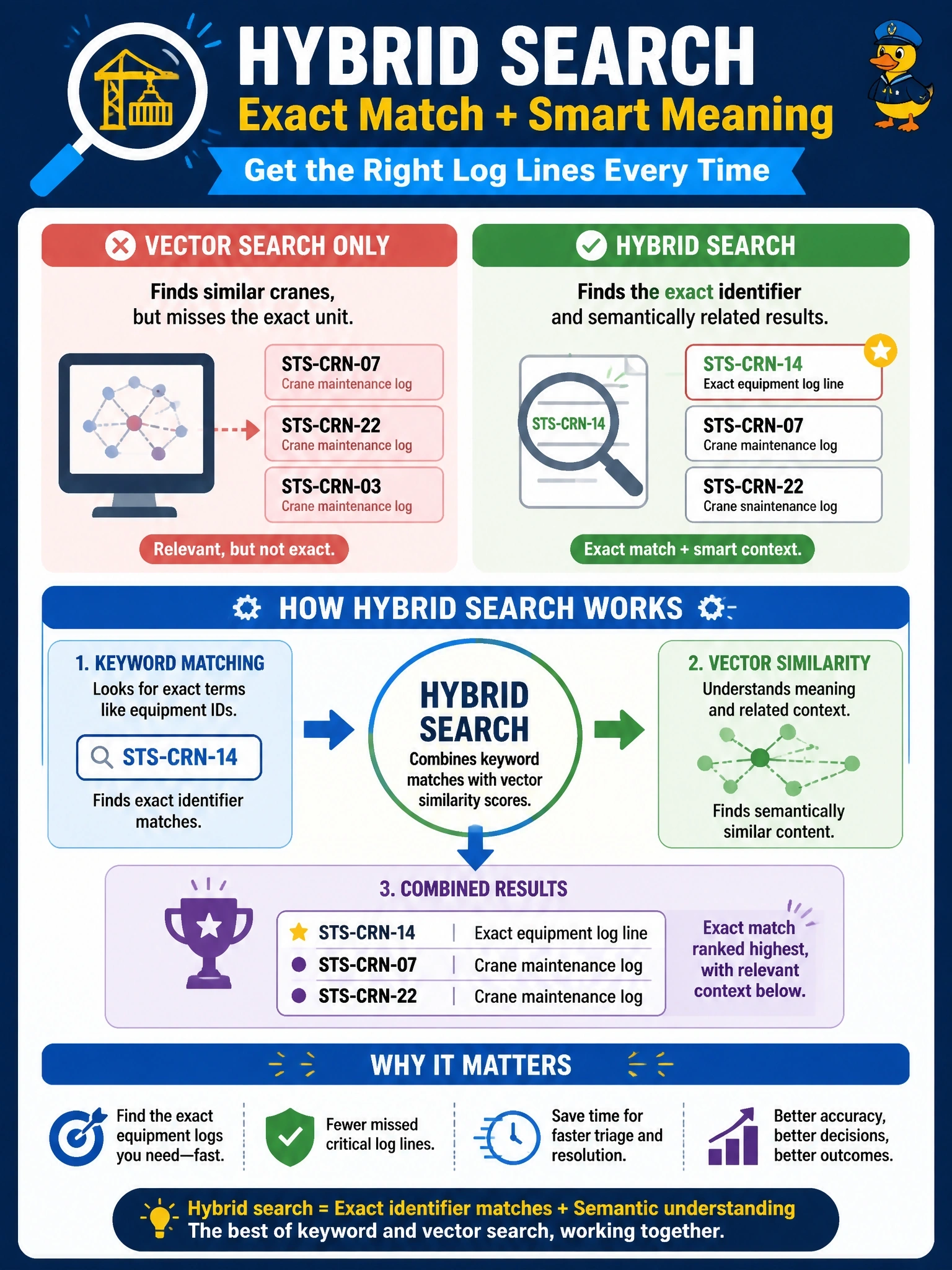
Maintenance-triage queries at Meridian Line usually name an exact equipment identifier such as 'STS-CRN-14', and pure vector retrieval often returns semantically similar entries about other cranes while missing the exact log lines for that unit. Which Vector Search capability addresses this most directly?
Select an answer to reveal the explanation.
Short Explanation
You’re right to focus on the equipment code: embeddings capture meaning better than the difference between similar serial numbers. Hybrid search adds keyword matching, so an exact identifier can count alongside semantic similarity; use it when your users search with codes.
Full Explanation
Dense embeddings compress text into a semantic space, and identifiers, part numbers, and HS codes are tokens that space handles poorly: they are rare, carry little distributional meaning, and near-identical codes can land near-identically. Hybrid search blends keyword (lexical) scoring with vector similarity, so a literal match on “STS-CRN-14” contributes to the ranking rather than being averaged away. That makes it the intended remedy for code-bearing queries. Increasing embedding dimension may sound plausible, but larger vectors do not make a model treat a serial number as a distinguishing literal; changing the model also requires a full re-index without addressing the core problem. Direct Vector Access and Delta Sync differ in how the index is populated, not how text is matched, so neither preserves identifiers in a way that fixes semantic retrieval. Raising the number of results may expose more entries, but it does not improve the exact match’s ranking and can push it further down the list. Exam caveat: hybrid search combines lexical and semantic signals; it does not guarantee that every exact match ranks first. Practical check: query with a known equipment identifier and confirm that the exact unit’s log lines rank above semantically similar logs for other cranes.