
Port authorities supersede their circulars, so Meridian Line's corpus contains several revisions of the same berth-allocation rule and the copilot sometimes cites a revoked one. Every chunk carries an effective_date and a superseded flag, both synced into the index. Which change most directly stops revoked guidance from reaching the model?
Select an answer to reveal the explanation.
Short Explanation
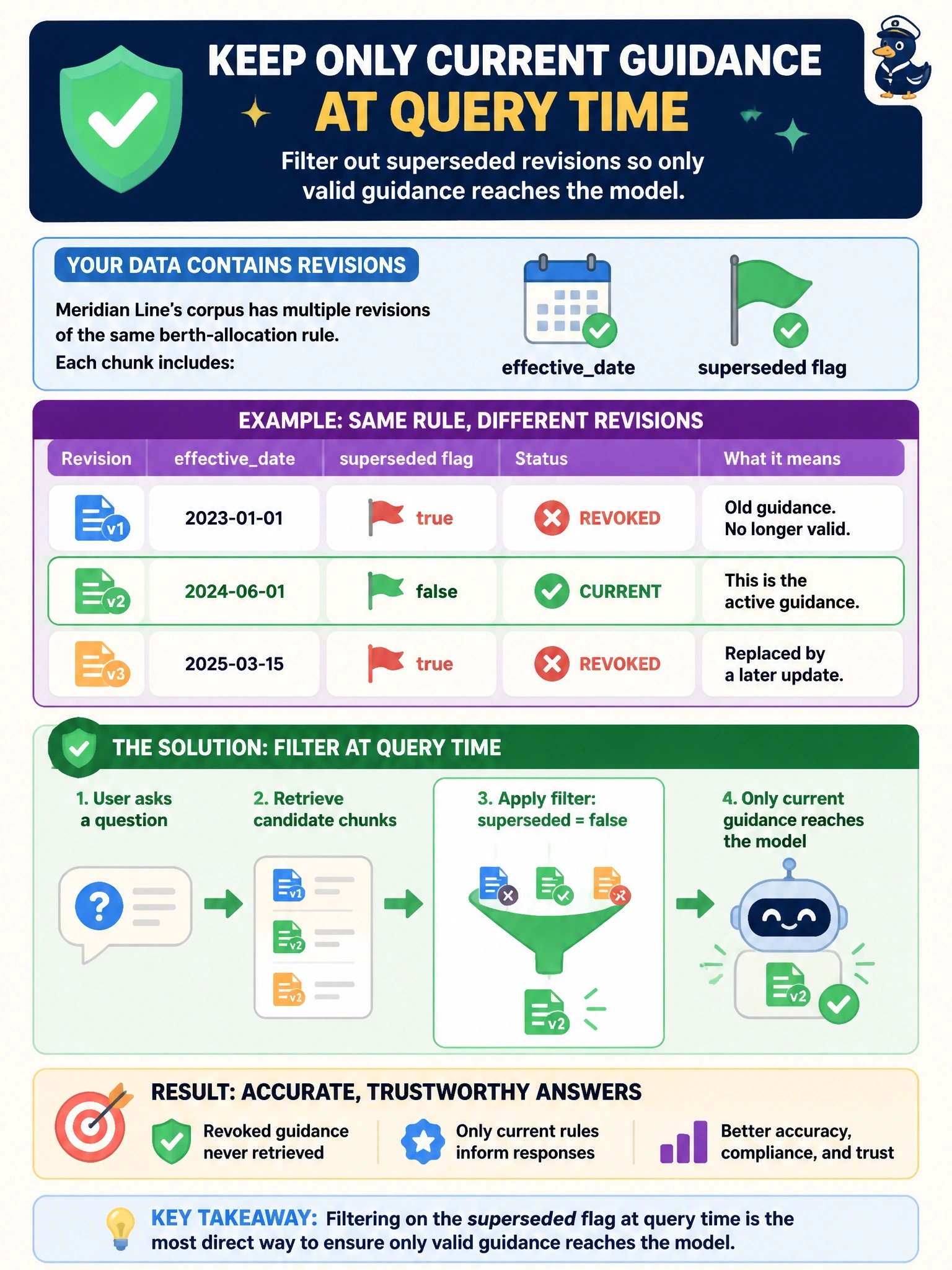
When a revision is revoked, you want to keep it out of retrieval entirely. Filtering on the superseded flag prevents revoked circulars from reaching the model, instead of asking the model to resolve conflicts after retrieval.
Full Explanation
Filtering on the superseded flag is the direct control because it removes revoked revisions from the query’s candidate set before they can be retrieved and passed to the model. The flag is already synced into the index, so it can enforce validity without relying on the model to interpret conflicting passages. Instructing the model to prefer the most recent document may sound reasonable, but it makes correctness depend on the model identifying and comparing dates correctly; it also allows revoked guidance into the retrieved context. Re-chunking changes passage size, not revision validity: both the current and revoked circulars can still be retrieved, and smaller pieces do not establish which rule governs. A larger embedding model may improve distinctions between some similar texts, but near-duplicate revisions can still have similar embeddings, and semantic similarity does not encode the governance fact that a revision was superseded. Exam caveat: effective dates can help determine which guidance applies, but they do not replace an explicit superseded-status filter when revoked material must never be retrieved. Practical check: query for a rule with multiple revisions and verify that no result marked superseded appears, while the current revision remains retrievable.