
Meridian Line's data science group has already produced and validated its own embedding vectors for the bill-of-lading corpus with a model they host themselves, and those vectors sit in a column of the Delta table. They now want a Vector Search index over that table. What should they configure?
Select an answer to reveal the explanation.
Short Explanation
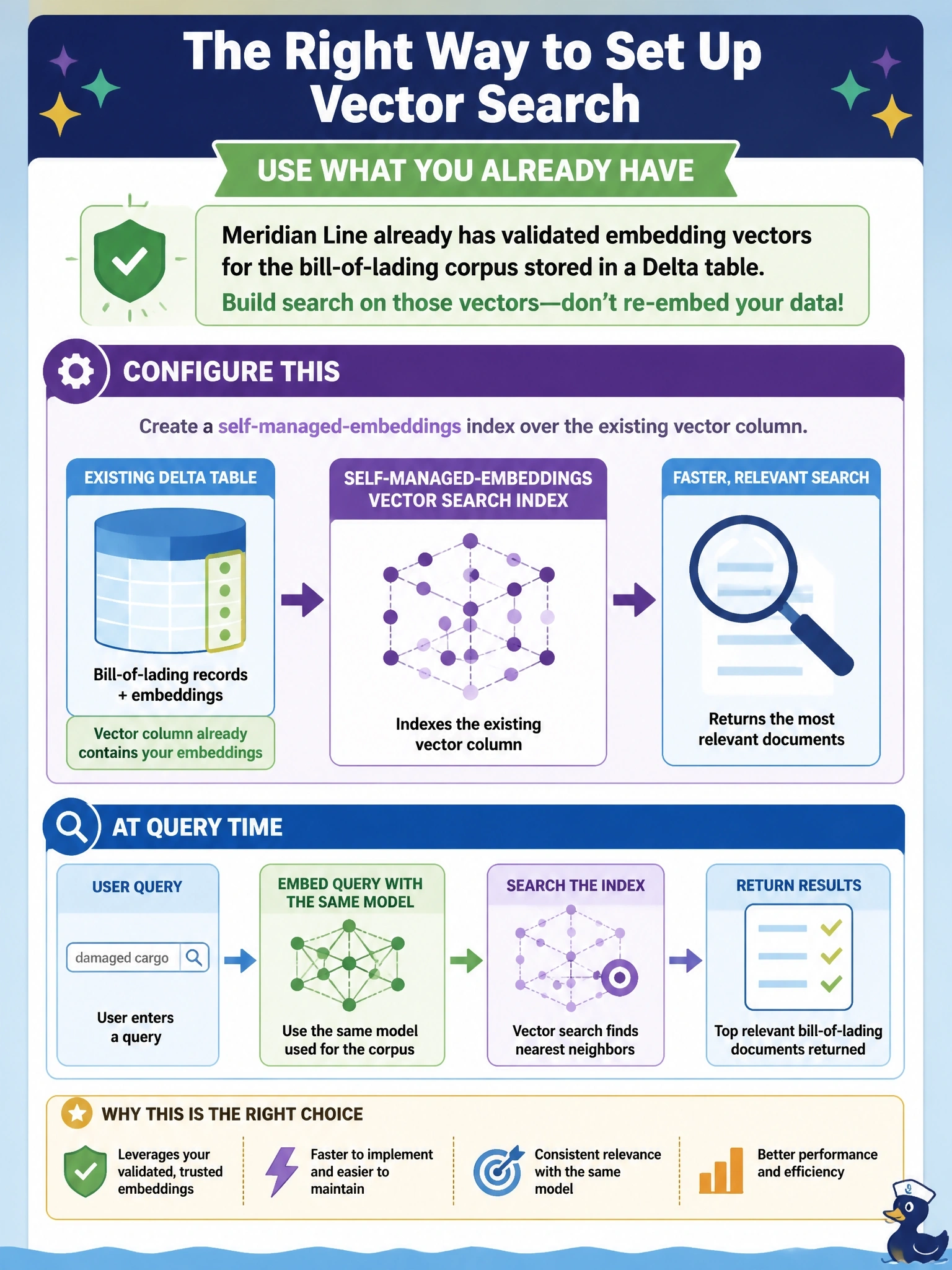
You can let Databricks embed your text, or bring vectors you’ve already created. With self-managed embeddings, you keep your validated vectors and embed each query with the same model so both sides share a coordinate system.
Full Explanation
A Delta Sync index can use Databricks-computed embeddings, where you provide a text column and embedding model endpoint and Databricks embeds documents and incoming queries, or self-managed embeddings, where you provide an existing vector column. Since Meridian Line has already validated its vectors, configuring a self-managed-embeddings index to index that column preserves its work; queries must be embedded with the identical hosted model before search. Configuring Databricks-computed embeddings while naming the vector column confuses text input with precomputed vectors: that mode takes text and invokes a model endpoint, rather than using an existing vector column. Dropping the column and asking Databricks to recompute is unnecessary, and the claim that self-managed vectors are supported only by Direct Vector Access is false: they are supported on Delta Sync indexes as well. Keeping Databricks-computed embeddings alongside the self-managed column for fallback also fails because the index has one vector space and no such fallback mechanism. Exam caveat: document and query vectors must come from the same model; changing models makes old and new vectors incomparable, so rebuild the index. Practical check: verify that the index selects the existing vector column and that the query path uses the same model that generated it.