
During a radiation biology review, a dental assistant asks how somatic effects of ionizing radiation differ from genetic effects in patients undergoing dental radiography. Which statement accurately describes this distinction?
Select an answer to reveal the explanation.
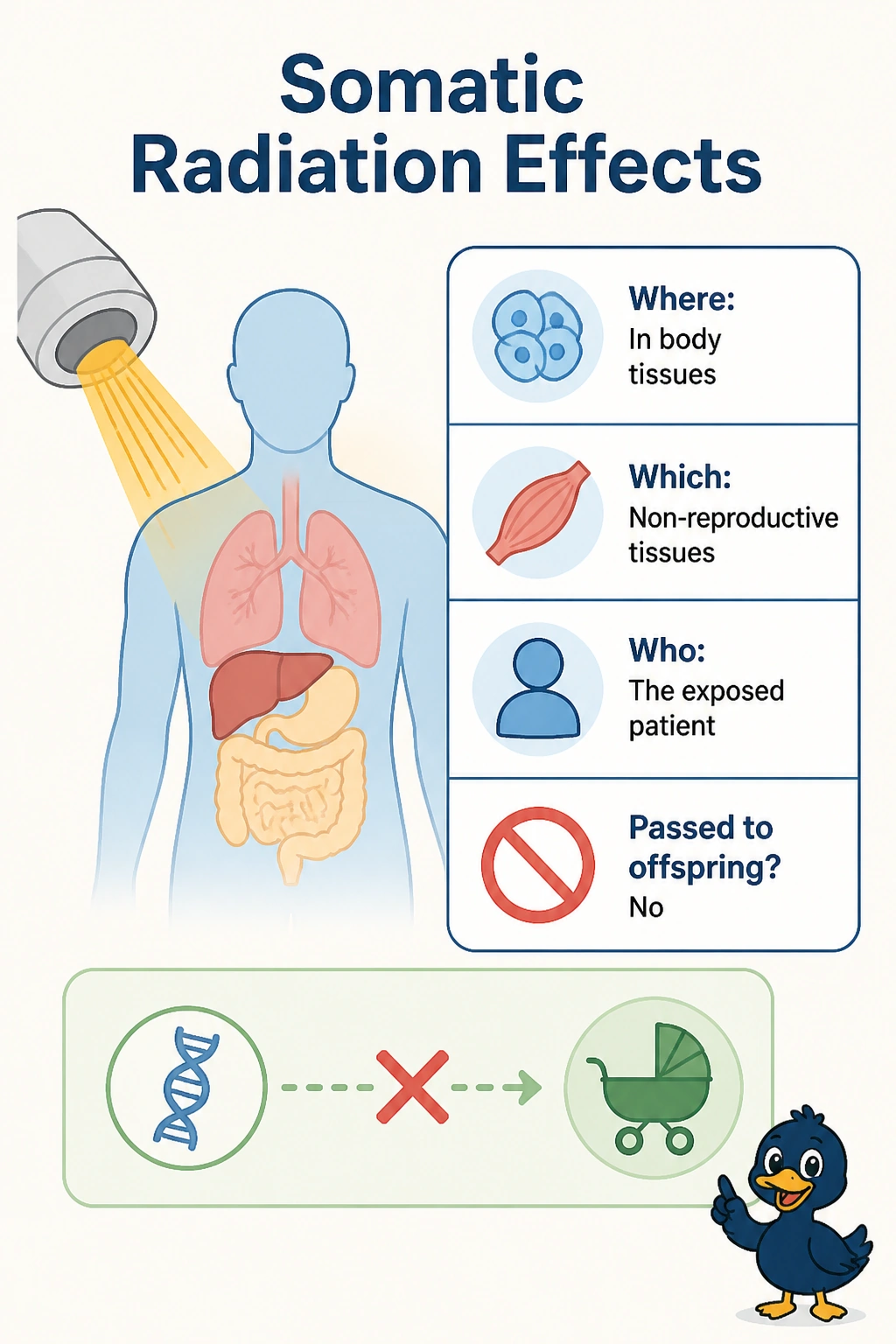
Short Explanation
Think of somatic effects as staying in one house, while genetic effects travel down the family tree. Somatic effects happen in the exposed patient's body tissues and are not inherited, whereas genetic effects involve reproductive cells and can be passed to future offspring. The trap is mixing up which cell type carries risk to the next generation—remember that your body's everyday tissues affect only you.
Full Explanation
Ionizing radiation can damage either somatic (non-reproductive) cells or germ (reproductive) cells, determining who bears the risk. "Somatic effects occur in non-reproductive body tissues of the exposed patient and are not passed to offspring" accurately defines somatic injury, such as carcinogenesis or cataracts, which affect only the irradiated individual. By contrast, genetic effects involve mutations in sperm or ova passed to future generations. Claiming that "Somatic effects occur only in reproductive cells and are transmitted to the patient's future offspring" reverses the two definitions by describing genetic effects. Asserting that "Somatic effects appear immediately after a single bitewing exposure and never involve a latent period" confuses acute high-dose deterministic injury with diagnostic exposures, which carry a long latent period before stochastic effects appear. Stating that "Somatic effects are restricted to dental staff from scatter radiation and never affect the patient" ignores that any irradiated person—patient or operator—can experience somatic injury. As a caveat, even though dental beams target the jaws rather than the gonads, minimizing exposure remains essential because somatic risk is cumulative. For an operational check, confirm the rectangular collimator is properly positioned before every intraoral exposure; ADA 2024 no longer recommends a thyroid collar.
Prefer to study offline? Printable PDF study book + test engine ($7.50, unofficial). These questions stay free here.