
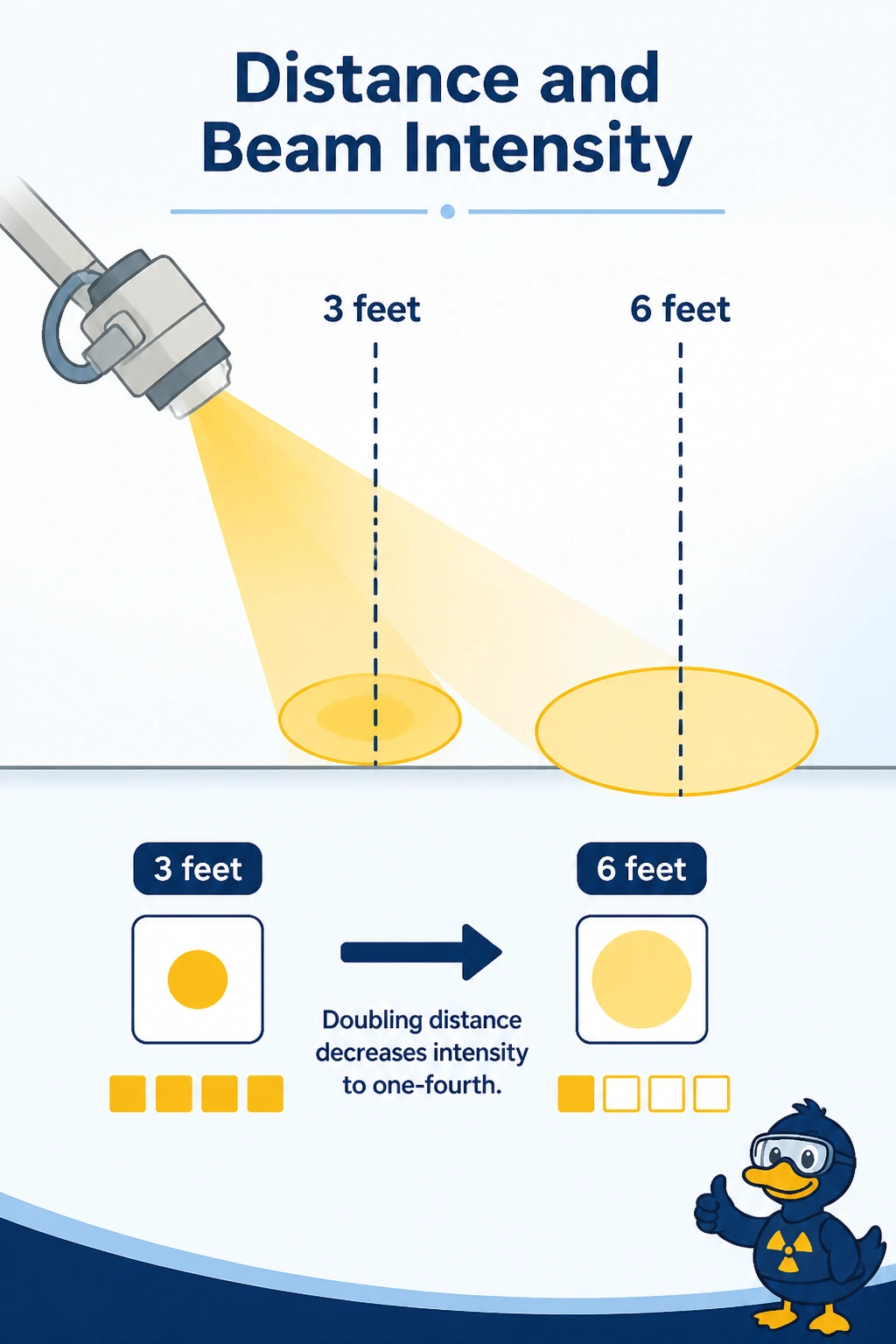
During a radiation safety review, a dental assistant asks how moving from 3 feet away from the X-ray tubehead to 6 feet away changes the intensity of the radiation beam. According to the inverse square law, how does doubling the distance affect beam intensity?
Select an answer to reveal the explanation.
Short Explanation
Stepping back from an X-ray source works like backing away from a flashlight in a dark room—the light spreads out over a much wider area fast. Do not fall for the trap of thinking twice the distance cuts exposure in half, because the inverse square law rewards your extra steps with a fourfold drop.
Full Explanation
Distance is one of the simplest and most reliable tools for reducing occupational radiation exposure when a fixed barrier is unavailable. The correct answer is The beam intensity decreases to one-fourth of the original level because the inverse square law states that radiation intensity is inversely proportional to the square of the distance from the source. Doubling the distance from 3 feet to 6 feet spreads the same number of photons over four times the surface area, cutting intensity to one-fourth. Choosing The beam intensity decreases to one-half of the original level applies a simple linear relationship instead of squaring the distance change. Selecting The beam intensity increases by a factor of two at the sensor reverses the physical relationship, as moving farther from a point source always reduces intensity. Picking The beam intensity remains unchanged unless exposure time changes ignores beam divergence, which disperses photons as they travel through space even when exposure settings stay constant. Caveat: the inverse square law strictly assumes a point source in free space and does not account for scatter off walls or objects in a small operatory. Operational check: always stand at least 6 feet away from the tubehead and outside the primary beam path, or behind a protective barrier, before initiating any intraoral exposure.
Prefer to study offline? Printable PDF study book + test engine ($7.50, unofficial). These questions stay free here.