
A dental assistant is exposing an intraoral periapical image in an operatory without a fixed lead-lined control booth and must hold the exposure button from inside the room. Where should the assistant stand relative to the patient's head and the primary X-ray beam?
Select an answer to reveal the explanation.
Short Explanation
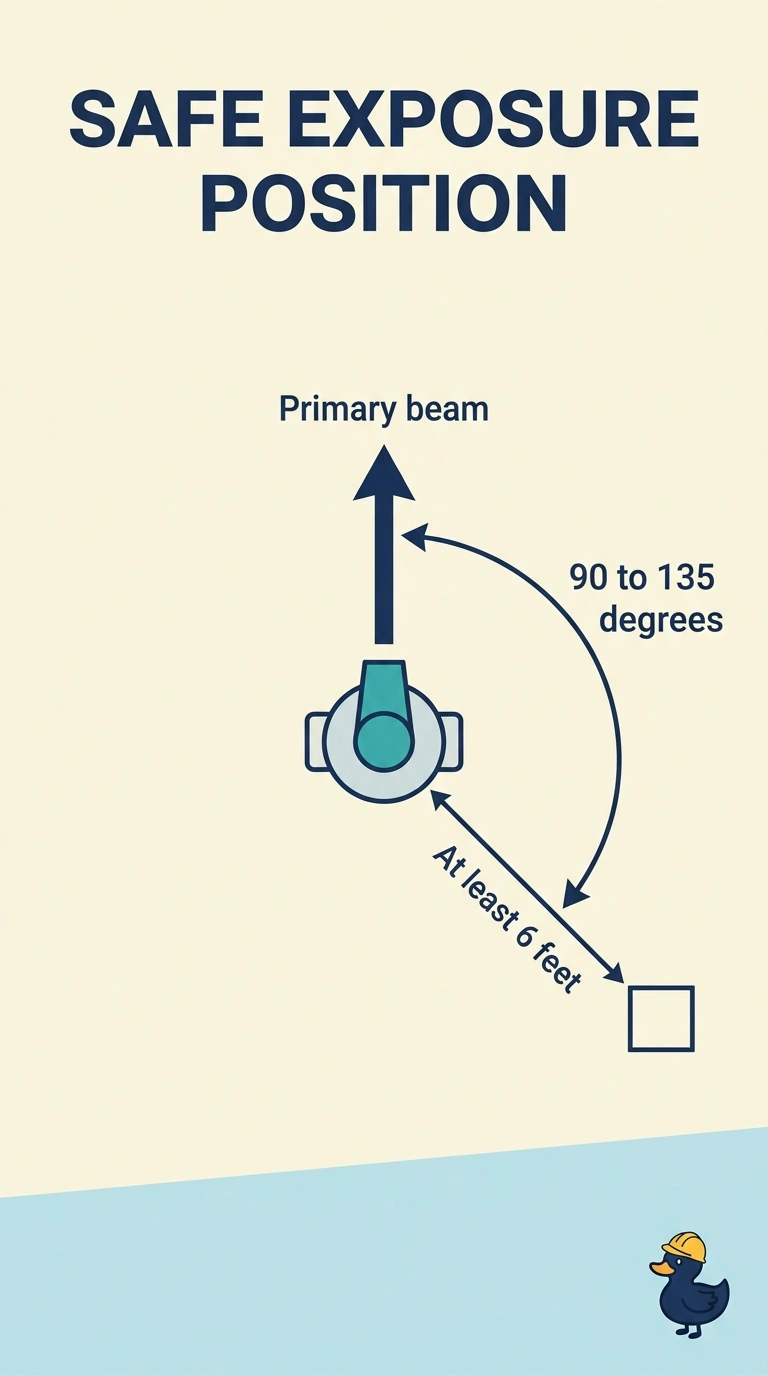
Without a lead-lined barrier, you can reduce scatter exposure with distance and smart positioning. Stand at least six feet away at a 90-to-135-degree angle to the primary beam, rather than close behind the tubehead, in the beam’s exit path, or beside the chair holding the sensor.
Full Explanation
When a protective structural barrier is unavailable during intraoral radiography, you minimize operator dose by using the position-and-distance rule, based on inverse-square law attenuation and scatter geometry. Standing at least six feet away at a 90-to-135-degree angle to the primary beam places you outside the main beam path and in the zone of lowest scatter intensity from the patient’s head. Standing directly behind the tubehead within three feet does not provide adequate distance and exposes you to higher scatter and potential tubehead leakage. Standing directly in line with the primary beam exit path places you in the unattenuated or patient-transmitted primary beam, causing unnecessary exposure. Standing beside the patient’s chair holding the sensor violates fundamental radiation safety because you must never hold receptors during exposure. As an exam caveat, if a fixed shielded barrier with a viewing window is present, standing completely behind it is always preferable to relying on distance alone. As a practical check, extend the coiled exposure cord fully before pressing the button so you are outside the six-foot radius.
Prefer to study offline? Printable PDF study book + test engine ($7.50, unofficial). These questions stay free here.