
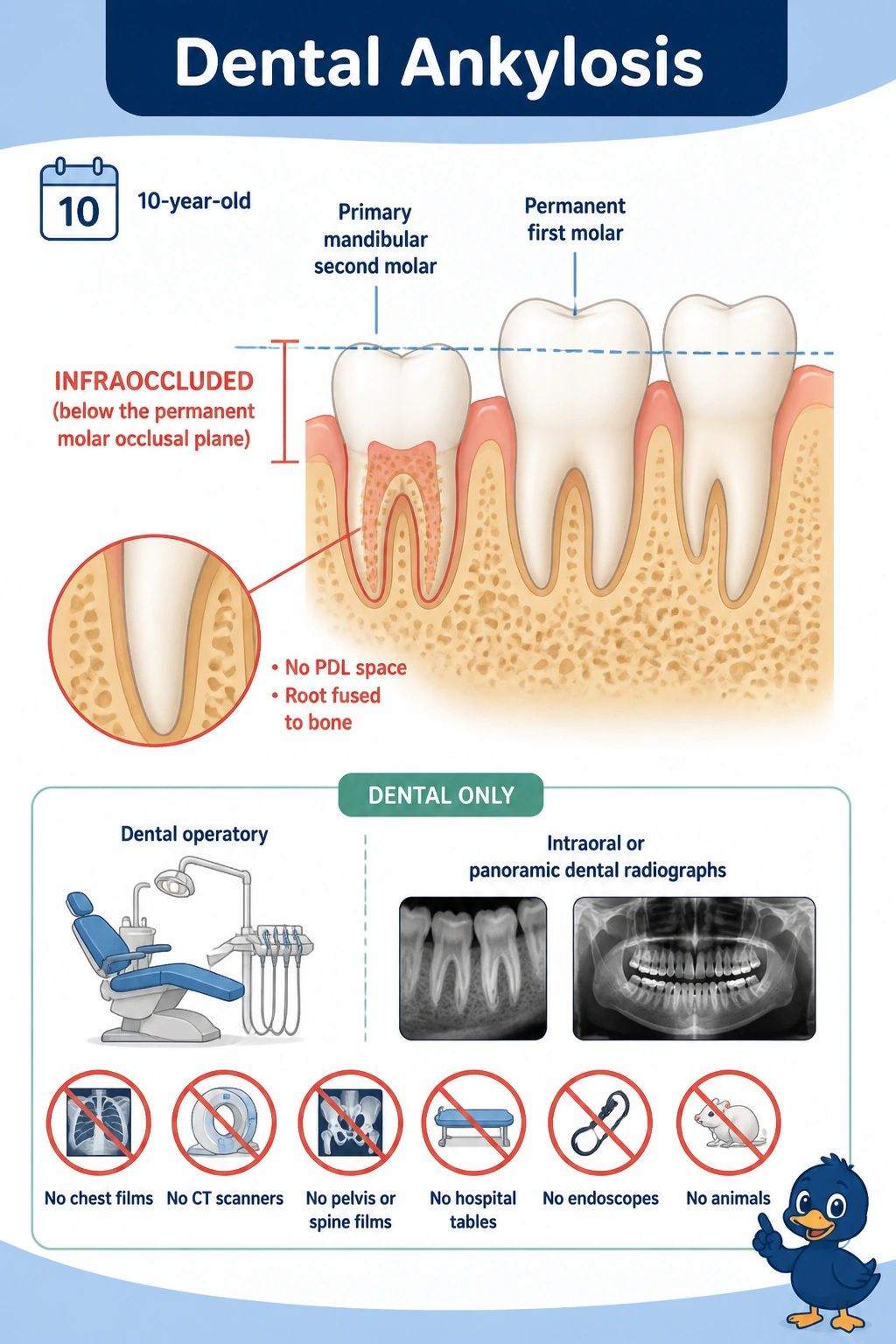
While evaluating a digital bitewing radiograph of a 10-year-old patient, a dentist notices a primary mandibular second molar positioned well below the occlusal plane of the adjacent permanent first molar, with no visible periodontal ligament space and direct fusion between the root and alveolar bone. Which condition is present?
Select an answer to reveal the explanation.
Short Explanation
When a baby molar looks like it is sinking below its neighbors, it is usually not moving down—the surrounding teeth are erupting up while that tooth is welded to the bone. When you notice a missing periodontal ligament space on the radiograph, you are looking at dental ankylosis rather than internal resorption or extra cementum.
Full Explanation
Dental ankylosis occurs when the periodontal ligament breaks down and the alveolar bone fuses directly to the root cementum or dentin, halting further eruption while adjacent teeth continue to erupt normally and leaving the ankylosed tooth submerged below the occlusal plane. Radiographically, the hallmark finding is the absence of the thin radiolucent periodontal ligament space and lamina dura along the fused root surface. Selecting Internal root resorption is incorrect because that condition appears as a smooth, round-to-ovoid radiolucent enlargement within the pulp chamber or root canal space rather than bone-to-root fusion. Choosing Condensing osteitis is wrong because it presents as a localized, diffuse radiopacity in the bone surrounding the apex of a nonvital tooth with pulpitis or necrosis, not a submerged tooth with a missing ligament space. Identifying Hypercementosis fails because excessive cementum deposition creates a bulbous, enlarged root tip that still retains an intact surrounding periodontal ligament space and lamina dura. As a clinical caveat, ankylosis can be difficult to confirm on a single two-dimensional view if overlapping bone obscures a small area of fusion. As an operational check, test the tooth clinically for a lack of mobility and a sharp, solid percussion sound alongside the radiographic loss of the periodontal ligament space.
Prefer to study offline? Printable PDF study book + test engine ($7.50, unofficial). These questions stay free here.