
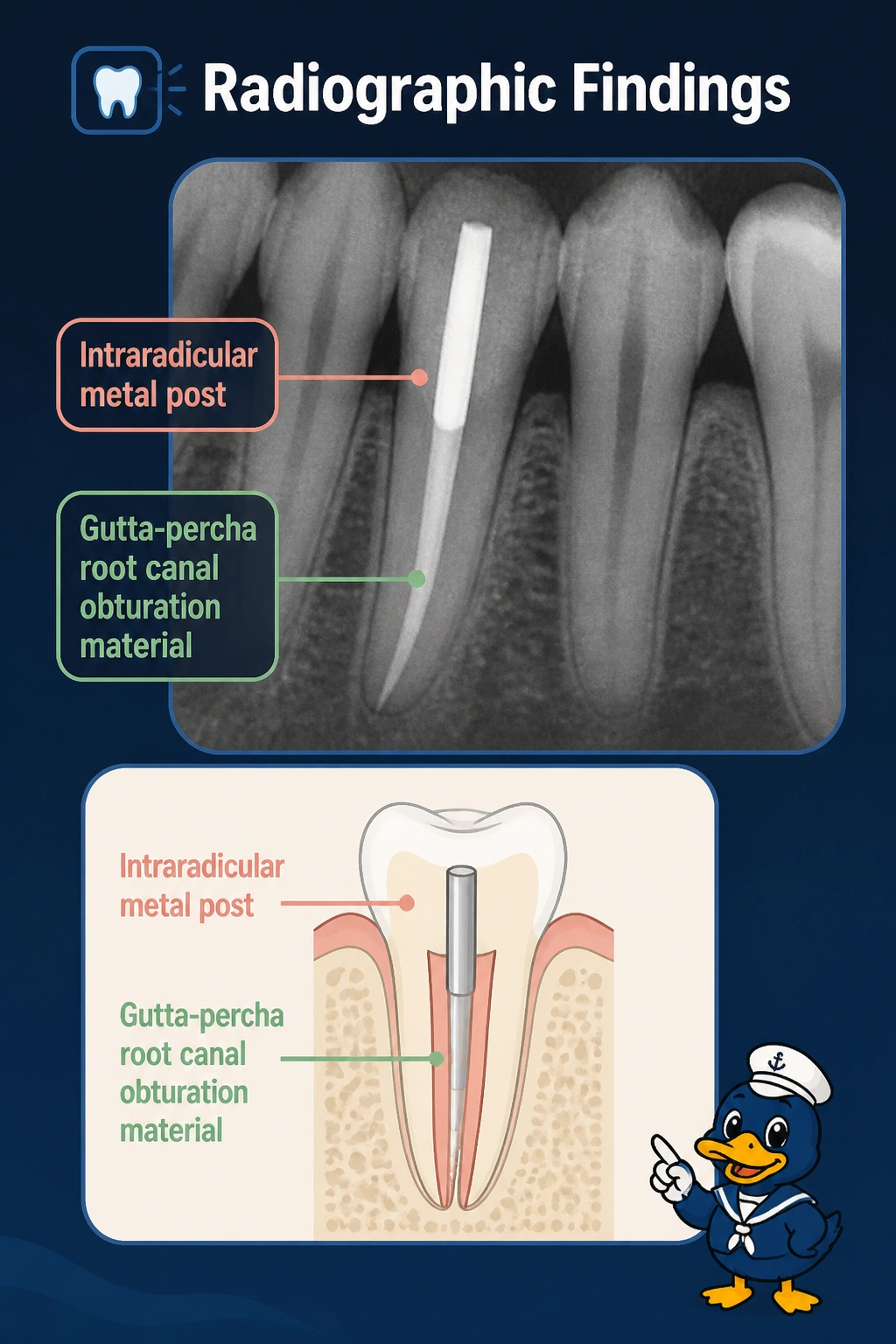
While reviewing a digital periapical radiograph of a previously treated maxillary central incisor, a clinician observes a smooth, tapered radiopaque material filling the apical canal and a brighter, parallel-sided radiopaque rod extending from the pulp chamber into the coronal root. What do these findings represent?
Select an answer to reveal the explanation.
Short Explanation
On a periapical image, a root canal filling and a metal post look like a two-tone highway—smooth, slightly dimmer gutta-percha down the apex and a bright white metallic rod up top. When you see that clean, tapered outline, don't mistake it for a broken file or natural dentin.
Full Explanation
In a previously root-canal-treated tooth, the smoothly tapered radiopaque material in the apical canal paired with a brighter, parallel-sided metallic rod in the coronal root represents "Gutta-percha root canal obturation material and an intraradicular metal post", where gutta-percha appears moderately radiopaque and the metal post absorbs more photons to look intensely white. By contrast, "Physiologic secondary dentin formation and a fractured endodontic file tip" would show a narrow, faint pulp canal rather than a full apical obturation, and a separated file appears as a tiny, twisted radiopaque fragment wedged inside the canal rather than a broad coronal post. Similarly, "Pulp canal obliteration with an overlying composite resin Class III restoration" narrows or eliminates the canal space with dentin-like density and shows a coronal proximal filling rather than a root-retained rod. Meanwhile, "Idiopathic osteosclerosis superimposed over a normal, vital root canal space" appears as dense trabecular bone outside the root rather than a uniform material confined within the canal walls. As an exam caveat, always compare the radiopacity of restorative metals against gutta-percha and dentin to distinguish endodontic materials from pathology. As an operational check, trace the entire root outline from crown to apex to confirm the post and obturation stay centered within the canal without perforating the root.
Prefer to study offline? Printable PDF study book + test engine ($7.50, unofficial). These questions stay free here.