
While reviewing a digital panoramic radiograph of an asymptomatic adult patient, a clinician observes a thick, horizontal radiopaque band extending across the image just superior to the apices of the maxillary teeth. Which anatomical structure does this radiopaque band represent?
Select an answer to reveal the explanation.
Short Explanation
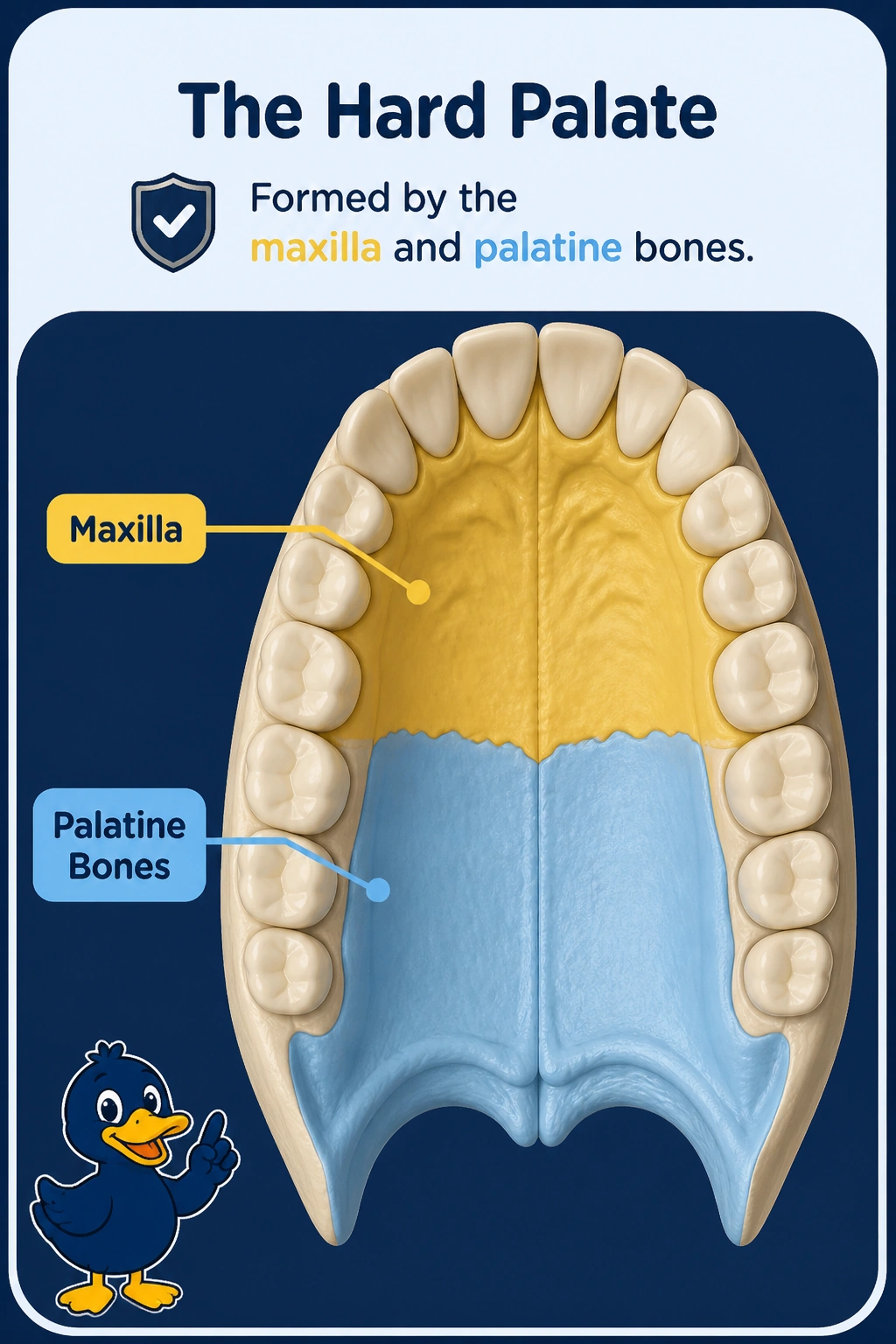
Picture the roof of the mouth as a bony shelf running across the upper jaw—on a panoramic image, that dense shelf shows up right above the upper root tips. When you see a thick horizontal radiopaque band superior to the maxillary apices, you are looking at the hard palate. The trap is confusing this dense horizontal bony band with the thin curved border of the maxillary sinus or the faint posterior shadow of the soft palate and uvula.
Full Explanation
On a digital panoramic radiograph, The hard palate formed by the maxilla and palatine bones projects as a thick, horizontal radiopaque band located just superior to the apices of the maxillary teeth because the dense cortical bone of the palatal processes attenuates X-ray photons strongly as the rotational beam sweeps across the upper jaw. In contrast, The inferior border of the maxillary sinus appears as a thin, curved radiopaque cortical line arching above the maxillary posterior roots rather than a thick horizontal band spanning the entire arch. The cartilaginous portion of the nasal septum consists of radiolucent cartilage rather than dense cortical bone, so it does not cast a thick, bright horizontal radiopaque band above the root apices. Meanwhile, The shadow of the soft palate and uvula appears as a faint, diffuse soft-tissue radiopacity extending posteriorly and downward across the mandibular ramus rather than sitting directly above the maxillary apices. As a clinical caveat, if the patient's chin is tipped upward during positioning, the hard palate can project even higher over the maxillary apices and cast a secondary ghost-like band that obscures the roots. For an operational check, trace the horizontal radiopaque band across the midline and posteriorly above the maxillary roots to confirm the hard palate before evaluating the maxillary sinus.
Prefer to study offline? Printable PDF study book + test engine ($7.50, unofficial). These questions stay free here.