
While reviewing a digital periapical radiograph of asymptomatic, vital maxillary central and lateral incisors, a clinician observes two smooth, rounded, faint radiopaque masses projecting bilaterally from the lateral walls into the dark radiolucent nasal cavity superior to the root apices. Which normal anatomical landmark do these structures represent?
Select an answer to reveal the explanation.
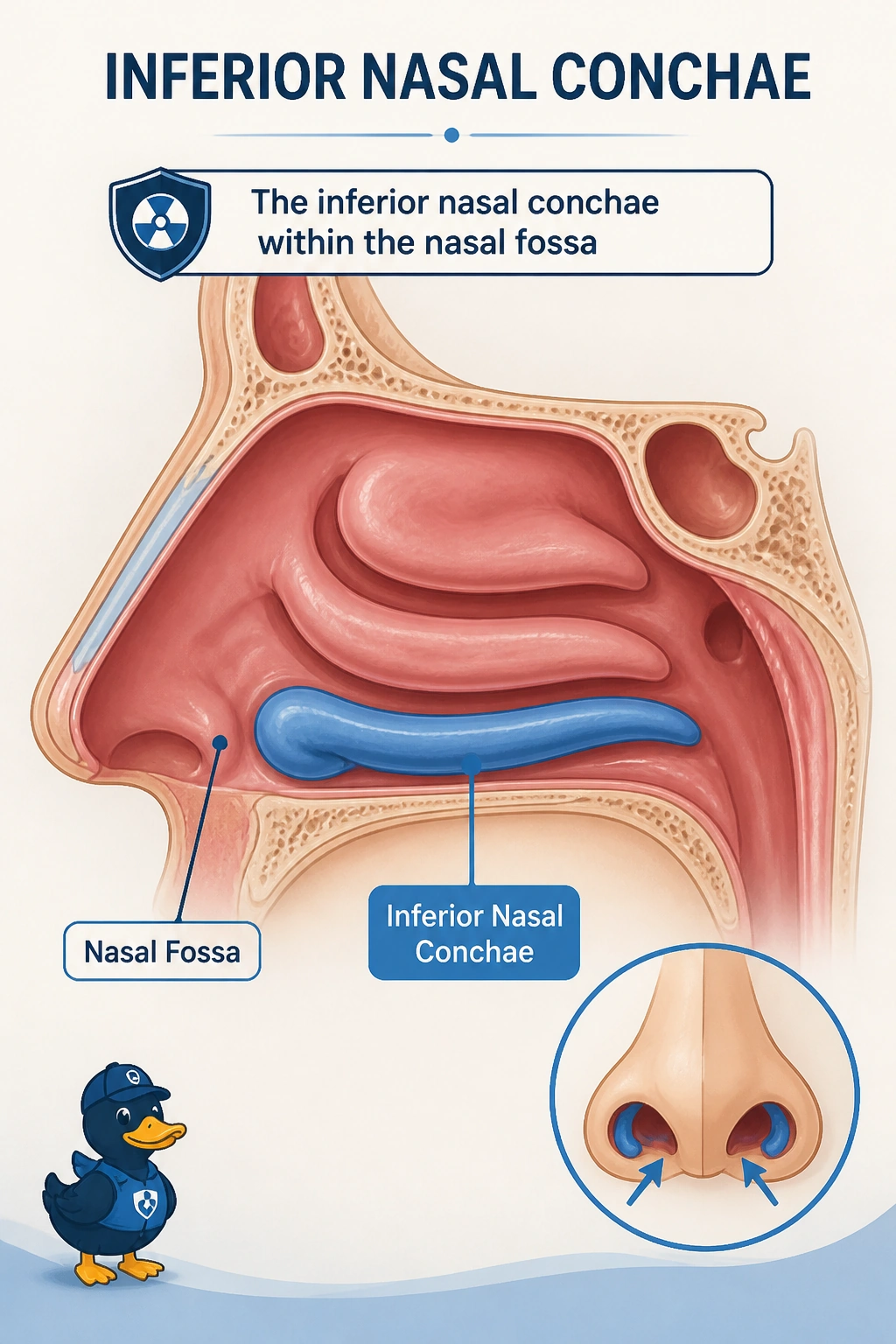
Short Explanation
You may mistake these paired, soft-tissue-like clouds in the dark nasal cavity for a problem, but they are normal inferior nasal conchae. Their lateral position distinguishes them from the maxillary sinuses and midline landmarks, while intact tooth apices and lamina dura support healthy incisors. Knowing your nasal fossa landmarks helps you avoid over-diagnosing healthy patients.
Full Explanation
On a maxillary anterior periapical radiograph, the paired nasal fossae appear as large radiolucent cavities superior to the incisor apices. The inferior nasal conchae within the nasal fossa are normal scroll-shaped bony and mucosal structures projecting from the lateral nasal walls. Their thin bone and overlying soft tissue create smooth, rounded, diffuse radiopacities inside the dark nasal airway. The bilateral maxillary sinuses extending medially are not the structures shown: the sinuses lie more posteriorly over the premolars and molars and have a thin, continuous radiopaque cortical floor. The anterior nasal spine at the inferior midline is a small, sharp, V-shaped radiopaque projection at the base of the nasal septum, not a pair of lateral masses. The median palatal suture between the central incisors is a thin vertical radiolucent line between the central incisor roots, not rounded radiopacities in the nasal cavity. As an exam caveat, steep vertical angulation on a maxillary anterior image can project the inferior nasal conchae closer to the incisor apices, where they may mimic periapical lesions. As a practical check, trace the intact lamina dura around the incisor roots and confirm normal pulp vitality before attributing a nasal-cavity shadow to pathology.
Prefer to study offline? Printable PDF study book + test engine ($7.50, unofficial). These questions stay free here.