
On an initial digital periapical radiograph of a maxillary first premolar, the buccal and palatal roots are completely superimposed, preventing the endodontist from evaluating the palatal root apex. How should the dental assistant adjust the tubehead setup for the retake to separate the two roots?
Select an answer to reveal the explanation.
Short Explanation
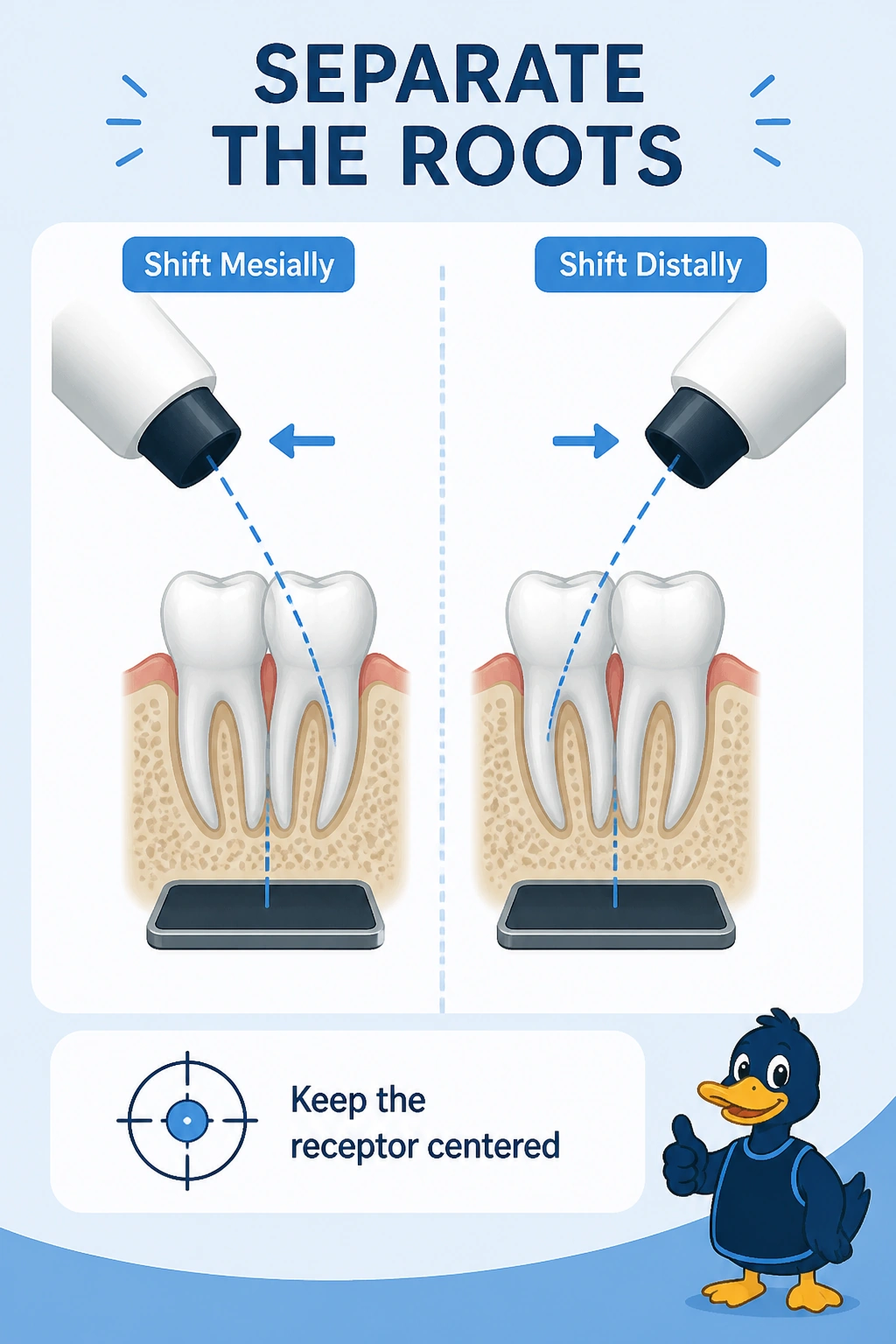
When two roots hide behind each other like cars in a single lane, you have to step to the side to see them both. The trap is changing vertical angulation or kVp, which only stretches the tooth or alters contrast without separating buccal from palatal roots. Shift your horizontal tubehead angle mesially or distally so the roots project side by side.
Full Explanation
To separate superimposed buccal and palatal roots on a multirooted tooth such as a maxillary first premolar, the clinician should Shift the horizontal angulation mesially or distally while keeping the receptor centered. Changing the horizontal angle projects the buccal and palatal roots onto different horizontal positions on the digital sensor, allowing each root canal and apex to be evaluated individually using the buccal object rule. Choosing to Increase the vertical angulation steeply downward toward the occlusal plane only foreshortens the roots vertically and fails to separate structures aligned buccolingually. Opting to Decrease the kilovoltage peak (kVp) to sharpen contrast between the roots alters grayscale contrast but cannot physically separate two superimposed anatomical structures along the same beam path. Deciding to Rotate the digital sensor vertically so the long axis sits horizontally reduces apical coverage and does not change the projection geometry of the central X-ray beam. As a clinical caveat, shifting the horizontal angle too aggressively can introduce interproximal overlap between adjacent teeth, so a modest horizontal shift is preferred. For an operational check, document the direction of the horizontal shift (mesial or distal) in the chart so the endodontist can accurately apply the SLOB rule to identify which root is buccal and which is palatal.
Prefer to study offline? Printable PDF study book + test engine ($7.50, unofficial). These questions stay free here.