
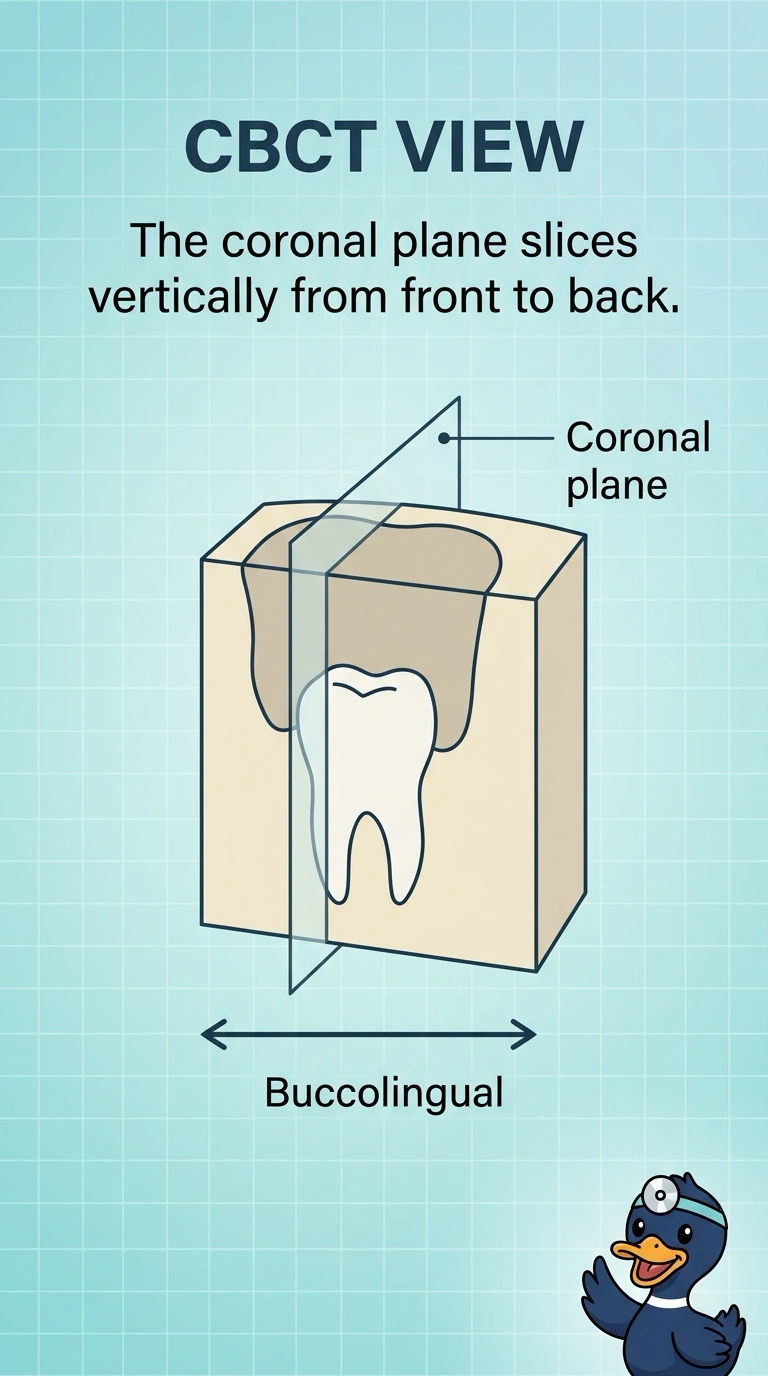
An endodontist is reviewing a cone-beam computed tomography (CBCT) scan of a maxillary first molar to evaluate how close the palatal root apex sits to the maxillary sinus floor and buccal cortical plate in a vertical cross-section. Which CBCT viewing plane best displays this buccolingual relationship?
Select an answer to reveal the explanation.
Short Explanation
Picture slicing a loaf of bread from front to back so you can look straight into the cheek-to-tongue profile of a single molar and the sinus above it. The trap is choosing the axial slice, which shows you a view looking down from above like a floor plan.
Full Explanation
The coronal plane slicing vertically from front to back divides the anatomy into anterior and posterior sections, giving the clinician a direct buccolingual cross-sectional view of a posterior tooth's roots relative to the buccal cortical plate and the floor of the maxillary sinus. The axial plane slicing horizontally from crown to apex views the dental arch from top to bottom, which is useful for locating extra root canals or horizontal fractures but cannot show vertical height between a root tip and the sinus floor in a single slice. A panoramic reconstruction curved along the entire dental arch provides a mesiodistal overview of both jaws similar to a standard panoramic image, still superimposing buccal and palatal structures rather than separating them buccolingually. The sagittal plane slicing vertically from left to right divides anatomy into left and right parts and shows a mesiodistal slice along the arch for a maxillary molar, which displays mesial-distal root separation and sinus height but not buccal-palatal thickness or buccal plate relationship. As an imaging caveat, multiplanar reconstruction software allows you to scroll slice by slice through the coronal view while cross-referencing the axial cursor. For an operational check, align the vertical cross-hair through the long axis of the molar in the axial view before evaluating the coronal slice.
Prefer to study offline? Printable PDF study book + test engine ($7.50, unofficial). These questions stay free here.