
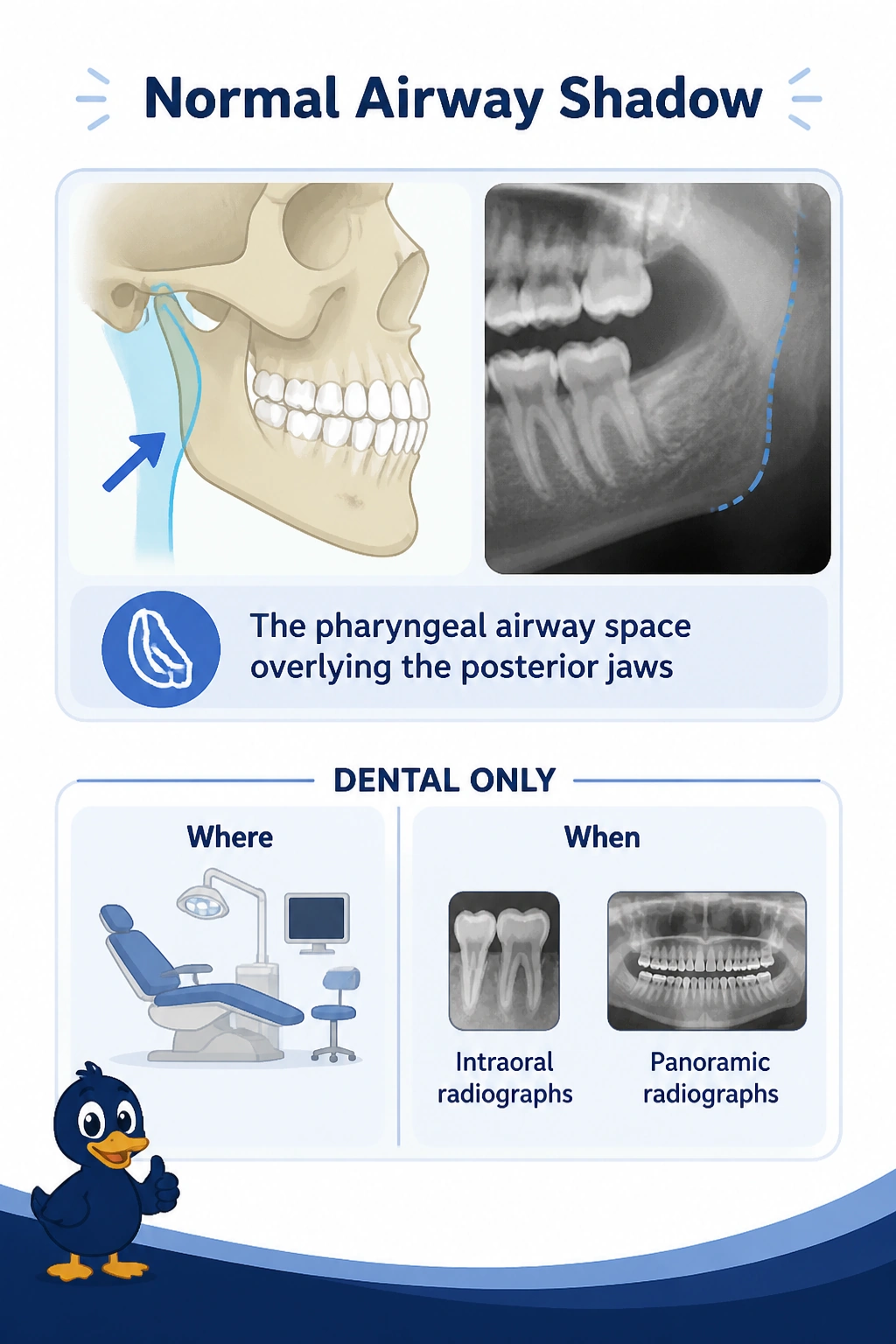
While reviewing a digital panoramic radiograph of an asymptomatic adult, a clinician notes a broad, dark radiolucent band extending obliquely across the mandibular rami and posterior molar roots bilaterally. Which normal anatomical feature accounts for this appearance?
Select an answer to reveal the explanation.
Short Explanation
Air looks black on a radiograph, and the open throat behind your tongue creates a wide dark band right across the back of the jaw. Watch out for the trap of confusing this normal airway shadow with nasal superimposition or a tongue-positioning error.
Full Explanation
The pharyngeal airway space overlying the posterior jaws appears on panoramic images as a wide, symmetric radiolucent band running downward and forward across the mandibular rami, soft palate, and posterior teeth because air in the nasopharynx and oropharynx attenuates very few X-ray photons. The maxillary sinus floor extending inferiorly into the mandible is anatomically impossible, as the maxillary sinuses sit superiorly above the maxillary posterior roots. The nasal fossa superimposed over the mandibular rami is incorrect, as the nasal fossae are superior midline air spaces projecting over the anterior maxilla, not obliquely across the posterior mandible bilaterally. The palatoglossal air space caused by dropping the tongue creates a horizontal dark band directly over the maxillary root apices, not an oblique shadow across the mandibular rami. As a caveat, patients with enlarged tonsils or pharyngeal masses can narrow or asymmetrically distort this airway shadow. As an operational check, trace the continuous cortical borders of the mandibular ramus and inferior border through the dark band to confirm normal anatomy before suspecting pathology.
Prefer to study offline? Printable PDF study book + test engine ($7.50, unofficial). These questions stay free here.