
While reviewing a digital bitewing radiograph, a clinician suspects occlusal caries on a mandibular first molar that shows dark fissure staining clinically. Why is early occlusal caries confined to the enamel difficult to detect on a standard bitewing image?
Select an answer to reveal the explanation.
Short Explanation
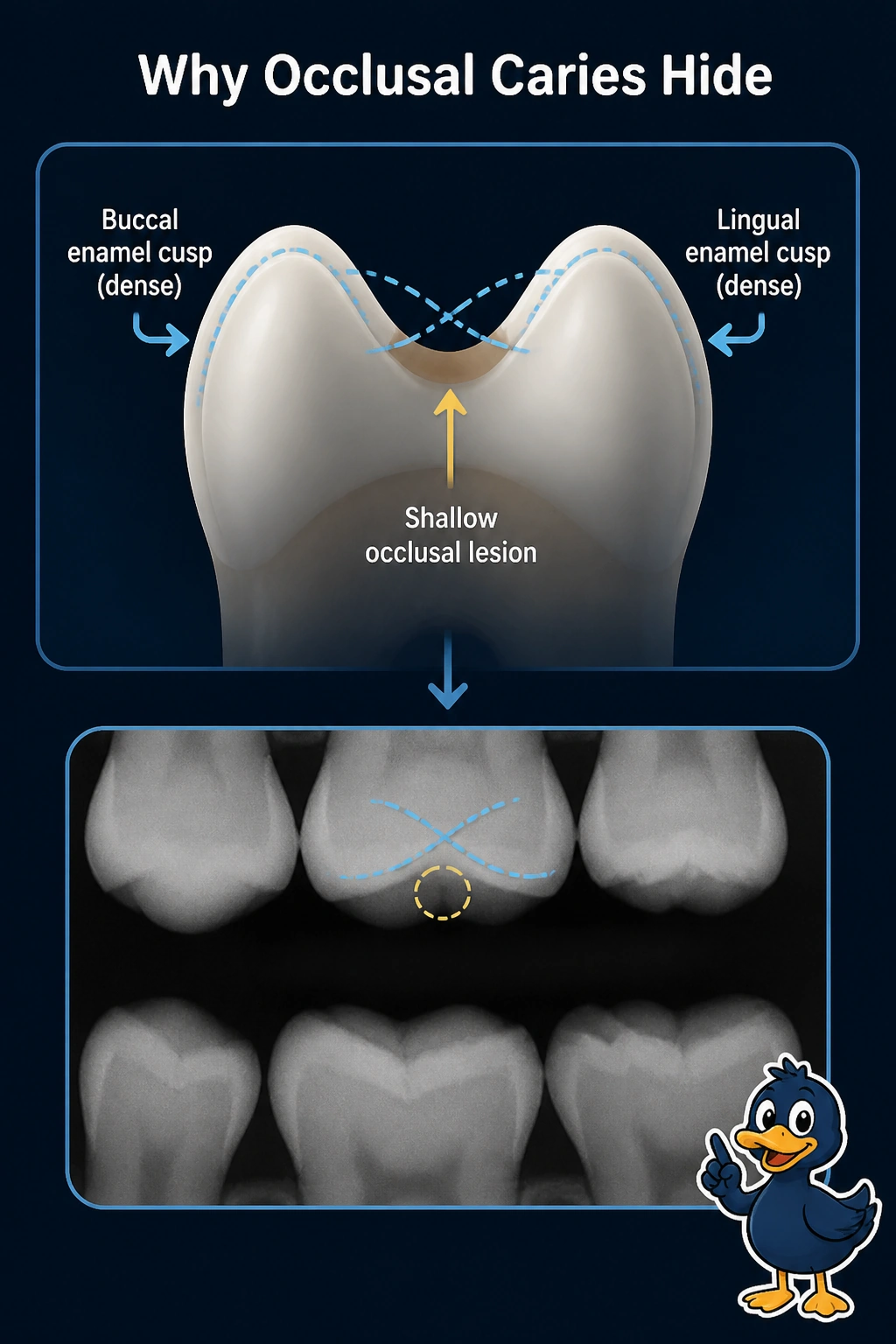
Trying to spot tiny occlusal decay on a bitewing is like looking through two thick glass walls at a hairline scratch between them. The trap is blaming sensor quality when it is actually the dense outer enamel hiding your view until decay spreads deeper into dentin.
Full Explanation
Dense buccal and lingual enamel cusps superimpose over the shallow occlusal lesion because a two-dimensional bitewing projects the X-ray beam buccolingually through thick, intact cuspal enamel. That heavy attenuation masks minor mineral loss in the occlusal pits and fissures until caries penetrates the dentinoenamel junction and spreads laterally as a broad radiolucency in dentin. The bisecting-angle beam geometry stretches the occlusal cusps is incorrect because bitewing radiographs use a parallel or near-perpendicular beam geometry rather than the bisecting-angle technique. Digital sensors lack sufficient spatial resolution for molar enamel fails because modern intraoral digital receptors readily resolve enamel structures, as demonstrated by their accuracy for incipient interproximal caries. Adjacent proximal restorations create burn-out artifacts on the crown is also inaccurate because cervical burnout occurs at the thinner root neck below the cementoenamel junction, not across the thick occlusal table. As a diagnostic caveat, a negative bitewing does not rule out early occlusal caries, which requires careful visual and tactile clinical assessment. For a concrete operational check, inspect the zone directly beneath the occlusal enamel at the dentinoenamel junction on the bitewing and correlate any subtle radiolucency with dry-field clinical examination.
Prefer to study offline? Printable PDF study book + test engine ($7.50, unofficial). These questions stay free here.