
While evaluating a digital panoramic radiograph, you notice a dark, curved radiolucent shadow across the crowns of the maxillary and mandibular incisors that reduces contrast on the anterior enamel, while the root apices remain clear. Which patient positioning error most likely caused this artifact?
Select an answer to reveal the explanation.
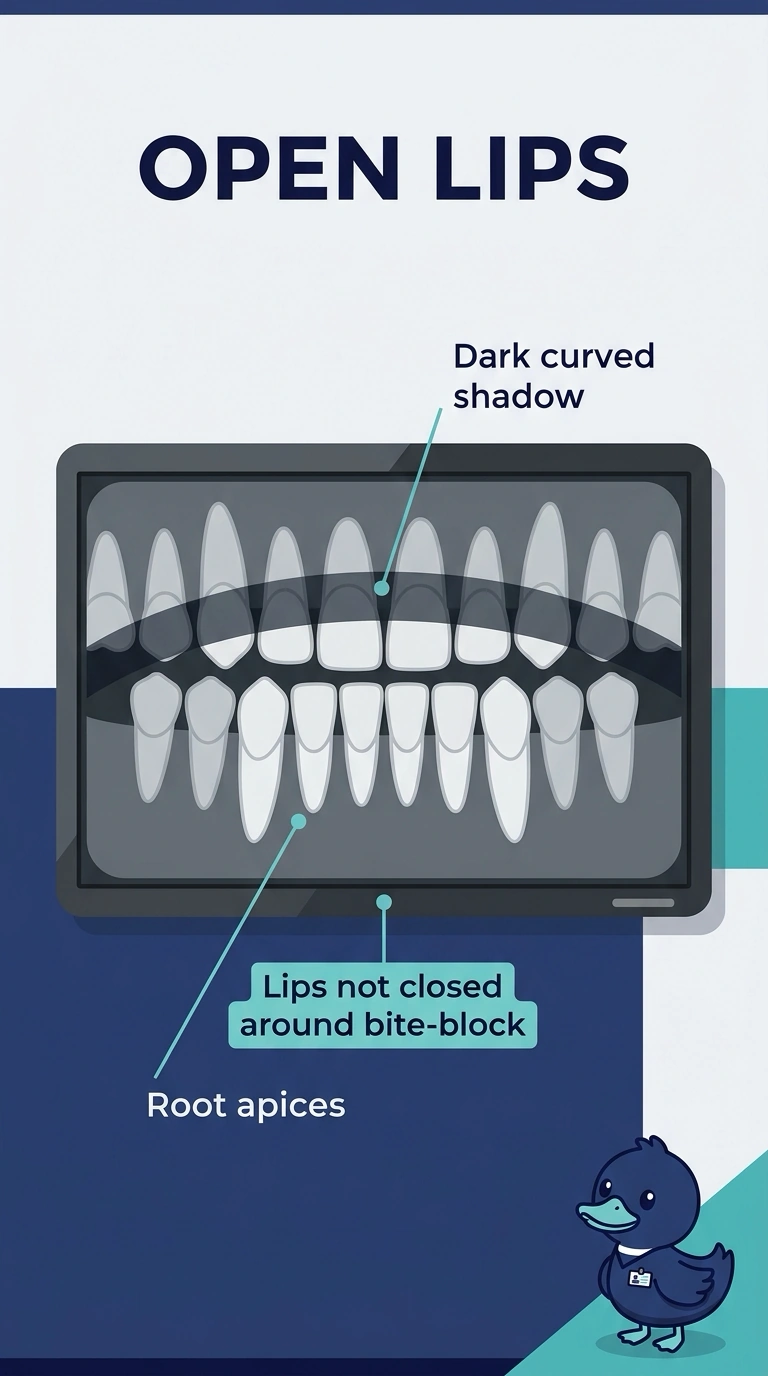
Short Explanation
Air is a sneaky thief on panoramic images—anywhere it sits in front of teeth, it steals contrast and leaves a dark shadow. When your patient leaves their lips parted around the bite-block, you see a dark radiolucent band right over the front crowns. The trap is blaming the tongue, which casts its dark shadow higher up over the maxillary root apices instead.
Full Explanation
Air spaces inside the oral cavity absorb far fewer X-ray photons than soft tissue, so any unsealed air gap creates a localized radiolucent shadow on the panoramic image. Because "The patient did not close the lips around the bite-block" occurred, air remained between the parted lips and the labial surfaces of the anterior teeth, casting a dark radiolucent shadow across the incisor crowns while leaving the root apices unaffected. By contrast, if "The patient failed to press the tongue flat against the hard palate" occurred, the palatoglossal air space would appear as a horizontal dark radiolucent band across the apices of the maxillary teeth rather than over the anterior crowns. If "The patient slumped forward, causing the cervical spine to overlap" occurred, the artifact would be a broad, triangular radiopaque shadow in the midline obscuring both crowns and roots, not a radiolucent air shadow. Similarly, if "The patient's chin was tipped too high relative to the floor" occurred, the occlusal plane would flatten or curve downward and the hard palate would superimpose over the maxillary roots rather than creating an anterior crown radiolucency. As a clinical caveat, patients with nasal congestion or severe dental protrusion may find lip closure uncomfortable during the scan. For an operational check, remind the patient to close their lips gently around the bite-block and swallow once to place the tongue against the palate right before pressing the exposure button.
Prefer to study offline? Printable PDF study book + test engine ($7.50, unofficial). These questions stay free here.