
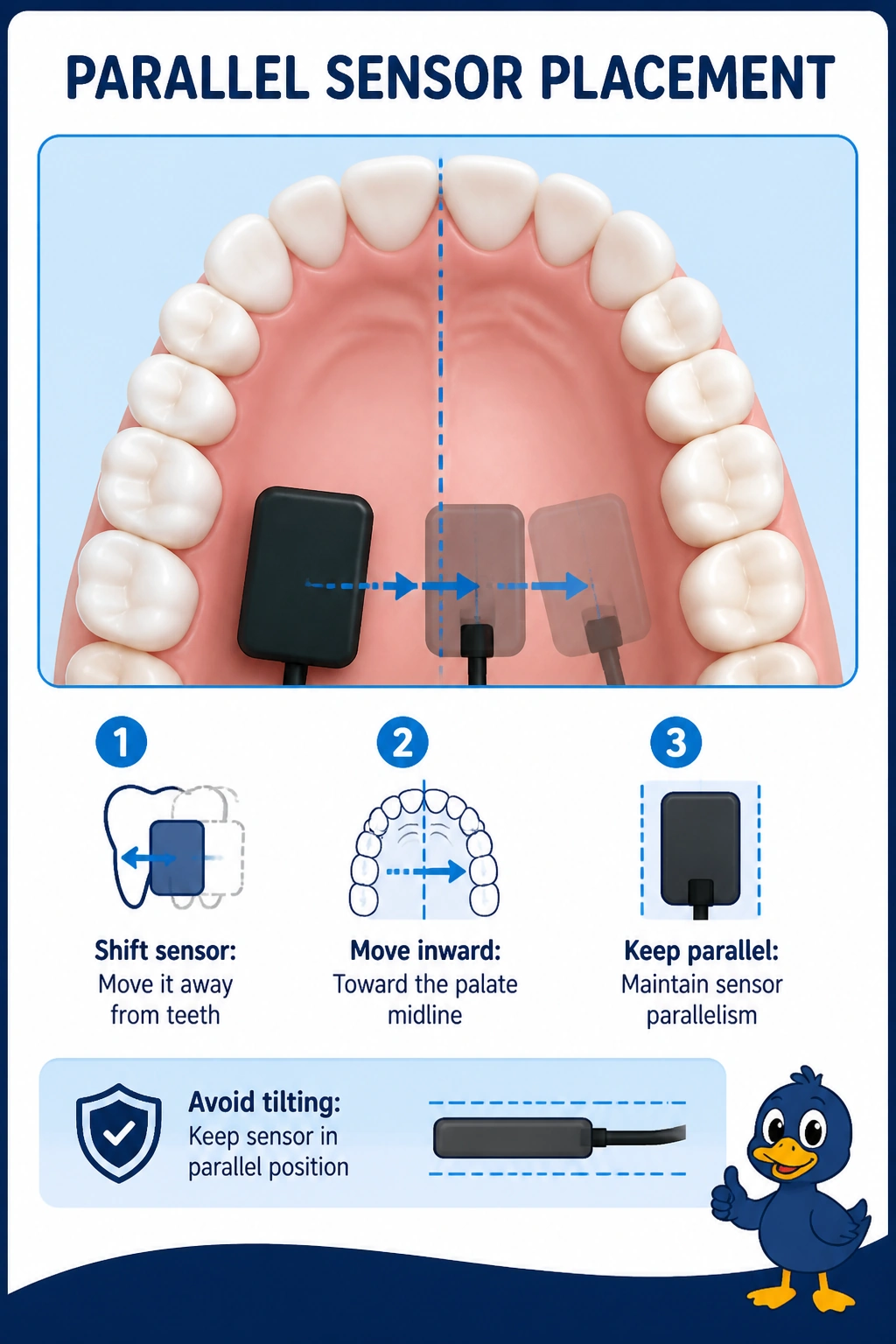
While taking a maxillary premolar digital periapical radiograph using the paralleling technique, a patient's shallow palate prevents placing the rigid sensor directly against the lingual crown surfaces without tilting it. How should the dental assistant modify sensor placement to maintain parallelism?
Select an answer to reveal the explanation.
Short Explanation
When a shallow palate crowds your sensor, forcing it tight against the teeth tilts it out of parallel like a leaning ladder. The trap is trying to compensate with extra vertical angulation, which turns a paralleling shot into a distorted bisecting view. Instead, slide the sensor toward the deeper midline of the palate where it can stand upright.
Full Explanation
Move the sensor slightly away from the teeth toward the midline of the palate because the palatal vault is deepest at the center, allowing the rigid receptor to stand parallel to the long axis of the premolar. Because the paralleling technique uses a long position-indicating device, increasing the object-to-receptor distance slightly does not introduce clinically significant magnification or unsharpness. Tilt the top border of the sensor outward and increase vertical angulation abandons the paralleling principle and introduces dimensional distortion if the beam is not adjusted to bisect the angle. Switch to a shorter position-indicating device to bring the tubehead closer increases beam divergence, which magnifies the tooth and worsens geometric unsharpness when the sensor is displaced lingually. Increase milliamperage to offset distortion from the nonparallel sensor confuses exposure with geometry because milliamperage controls photon quantity and density, not dimensional accuracy or angulation distortion. As a caveat, moving the sensor too far posteriorly while shifting medially can trigger the patient's gag reflex. Ask the patient to breathe through their nose and confirm the aiming ring aligns squarely with the PID before exposing.
Prefer to study offline? Printable PDF study book + test engine ($7.50, unofficial). These questions stay free here.