
While examining a digital bitewing radiograph, a clinician sees a small, triangular radiolucency on the distal enamel surface of a mandibular first molar that widens abruptly at the dentinoenamel junction. What does this radiographic pattern indicate?
Select an answer to reveal the explanation.
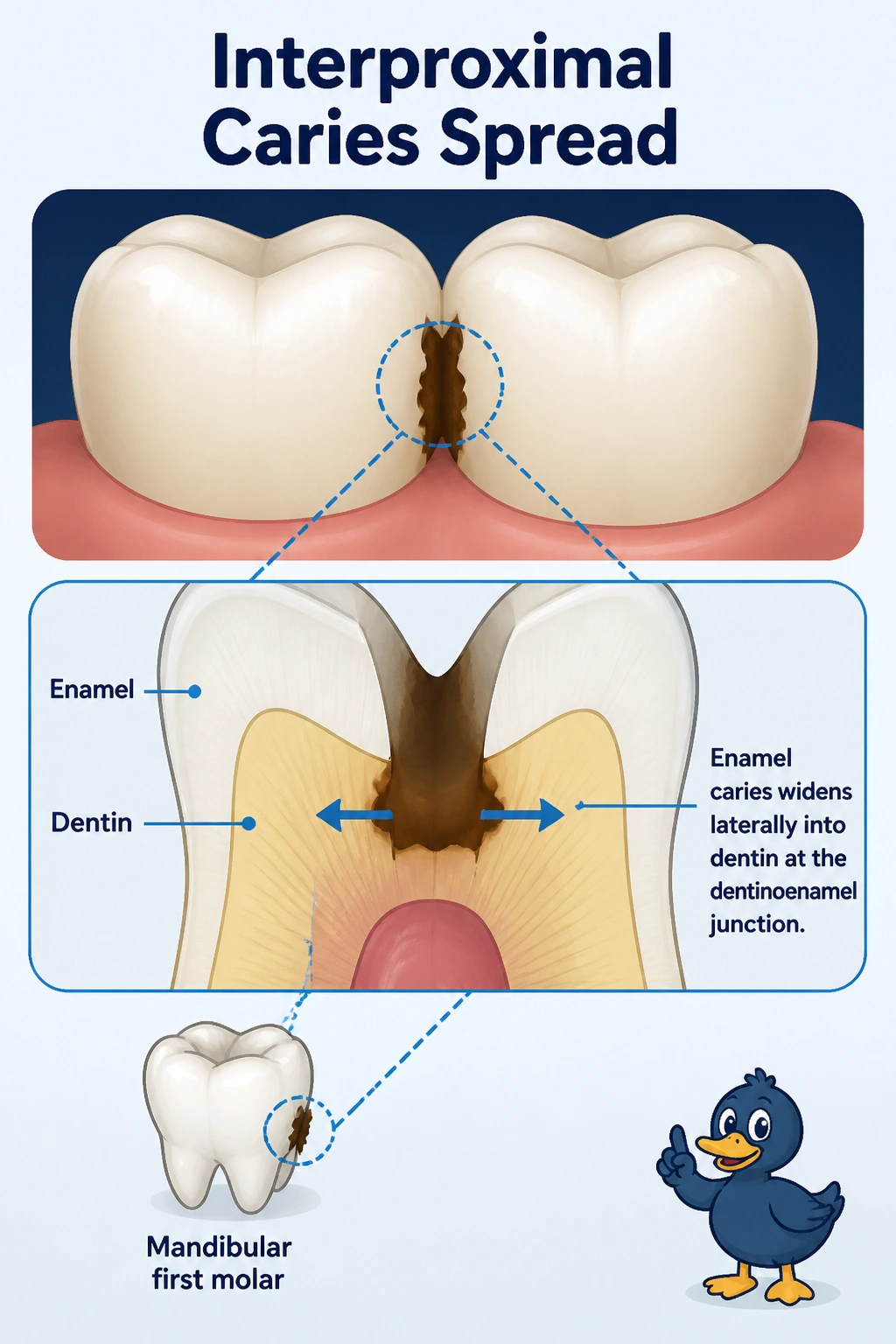
Short Explanation
Think of caries like a small funnel in enamel that suddenly hits softer ground at the dentinoenamel junction and spreads out wide. The trap is mistaking that classic two-triangle pattern for benign cervical burnout or a harmless anatomical bump. When you see a dark wedge widening under intact-looking enamel, look closely at the dentin.
Full Explanation
On a digital bitewing radiograph, a triangular radiolucency in the outer enamel that expands abruptly at the dentinoenamel junction indicates Interproximal caries that has penetrated enamel and spread laterally into dentin. Enamel is densely mineralized, so decay progresses slowly in a narrow cone toward the junction; once bacteria reach the less mineralized dentin, the lesion spreads rapidly along the dentinoenamel junction and forms a second, wider radiolucent triangle pointing toward the pulp. Cervical burnout caused by normal root anatomy near the neck appears lower down on the root surface apical to the cementoenamel junction as a diffuse, collar-like radiolucency beneath intact enamel. Mach-band effect from overlapping enamel at the contact point is an optical illusion of edge darkening rather than true demineralization and lacks widening at the dentinoenamel junction. An enamel pearl projecting from the distal furcation area presents as a small, well-defined, round radiopacity on the root surface rather than a radiolucent defect in the crown. As a caveat, radiographs underestimate the actual histologic depth of caries, so clinically small lesions at the junction often require restorative evaluation. For an operational check, use the digital software's contrast and magnification tools on a calibrated monitor without over-sharpening to trace the radiolucency across the dentinoenamel junction.
Prefer to study offline? Printable PDF study book + test engine ($7.50, unofficial). These questions stay free here.