
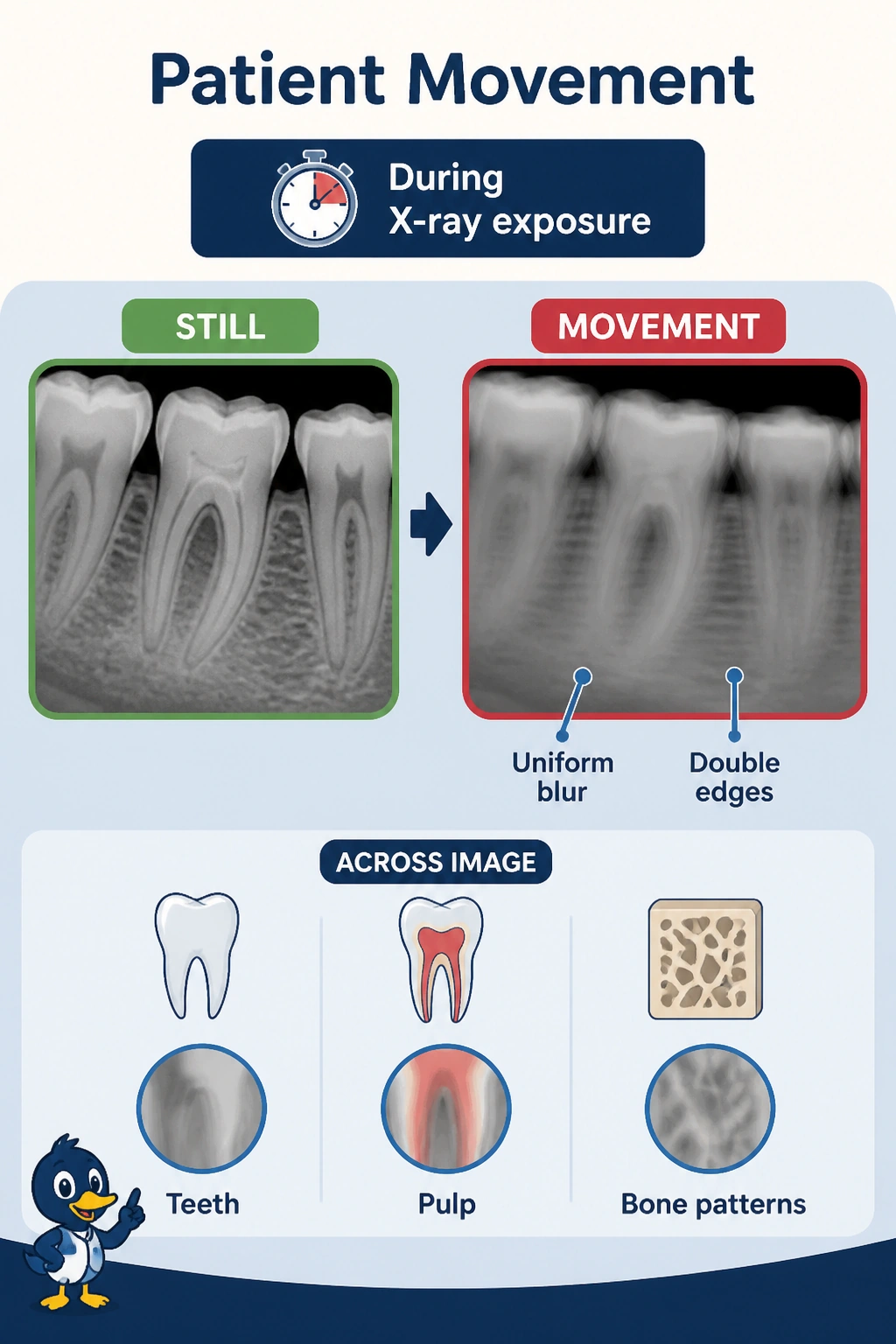
After exposing a digital periapical radiograph on an anxious pediatric patient, a clinician observes that the tooth outlines, pulp chambers, and trabecular bone patterns appear uniformly blurred and double-edged across the entire image. What is the most likely cause of this diagnostic error?
Select an answer to reveal the explanation.
Short Explanation
When every edge on your radiograph looks like a shaken photograph, the problem occurred while the beam was active. Patient movement creates uniform double edges, unlike excessive horizontal angulation or insufficient kilovoltage peak, which affect tooth overlap or image brightness. Help your patient stay still during exposure so fine trabecular and root details remain crisp.
Full Explanation
Uniform blurring and double-contoured borders across teeth and supporting bone indicate patient movement during the X-ray exposure. When the patient shifts while X-rays are striking the sensor, each anatomic edge is recorded in multiple slightly offset positions, reducing sharpness throughout the image. Excessive horizontal angulation of the X-ray beam causes adjacent teeth’s proximal surfaces to overlap horizontally, obscuring interproximal detail without blurring the trabecular pattern. Insufficient kilovoltage peak on the control panel reduces beam penetration, producing an overly light image with high contrast rather than motion blur. Placing the receptor too far from the tooth crowns increases object-to-receptor distance, enlarging the image and increasing geometric penumbra, but does not create the characteristic uniform double edges of movement. As an exam caveat, motion blur affects structures across the field simultaneously; digital brightness or contrast adjustments cannot restore lost sharpness, so a retake may be needed if root apices or trabeculae are obscured. For a practical check, coach the patient to bite steadily on the receptor holder and remain still just before exposure, then inspect the image for crisp lamina dura and root outlines.
Prefer to study offline? Printable PDF study book + test engine ($7.50, unofficial). These questions stay free here.